
Livraison le jour même ou le lendemain

Qualité garantie

Débloquez vos offres de bienvenue: Livraison GRATUITE | Jusqu'à -80 % | 30 jours d'essai gratuits à JoyPlus
Téléchargez l'application
A home fitness machine can quickly become bulky, noisy or a chore to use if its features don't match your living space or your habits. In a typical British flat, certain criteria matter more than a long list of functions: the actual dimensions, noise level, maximum user weight and ease of storage.
Before you start comparing models, here are the most common mistakes to avoid.
A motor's power can be expressed in different ways. A figure in watts or horsepower alone won't tell you whether a treadmill is suitable for walking, jogging or regular running. You also need to check the maximum speed, running surface area and maximum user weight.
A machine designed mainly for walking won't necessarily meet the needs of someone who wants to run several times a week.
A foldable piece of equipment doesn't magically disappear. Measure the space you have available during use, and then the space you have for storage. Also think about doorways, the weight of the machine and whether it has transport wheels.
In a small flat, a compact fitness machine or an under-desk walking treadmill can prove far more practical than a bulky model, even if it offers fewer programmes.
Even a quiet treadmill is still audible, especially when you're running and in a building where vibrations travel easily through the floor. Decibel figures let you compare spec sheets, but the noise also depends on the floor covering, vibrations, the user's weight and how well the belt is maintained.
Place the machine on a stable surface and, if necessary, add a suitable protective mat to reduce vibrations.
Take three measurements before you order:
A foldable cross trainer can reduce the storage space needed, while a foldable Pilates machine will be better suited to controlled sessions and floor exercises. In both cases, check the frame's stability and the maximum user weight stated by the manufacturer.
For a treadmill, compare the maximum speed and the type of incline. A manual incline means you have to stop to change the setting, whereas a treadmill with automatic incline lets you adjust the intensity from the console, depending on the features offered.
For a cross trainer, the number of resistance levels gives a good indication of how progressive your workouts can be. The stride length also needs to suit the user's height.
Avoid choosing a model whose maximum user weight is close to your own weight. A reasonable margin makes for a more comfortable experience and better stability, without replacing the need to follow the manufacturer's instructions.
Also check:
Bluetooth apps, the display and connected programmes can be useful for tracking time, speed or distance. However, they should not overshadow the essential mechanical features.
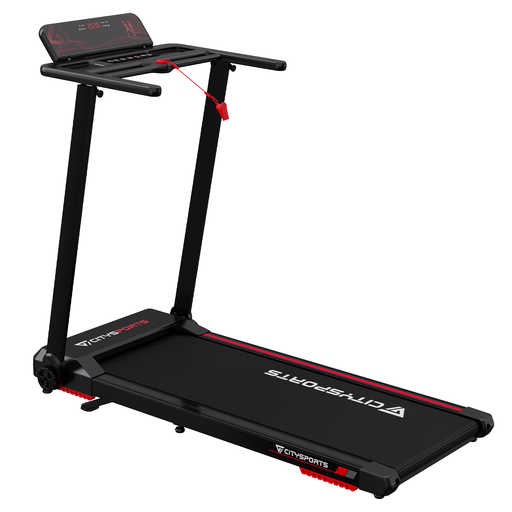
Why this choice suits this profile: With a speed range of 1 to 12 km/h and a foldable design, this model is ideal for your first sessions of walking, jogging or light running at home.
The spec sheet clearly states the dimensions, a maximum user weight of 120 kg, two manual incline positions and an advertised noise level below 45 dB.
1,400 W motor, six-layer belt, LED display and app connectivity.
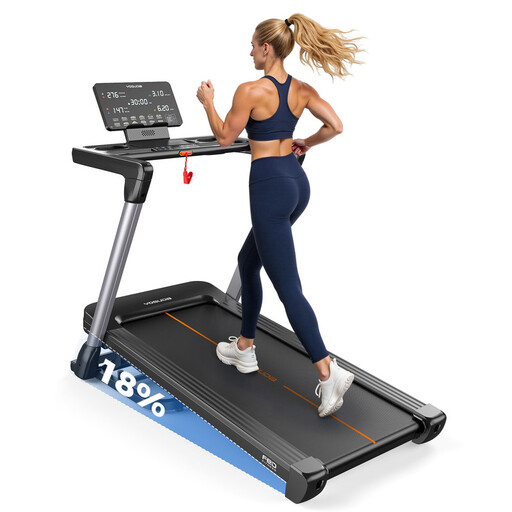
Why this choice suits this profile: This model is aimed at regular users who want plenty of adjustments to alternate between brisk walking, running and incline training.
The stated maximum user weight reaches 172 kg and the electric incline goes up to 18%. Two figures you can compare directly with your own usage.
3 HP brushless motor, four-part cushioning system, high-resolution LED display and Bluetooth connectivity.
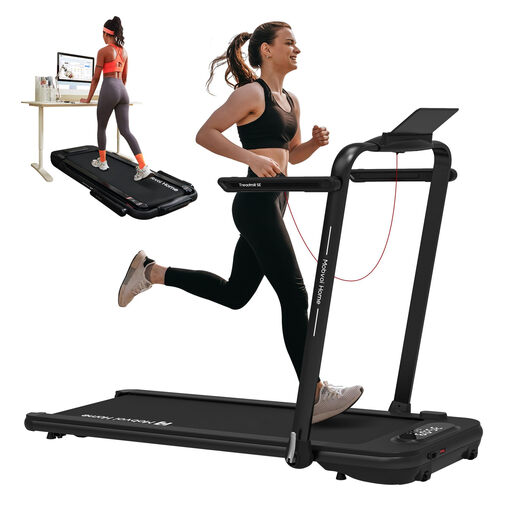
Why this choice suits this profile: Remote workers can use it as an under-desk walking treadmill, then switch to running mode once the space is clear.
The three modes distinguish walking, desk work and running. The manufacturer states a folded height of approximately 12.7 cm and integrated wheels.
Speed up to 12 km/h, maximum user weight of 120 kg, five-layer belt, remote control and TicSports app.
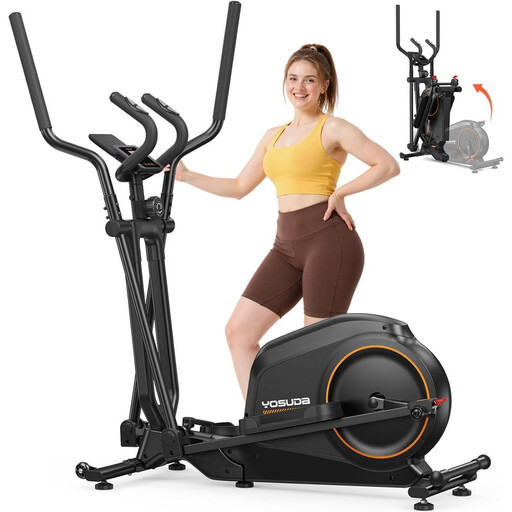
Why this choice suits this profile: This home cardio machine offers progressive resistance and a stated folded footprint of approximately 0.2 m², making it suitable for smaller spaces.
The spec sheet details the 16 resistance levels, 38 cm stride length and recommended user height of around 175 cm.
Steel frame, non-slip pedals, LCD display showing six data points and an advertised noise level below 20 dB according to the product sheet.
We've put together a comprehensive, real-time selection of products that meet these demanding criteria and European safety standards.
Before your first session, set up the machine on a flat, stable and clear floor. Respect the safety clearance around a treadmill and always use the safety key. For a cross trainer, check the bolts are tight after the first few uses.
Maintenance varies by model, but generally includes:
A children's trampoline must be set up with a safety net and in a clear area. The stated maximum user weight does not remove the need for adult supervision or for following the usage instructions.
A compact walking treadmill, with a speed suited to slow walking and a low folded height, will generally be the most practical. Check its stability, the advertised noise level and whether it's compatible with your desk before you buy.
The cost mainly depends on the motor power, the length of your sessions and your electricity rate. To estimate it, multiply the power in kilowatts by the number of hours of use, then by your electricity tariff. Motorised machines may also need lubrication and periodic belt checks.
It depends on how often you use it, the weight it supports, how well you maintain it and the storage conditions. Sticking to the maximum user weight, cleaning the machine regularly and following the manual's recommendations all help to prevent premature wear. Also check the warranty terms and the quality of after-sales service before you order.