
Livraison le jour même ou le lendemain

Qualité garantie

Débloquez vos offres de bienvenue: Livraison GRATUITE | Jusqu'à -80 % | 30 jours d'essai gratuits à JoyPlus
Téléchargez l'application
Equipping your home for workouts can quickly become a headache. Between marketing promises and the jungle of available options, it's easy to make a mistake and end up with a piece of equipment gathering dust in a corner. The goal of this guide: to help you find the fitness gear that truly matches your needs, your space, and your ambitions—without throwing your money away.
To avoid falling into common traps, here are the most frequent pitfalls to watch out for.
To build a solid and lasting foundation, focus on a few criteria that guarantee the safety, effectiveness, and longevity of your equipment.
Your strength will evolve. Equipment that doesn't adapt to your progress will quickly become obsolete.
Good fitness equipment must, above all, be safe. Pay close attention to the finishes.
Rather than just a list of products, we've selected equipment tailored to specific profiles. It's up to you to find the one that fits.
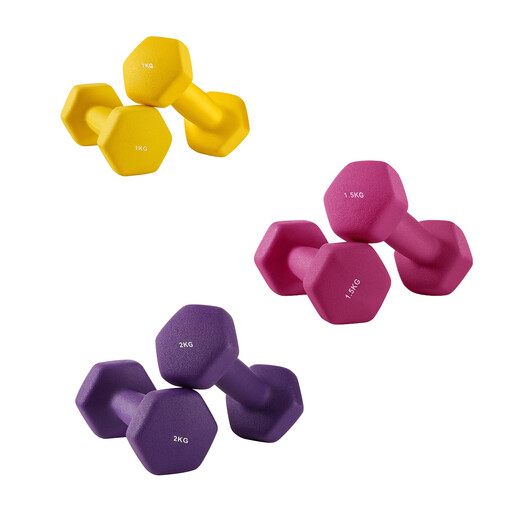
Why we chose it: Perfect for starting out, this set offers three different weights for a gentle introduction to strength training. Its compact stand is a real plus for keeping your workout space tidy, even in a small apartment.
Unlike low-end kits, this set focuses on the quality of a single type of equipment. The neoprene coating and hexagonal shape are details that make all the difference in terms of long-term comfort and safety.
The storage rack and anti-roll hexagonal design make it a particularly well-thought-out kit for home use.
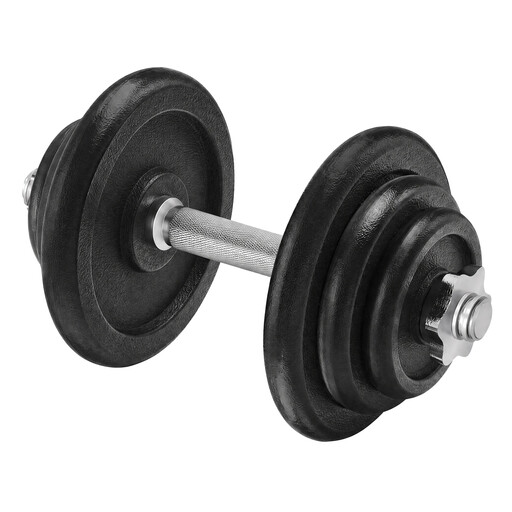
Why we chose it: For those aiming to build mass or significantly increase their strength, an adjustable set is essential. This 20 kg kit allows for progressive overload, a key principle of strength training.
It solves the problem of equipment quickly becoming too light. No need to buy new pairs of dumbbells; just add more plates. Its cast iron construction ensures unbeatable durability, far from the sand-filled plastic alternatives.
Its high modularity allows you to adjust the load for each exercise (curls, squats, lunges) and support your progress over the long term.
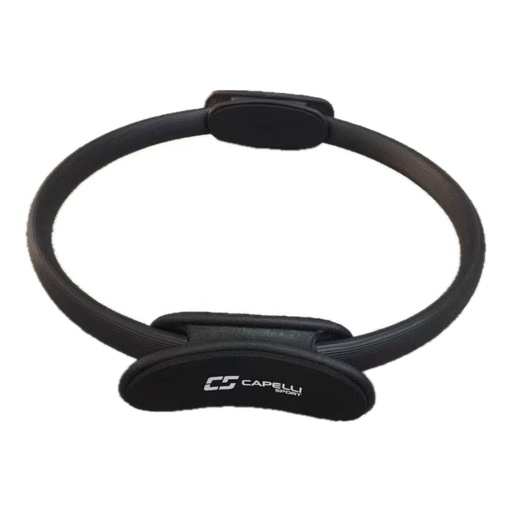
Why we chose it: This accessory is a Pilates classic for good reason. It adds moderate resistance and helps engage deep muscles (core, thighs, arms), which improves posture and stability.
It isn't marketed as a miracle solution, but as a specialized tool. Lightweight and discreet, it avoids the bulky equipment trap and focuses on a single mission: strengthening stabilizer muscles.
Its lightness and simplicity make it a perfect accessory to integrate into a yoga, Pilates, or physical therapy routine, with no setup required.
Resistance bands are an excellent complement to diversify your workouts. Discover our selection, rigorously chosen for its quality and durability.
For a beginner, the priority is to master the form of the movements before thinking about lifting heavy. Generally, women can start with 1 to 3 kg dumbbells for the upper body, and men with 2 to 5 kg weights. The ideal choice is a dumbbell set with multiple weights or an adjustable kit to adapt the load and progress at your own pace.
It all depends on the materials and how often you use them. Well-maintained cast iron weightlifting plates can literally last a lifetime. For accessories like TPE or latex resistance bands, inspect them regularly. With frequent use, it's best to replace them every one to two years to prevent them from snapping mid-exercise.
Not at all. A space the size of a yoga mat is more than enough. The secret is to focus on compact and versatile equipment. A pair of dumbbells, a jump rope, and ankle weights can easily be stored in a closet. Accessories like an ab wheel or a Pilates ring are also very discreet. The important thing is to prioritize the relevance and quality of the equipment, not its size.