
Livraison le jour même ou le lendemain

Qualité garantie

Débloquez vos offres de bienvenue: Livraison GRATUITE | Jusqu'à -80 % | 30 jours d'essai gratuits à JoyPlus
Téléchargez l'application
Setting up a workout space at home allows you to exercise regularly, without a gym membership or travelling to the gym. However, choosing home fitness equipment deserves a few checks, particularly when you are considering a multi-gym station, a power tower or a pull-up bar.
Product descriptions often highlight the number of possible exercises or a high load capacity. However, three common pitfalls regularly arise:
To avoid buying equipment that is not right for you, compare the technical specifications with the space available, your fitness level and your usual training habits.
A power tower generally combines a pull-up bar, a dip station and handles for leg raises. Its height and floor footprint have a direct impact on how comfortable it is to use.
Before placing your order, measure:
An alloy steel frame can provide a rigid base, but stability also depends on the width of the feet, weight distribution and how tightly the joints are secured. An anti-slip surface can help prevent movement, but it is no substitute for a level floor or correct assembly.
Manufacturers often state the maximum load in pounds. As a guide, 440 lb is approximately 200 kg, while 480 lb represents around 218 kg. These figures give an indication of the stated resistance of the structure; they do not mean that you can add extra weight without taking the movements you perform into account.
For bodyweight training, consider:
Always observe the limit stated in the product description and the manufacturer’s instructions. Leaving a margin between the load actually used and the stated maximum load can help protect the structure and fixings.
A multifunctional strength-training machine is only worthwhile if its accessories match the exercises you actually do. A station with a bench may suit those who want to vary their movements, but it takes up more space and generally requires more time to assemble.
For a typical home programme, look in particular for:
A drill-free pull-up bar may be easier to install in a flat, but its compatibility with the door frame must be checked carefully. The stated load does not guarantee that the bar will fit every door: check the width, thickness, strength of the frame and whether there are any mouldings.
The options below are grouped according to the space available and the type of training required. The capacities listed correspond to the information published in the product descriptions; they assume full assembly and use on a stable floor.
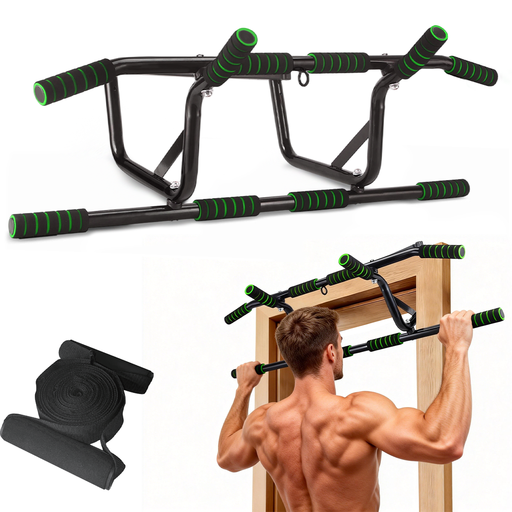
Why this choice suits this profile : This drill-free pull-up bar is suitable for anyone looking to start bodyweight strength training without installing a complete structure in a bedroom or flat.
Drill-free installation keeps DIY work to a minimum, but you must check that the door frame is compatible before each use and not rely solely on the stated 200 kg load capacity.
Ergonomic, anti-slip handles, plus resistance bands included according to the product description.

Why this choice suits this profile : This model is designed for households with a dedicated space that want to combine several exercises on a single strength-training station.
Its stated dimensions of 104 × 76 × 251 cm should be compared with those of your room before purchase. The steel frame and anti-slip base help promote stability, provided the station is assembled correctly.
Integrated bench, pull-up bar with climbing grip and a stated capacity of 218 kg.

Why this choice suits this profile : Its design is suitable for regular users who prioritise pull-ups, dips and upper-body strength training in a permanent workout space.
The product description specifies an alloy steel structure, dimensions of 106 × 106 × 239 cm and a maximum load of 200 kg. This information helps you check the footprint and stated resistance before purchase.
Adjustable height, pull-up bar and dip station combined on an alloy steel frame.
We have put together a complete, real-time updated list of products that fully meet these strict selection criteria and European safety regulations.
A station intended for home use must be assembled according to its instructions, without modifying any parts or removing any fixings. Before your first workout:
To complement a strength-training station, resistance bands allow you to increase the intensity gradually while taking up very little space. They can be used for warm-ups or strength exercises, but should be inspected regularly to identify any cracks, deformation or signs of wear.
Maintenance is straightforward: wipe the frame with a dry cloth, clean the handles and store the accessories away from moisture. Frequent use does not remove the need to check the overall condition of the equipment regularly.
Allow for the floor footprint specified by the manufacturer, as well as a clear area around the station for your legs and movement. The ceiling height must also allow you to grip the bar without touching it. If you live in a flat, measure doorways and the lift before delivery as well.
No. It depends entirely on the width and strength of the door frame. Mouldings, lightweight partition walls or older doors may limit compatibility. Read the stated dimensions carefully, follow the instructions and check the fixings before every workout.
A mechanical station generally does not use electricity. The main costs are the initial purchase, the space required, maintenance and the possible replacement of worn bands or parts. A multifunctional model may eliminate the need to buy several pieces of equipment, but it requires more space and assembly time.