
Livraison le jour même ou le lendemain

Qualité garantie

Débloquez vos offres de bienvenue: Livraison GRATUITE | Jusqu'à -80 % | 30 jours d'essai gratuits à JoyPlus
Téléchargez l'application
Switching to an electric car is a major step. But once the vehicle is in your garage, another equally crucial question arises?: how do you charge it efficiently at home?? Faced with a maze of options—wall-mounted chargers, portable units, various power levels, and smart features—it's easy to feel overwhelmed. Yet the goal remains simple?: reliable, safe, and, if possible, cost-effective charging.
As the Head of Product Recommendations at Joybuy, I'm here to help you make sense of it all. This article breaks down the essential features of an electric car charging station and presents a selection of relevant products to help you make an informed choice, without the unnecessary marketing jargon.
Before diving into specific models, it's important to understand a few key technical criteria that will determine your daily convenience and compatibility with your electrical system.
The charger's power level directly impacts your vehicle's charging speed. This choice mainly depends on two factors?: the capacity of your electrical installation and the maximum charging power your car can handle.
For maximum flexibility or as a backup, a Type 2 portable charger that plugs into a standard domestic socket (Schuko) is a simple solution, although significantly slower (typically 2.3 to 3.7?kW).
Modern chargers do more than just deliver power. Smart features can lead to significant savings and provide real peace of mind.
In Europe, the standard for AC charging is the Type 2 connector. Ensure the charger you choose is equipped with this connector, which is compatible with almost all electric and plug-in hybrid vehicles on the market.
Safety is non-negotiable. Verify that the charger includes essential protections?: DC (6mA) and AC (30mA) leakage protection, as well as safeguards against overvoltage, undervoltage, and overheating. A high IP rating (e.g.,?IP65) guarantees its resistance to dust and water splashes, allowing for worry-free outdoor installation.
Here is a selection of charging solutions that cater to different needs and budgets, from portable simplicity to smart performance.

Its key feature?: This portable charger is the very definition of simplicity. No complex installation is required; just plug it into a standard domestic socket (Schuko 16A) to start charging. It's the ideal solution for a second home, for travel, or as a backup at home.
Advantages?:
Who is it for?? Drivers looking for a no-installation home charging solution, renters, or those who want a backup charger for travel. Perfect for plug-in hybrid vehicles or for a slow overnight charge on a fully electric vehicle.
See details and price on Joybuy.fr
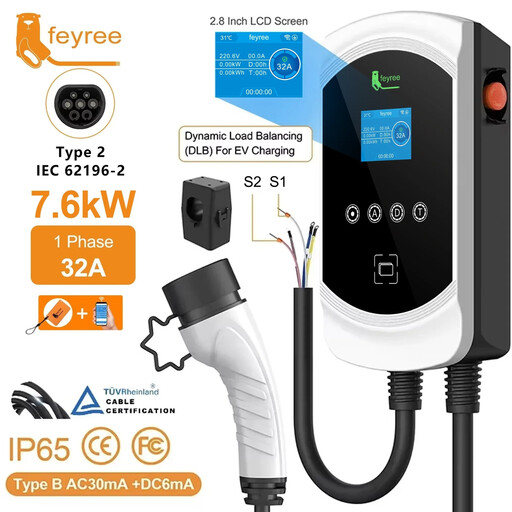
Its key feature?: This 7.6?kW wallbox combines ideal everyday charging power with genuinely useful smart features. Its dynamic load balancing function is a major asset for optimising charging without the risk of tripping your breaker.
Advantages?:
Who is it for?? Homeowners who want a primary charging solution that is powerful, smart, and helps them control their energy consumption and electricity bill.
See details and price on Joybuy.fr
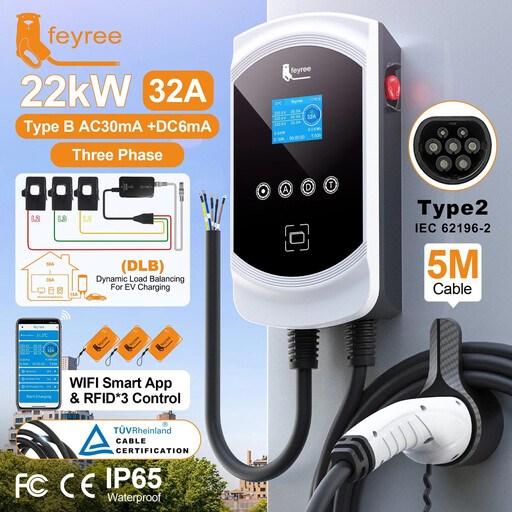
Its key feature?: This is the solution of choice for those who want the maximum charging speed at home. Building on the excellent features of its smaller sibling, this 22?kW wallbox is designed for three-phase installations and vehicles capable of handling high power.
Advantages?:
Who is it for?? Users with a three-phase supply and an electric vehicle that accepts 22?kW AC charging. This is a future-proof choice that guarantees minimal charging times.
See details and price on Joybuy.fr
This selection aims to cover the most common scenarios. However, every situation is unique. If you are looking for different power levels, alternative designs, or specific features, feel free to explore our full catalogue.
Discover our full range of Electric Car accessories on Joybuy.fr
For most homes with a single-phase supply, a 7.4?kW charger is the most balanced choice. It provides a full charge overnight without requiring a major upgrade to your electricity plan. If you have a three-phase installation and a compatible vehicle, an 11?kW or 22?kW charger will offer faster charging.
Yes, for a wall-mounted charger (wallbox). The installation must be carried out by a qualified electrician, ideally one certified for EV charger installations. This ensures the safety of the installation and is often a requirement to qualify for potential government grants. In contrast, a Type 2 portable charger like the GONEO model simply plugs into a power socket, preferably a pre-installed reinforced one.
Dynamic load balancing is a feature that adjusts the car's charging power based on the home's overall electricity consumption. It is very useful for preventing the main circuit breaker from tripping when other power-hungry appliances (heating, oven, etc.) are running simultaneously. It provides peace of mind and also helps you avoid upgrading to a more powerful, and therefore more expensive, electricity plan.