Which criteria should you check first?
Start by identifying the appliance you use most, then decide whether its condition and size mean it needs replacing or whether another solution would work. The energy-use benchmarks published by ADEME describe appliance types, not the bill for every household.
Replace a specific appliance
When: the appliance runs continuously or is used very often, and a model with a suitable capacity would better meet your needs.
Bear in mind: an energy rating alone does not guarantee savings if the new appliance is larger or the way you use it changes.
Keep it and adjust how you use it
When: the appliance is working and the main things to review are loads, programmes or the timing of cycles that can be delayed.
Bear in mind: according to ADEME, delaying a cycle can ease demand on the grid, but the effect on your bill depends on your electricity tariff.
Get it assessed for repair
When: an appliance has broken down but is still the right size and suits your household’s needs.
Bear in mind: ask for a diagnosis; any repair assistance available will depend on factors including the appliance, the fault and the repairer.
| Priority |
What to check |
Consumers concerned |
| Refrigeration running continuously |
Compare kWh/year and usable capacities for models of the same type that suit your storage needs. |
If my fridge or freezer runs day and night, I want to know whether its capacity still meets my needs before replacing it. Around 36% of consumers would make this their priority. |
| Laundry and drying |
For a washing machine, compare capacity and kWh/100 cycles for the Eco 40-60 programme; assess a tumble dryer separately. |
When laundry or tumble drying is a regular task, I first want to know whether the chosen capacity suits my usual loads. This would be the top priority for around 29% of consumers. |
| Dishwasher |
For a similar capacity, check kWh/100 Eco cycles and litres of water per Eco cycle. |
If I use my dishwasher often, I want to choose a useful capacity without overlooking the water used per cycle. Around 21% of consumers would prioritise this balance. |
| Frequent cooking |
For an oven, compare the capacity and kWh/cycle for each cooking mode shown. |
When I cook in the oven frequently, I want to check whether its capacity and my cooking habits make replacing it worthwhile. This would be the top priority for around 14% of consumers. |
Energy labels do not use the same unit for all these appliances: the European Commission gives annual consumption for refrigeration appliances, figures per 100 cycles for washing machines and dishwashers, and figures per cycle and mode for ovens. So compare models within the same category, with similar capacities and under comparable conditions of use.
Brands to know
There are no brand features to display in this section.
Appliances to consider on Joybuy
These fridge-freezers, washing machines and this tumble dryer can be used as points of comparison if you’re considering a targeted replacement. First choose the category and capacity that suit the way you use the appliance; the energy rating shown or the presence of a model here does not prove that your bill will go down.
 Image unavailable
Haier HTW5618ENMG, 3-door fridge-freezer, 360 L
Worth considering if a 360 L fridge-freezer suits your storage needs.
Class E; Total No Frost technology. Compare annual energy consumption and usable capacities with equivalent refrigeration appliances before deciding.
View on Joybuy
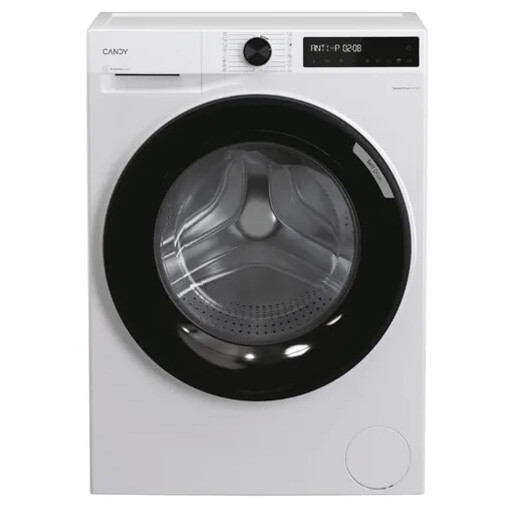 Image unavailable
Candy BR 411BL9-S, 11 kg front-loading washing machine
Worth considering if your usual laundry loads call for an 11 kg capacity.
Class A. To compare its energy consumption, check the Eco 40-60 programme figures on the energy label and compare them with those of washing machines with a suitable capacity.
View on Joybuy
 Image unavailable
Candy TCA464TM4-S ProWash 500, 6 kg washing machine
Worth considering if a 6 kg capacity and top-loading design suit the way you do your laundry and the space available.
Class B; spin speed stated as 1 400 tr/min. Check the dimensions, connections and reference programme figures before replacing your current appliance.
View on Joybuy
 Image unavailable
Sonlu CC-520WE, 444 L fridge-freezer
Worth considering if your household really needs a total refrigeration capacity of 444 L.
Class E; frost-free system and stated noise level of 40 dB. Check the dimensions and capacity of each compartment, then compare kWh/year with appliances of a similar capacity.
View on Joybuy
 Image unavailable
Hotpoint CHD84MWBSEE, 8 kg heat pump tumble dryer
Worth considering if you regularly use a tumble dryer and an 8 kg capacity suits your loads.
Class C. Check the energy consumption figure and reference programme on the label to compare it with other tumble dryers; also check the space available and installation requirements.
View on Joybuy
Frequently asked questions
Can I compare the energy consumption of all my appliances directly?
No. First compare models in the same category and using the same unit. The European Commission gives kWh/year for refrigeration appliances, kWh/100 cycles for washing machines and dishwashers, and kWh/cycle for ovens. Also check the capacity and reference programme or mode.
Is a better energy rating enough to justify replacing an appliance?
No. The rating alone does not tell you whether a new appliance’s size and features are right for your household. Compare capacities suited to the way you use the appliance and, for laundry, also take into account the water use and cycle duration shown on the energy label, as ADEME recommends.
What should I check before replacing a tumble dryer?
First check how often you need to use a tumble dryer, then look at the capacity, reference energy consumption and installation requirements of the model you’re considering. According to the European Commission, the rules for new household tumble dryers placed on the Union market since 1 July 2025 include requirements relating to heat pump technology. Its presence alone does not tell you how much energy you will use.
When should I consider a repair before buying a new appliance?
If an appliance has broken down but still meets your needs, ask for a diagnosis before making a decision. The ministries responsible for the ecological transition state that a repair bonus may be available when you use an approved repairer; check whether the appliance, fault and repairer are eligible.
Will delaying a laundry or dishwasher cycle necessarily reduce my bill?
No. ADEME presents delaying some uses as a way to ease demand on the grid, not as a guaranteed way to lower your bill. The effect on your household depends in particular on the tariff periods in your contract; also take the appliance’s noise and conditions of use into account.


