
Livraison le jour même ou le lendemain

Qualité garantie

Débloquez vos offres de bienvenue: Livraison GRATUITE | Jusqu'à -80 % | 30 jours d'essai gratuits à JoyPlus
Téléchargez l'application
Protecting your home has become a priority for many homeowners and renters. But with an overwhelming number of options on the market, it can be difficult to know where to start. Is a wireless alarm kit enough? Should you opt for a connected security system with a mobile app? This guide is here to demystify the market and help you make the right choice, whether you live in an apartment or a house.
To ensure you make the right decision, let's review the key criteria that will make all the difference and help you define your needs.
Today, wireless alarm kits dominate the consumer market. Their key advantage? An incredibly simple installation. No cutting into walls, no pulling cables: it's the perfect solution for renters or anyone looking to avoid major installation work. The various components (detectors, siren, hub) communicate via radio waves, so be sure to check the advertised range and the reliability of the protocol used. Conversely, wired systems, which are more complex to install, are renowned for their rock-solid reliability: no batteries to replace and total immunity to radio jamming.
A standalone system is the most straightforward: in case of an intrusion, it triggers a powerful alarm siren to scare off intruders and alert the neighbourhood. Basic, but effective. A connected security system goes much further. Connected to your internet router, it sends notifications to your smartphone, lets you check in on your home with an alarm with a camera, and allows you to control everything remotely. It's everything you need for peace of mind, whether you're at the office or on the other side of the world.
A basic kit typically includes a central hub, one or more motion detectors, door and window opening detectors, and a remote control. To fortify your protection, consider adding:
The right combination will, of course, depend on your property, whether you're securing a house with a garden or a simple apartment.
To move from theory to practice, here is our selection of products, each designed to meet a specific need, from the simplest kit to the most comprehensive system.
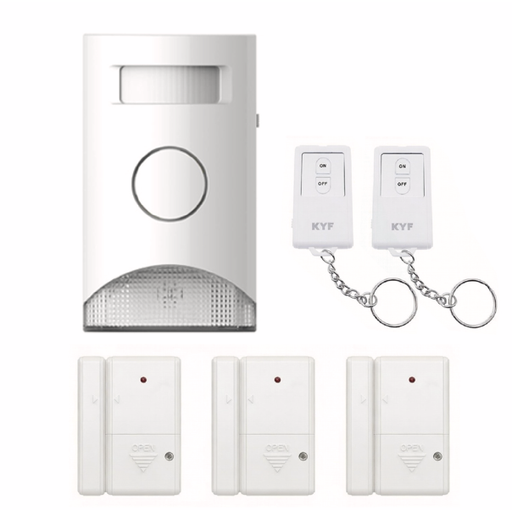
The Concept
This kit is an excellent entry point into the world of home security. It gets straight to the point: detect and alert. Its hub combines a powerful siren and a flashing light for dual auditory and visual deterrence. Installation is a breeze, making it a great choice for those who aren't DIY-inclined.
Key Features
Who is it for?
Perfect for a first level of security in an apartment, garage, or small space. We recommend it for those who want effective protection without the complexity of connected features, and who are on a budget.
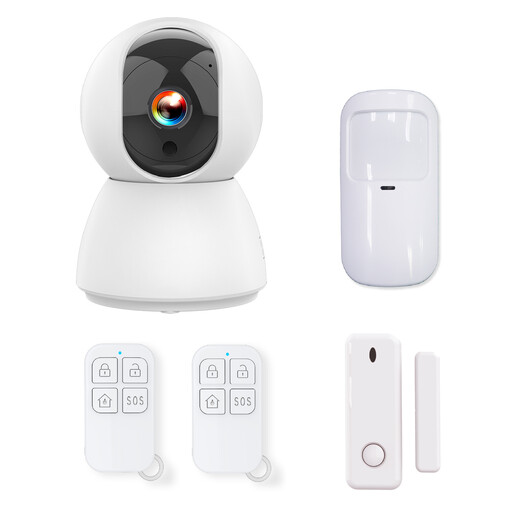
The Concept
Here, everything revolves around the camera. This 4MP motorised model isn't just an eye: it's the brain of the system. It acts as the central hub, includes its own 90?dB alarm siren, and communicates with the other detectors. A remarkably effective all-in-one approach, controllable from a single app.
Key Features
Who is it for?
For those who want a modern, visual, and interactive security solution. Ideal for tech enthusiasts and homeowners who demand the ability to check in live on their property and take action remotely.
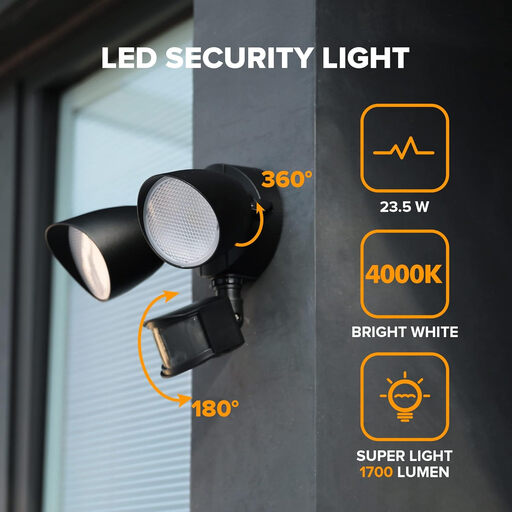
The Concept
Sometimes the best defence is deterrence. This outdoor security light is a perfect example. Its PIR (infrared) motion detector triggers a blinding 1250-lumen flash at the slightest presence, surprising the intruder and bathing the area in light for your cameras.
Key Features
Who is it for?
The essential accessory for any home alarm system protecting an outdoor area (garden, yard, driveway...). It fortifies your perimeter security and provides perfect visibility at night.
Your home is unique, and so are your security needs. If our selections don't perfectly match your project, you can build your own à la carte system.
Feel free to explore our full range of Security Sensors to pick and choose the components that perfectly suit your setup.
The opening detector, also known as a magnetic contact sensor, is a perimeter guard. Placed on a door or window, it triggers as soon as the entry point is opened, signalling an immediate breach. The motion detector, on the other hand, monitors a volume of space. Using infrared technology, it scans an entire room and detects any abnormal presence by its heat and movement.
Absolutely! The vast majority of wireless alarm kits are designed for DIY installation. The instructions are usually clear and guide you step-by-step through mounting the sensors and connecting them to the hub. A screwdriver and a little patience are all you need. However, for a wired system or a particularly complex installation, professional help is still recommended.
That's an excellent question. Reputable manufacturers encrypt all communications between your devices, the cloud, and your app. However, security is a chain, and you are an essential link. The golden rule: always use a complex and unique password for your alarm account, and make sure your own Wi-Fi network is secure (with a strong WPA2/WPA3 password).