Families avoiding added sugar
For a holiday breakfast or snack, you may be looking for a brioche labelled ‘no added sugar’. Check the ‘of which sugars’ line in the nutrition information too: this claim doesn’t mean the product contains no sugars.


If avoiding added sugar is your priority but you still want brioche for holiday breakfasts, La Boulangère sliced brioche fits the bill. However, Auchan lists 5.4 g of sugars per 100 g. If you’re looking for a less sweet brioche instead, Harrys lists 9.3 g of sugars per 100 g for its sliced brioche, while Auchan lists 10 g for the braided version. Be sure to compare the serving size and allergens before choosing.
For a holiday breakfast or snack, you may be looking for a brioche labelled ‘no added sugar’. Check the ‘of which sugars’ line in the nutrition information too: this claim doesn’t mean the product contains no sugars.
You want to choose between sliced and braided brioche, without insisting on a recipe with no added sugar. Harrys products let you compare a stated reduction with the amount of sugars declared per 100 g.
If a soft brioche isn’t essential, crispbread or another crunchy product could work well for a breakfast with something to spread on it. Check its product category and nutrition information rather than treating it as a brioche.
When choosing between these products, consider three separate questions: do you want to avoid added sugar, reduce sugars while still enjoying brioche, or try a different texture? Then compare the nutrition values per 100 g with the portion you plan to serve.
| What matters to you | What to check | Who it’s for |
|---|---|---|
| No added sugar | The claim on the pack and the ‘of which sugars’ figure per 100 g, then per slice. | For a holiday breakfast, I want to start with brioche that has no added sugar, without assuming it contains no sugar at all. Around 42% of consumers would make avoiding added sugar their priority. |
| Less sweet brioche | The sugars per 100 g and the product used as the reference for any stated reduction. | I want to stick with soft brioche, sliced or braided, and focus on reducing sugars rather than avoiding added sugar altogether. This would be a priority for around 33% of consumers. |
| A crunchy alternative | The product category, its sugars and energy value per 100 g, and its storage instructions. | If I need something to take with me and spread a topping on, I’m happy to swap brioche’s texture for a crunchy option. Around 25% of consumers would choose this first. |
A recipe can contain no added sugar and still list sugars in its nutrition information. For example, Auchan lists 5.4 g of sugars per 100 g for La Boulangère sliced brioche.
Compare the ‘of which sugars’ figure per 100 g and, if you know the serving weight, per portion too. For brioche labelled ‘less sugar’, also check which brioche the stated reduction is compared with.
Per 100 g, Harrys lists 327 kcal for its less sweet sliced brioche, while Auchan lists 328 kcal for La Boulangère brioche with no added sugar. These products have different sugar contents but similar energy values.
If this matters to you, check the energy value, fat content and serving size too.
The brioches mentioned contain wheat and eggs, among other ingredients; other ingredients and possible traces vary by product. Don’t assume the ingredients in a sliced brioche are the same as those in a braided one.
Check the ingredients list and highlighted allergens on the pack you’re buying, even if you already know the brand.
Auchan lists a 450 g loaf of La Boulangère sliced brioche with no added sugar, containing 15 slices.
The range mentioned includes ‘less sugar’ sliced and braided brioches; neither is described as having no added sugar.
Brioche Pasquier Wholemeal Crispbread with No Added Sugar is a crunchy breakfast option, not a brioche.
This product suits anyone looking for a crunchy breakfast with no added sugar over the holidays. It’s only a brioche alternative if you’re happy to switch to a different product category and texture.
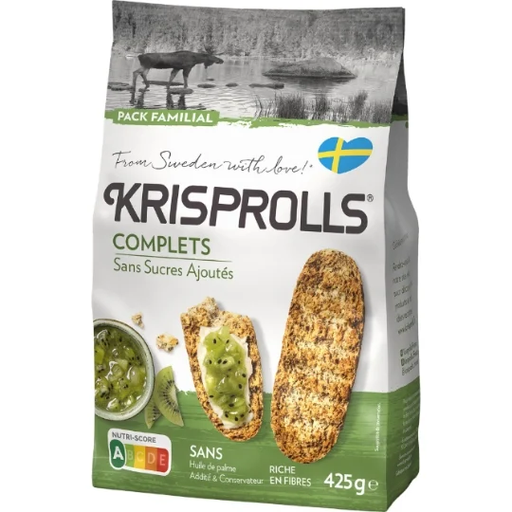 Image unavailable
Worth considering for a crunchy breakfast if you’re not looking for the texture of brioche. The product name indicates a recipe with no added sugar and a 425 g pack; this doesn’t mean it contains no sugars. Check the nutrition information and ingredients on the pack before comparing it with brioche.
No. Auchan lists 5.4 g of sugars per 100 g for La Boulangère sliced brioche with no added sugar. Check the ‘of which sugars’ line to see the declared amount, regardless of the claim on the front of the pack.
Of these three specific products, it’s La Boulangère sliced brioche with no added sugar, with 5.4 g per 100 g according to Auchan. Harrys lists 9.3 g for its less sweet sliced brioche, and Auchan lists 10 g for Harrys braided brioche. This comparison doesn’t rank every brioche on the market.
Follow the instructions on the pack you buy. Auchan recommends keeping La Boulangère brioche in a dry place at room temperature. For Harrys braided brioche, its product information says to keep it away from heat and reseal the pack after opening.
Check the specific recipe: the brioches mentioned contain wheat and eggs, among other ingredients, and La Boulangère’s also contains butter. Other ingredients and possible traces may vary between products, so always reread the label on the pack you choose.