Those who want to keep almost all their cookware
If replacing your pans and pots is out of the question, start by checking which ones will work on induction. For the rest, a ceramic hob means you won’t need a ferromagnetic base.


If the pans you want to keep have a ferromagnetic base and are within the hob’s accepted diameter range, an induction hob could be a good choice. To keep using non-compatible cookware without sorting through it, consider a ceramic hob instead. A combined induction and gas hob may suit you if you want to carry on cooking with gas. Whichever you choose, check the existing cut-out and the model’s requirements against your installation before making a decision.
If replacing your pans and pots is out of the question, start by checking which ones will work on induction. For the rest, a ceramic hob means you won’t need a ferromagnetic base.
You can keep the cookware that works with induction and replace only the rest. Also check the minimum diameter accepted by each cooking zone, especially for your smaller pans.
A combined hob lets you use induction zones and gas burners on the same surface. However, you’ll need to check the requirements for both energy sources, as well as the model’s dimensions.
Start by listing the cookware you want to keep, then compare your chosen technology with the cooking zones you need and the space available.
Consider this if: the cookware you want to keep has a ferromagnetic base and you’d like targeted heating.
The trade-off: non-compatible pans will need to be kept off these zones or replaced. Smaller items must also meet the minimum accepted diameter.
Consider this if: you want to keep using cookware that doesn’t have a ferromagnetic base.
The trade-off: it doesn’t heat in the same way as induction. Bosch describes induction as faster and more targeted than its ceramic hobs.
Consider this if: you’ll genuinely use both types of cooking zone, so you can keep some of your cookware and continue cooking with gas.
The trade-off: you’ll need to meet the installation requirements for both electricity and gas, as well as maintain the burners.
| Criterion | What to check | What matters to shoppers |
|---|---|---|
| Cookware compatibility | Test the base of each item you want to keep with a magnet; check the minimum diameter accepted by the hobs you’re considering. | I’m happy to sort through my pans, but I want to know which ones will work on induction before replacing any. Around 31% of shoppers make this their priority. |
| Heating type | Compare the model’s technology and features, then check its electrical requirements. | If my cookware is compatible, I mainly want to switch to induction for its targeted heating. Around 25% of shoppers share this priority. |
| Keeping cookware without sorting | Identify the cookware you want to keep, then consider a ceramic hob if its bases aren’t suitable for induction. | I don’t want to rule out any of my current pans because of their bases: around 19% of shoppers would put this need first. |
| Cooking zones and fitting | Measure the cut-out and the space beneath the worktop, and note how many zones you use and the size of your largest pans. | I cook with several pans at once and need to find a hob that fits the space available. The layout would be the main criterion for around 25% of shoppers. |
It’s the ferromagnetic base that matters: appearance and material name alone aren’t enough. A pan that’s too small may also go undetected by the cooking zone.
Hold a magnet against the base of each item you want to keep, then check the hob’s instructions for minimum diameters.
Pans that aren’t detected will need to be replaced if you want to use them on induction.
Two appliances with a similar overall width may require different cut-outs and clearances.
Measure the existing opening and compare it with the installation diagram for the exact model before choosing it.
A mismatch may mean modifying the worktop or make the planned installation impossible.
It combines proper induction zones and gas burners, each with its own installation and maintenance requirements to consider.
Choose this configuration only if you’ll use both technologies. Check the manufacturer’s guidance on electricity, gas and fitting.
You’ll still need to factor in burner maintenance and the requirements of both energy sources.
Bosch offers induction and ceramic hobs. Its PKM61RAA8F is an example of a ceramic model with three cooking zones.
Electrolux offers induction hobs, as well as the KDI951723K, which combines induction and gas.
The AEG HDB64623NB combined hob has two induction zones and two gas burners, with a stated appliance width of 590 mm.
Smeg describes the PM3643D as a four-zone combined hob that brings together induction and gas.
This induction hob is aimed at shoppers who want to keep using cookware with ferromagnetic bases when replacing a built-in hob.
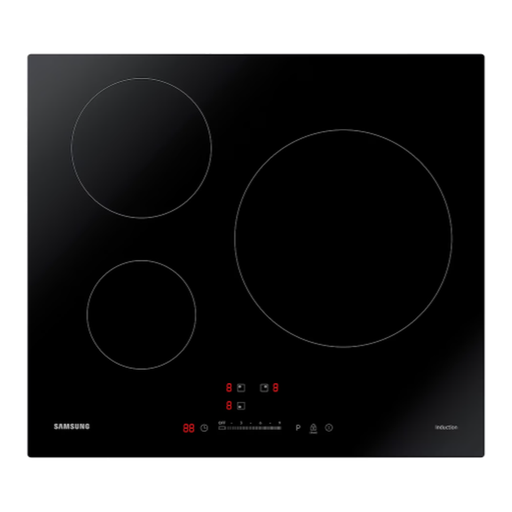 Image unavailable
Consider this if the pans you want to keep are suitable for induction and you need three cooking zones.
Stated total power: 7200 W. Check the model’s documentation for minimum accepted diameters, then ask a professional to compare its fitting and power supply requirements with your installation.
A magnet sticking to the base is an initial sign of compatibility, as Electrolux explains. Also check the cookware manufacturer’s guidance and the minimum diameter accepted by the zones on the hob you’re considering.
Yes, if the manufacturer says they’re induction-compatible thanks to a suitable base. Without one, aluminium and copper generally aren’t suitable. Check each item rather than relying on the visible material alone.
It doesn’t require the ferromagnetic base needed for induction, so it’s worth considering if you want to keep using pans that aren’t induction-compatible. However, check that your cookware is suitable for use with the hob you choose.
No. You’ll also need to measure the cut-out and the space beneath the worktop, then check the diagram for the specific model. A similar overall width doesn’t guarantee that the new hob will fit the same opening.
Ask a qualified professional to compare your existing installation with the electrical requirements of the model you’ve chosen. Don’t rely on its width or stated power alone. If you’re considering a combined hob, have the gas requirements checked too.