Households who want to keep their cookware
If you use several saucepans and frying pans every week, check which ones will work on an induction hob before deciding whether to replace them.


First, test the saucepans and frying pans you want to keep: if a magnet sticks to the base, an induction hob may be an option; if not, a ceramic hob lets you keep using cookware without a ferromagnetic base. A mixed hob can combine induction and gas, provided it suits your worktop cut-out and connections. Whichever type you choose, check the model’s instructions against your existing cut-out and installation before you buy.
If you use several saucepans and frying pans every week, check which ones will work on an induction hob before deciding whether to replace them.
Your new hob needs to fit the worktop cut-out and the available installation. The visible width of your old appliance isn’t enough to help you choose.
If some of your essential cookware isn’t suitable for induction, consider a ceramic hob or, if you have a suitable gas installation, a mixed hob.
Worth considering: if your essential cookware has a ferromagnetic base and you want responsive heating.
Bear in mind: cookware without a ferromagnetic base won’t work on an induction zone, as UFC-Que Choisir points out.
Worth considering: if keeping cookware without a ferromagnetic base matters more to you than switching to induction.
Bear in mind: the cooking zones heat up beneath the glass, and the surface stays hot after cooking.
Worth considering: if you want to use magnetic cookware on the induction zones and reserve other pans for the gas burners.
Bear in mind: you’ll need to check the cut-out, as well as both the electrical and gas connections.
| Factor | What to check | Who is it for? |
|---|---|---|
| Cookware you want to keep | Test the bases of any pans you plan to use on induction with a magnet, and compare their diameter with the cooking zones. | I want to keep the saucepans and frying pans I use most, without discovering after I buy a hob that they don’t work on induction. Around 45% of consumers put keeping their cookware at the top of their list. |
| Fitting and connections | Measure the cut-out and the space beneath the worktop, then compare the instructions with your existing supply; for a mixed hob, check the gas connection too. | If my new hob needs to fit my existing worktop, I want to avoid unexpected changes to the cut-out or connections. This is the main concern for around 33% of consumers. |
| Cooking style | Work out whether you need zones for large pans, a flexible cooking zone or the option to cook with gas. | For my large pans or the way I cook, the choice of zones and heating method matters more than keeping every item of cookware. This is the top priority for around 22% of consumers. |
Two hobs can both have a glass surface but heat in different ways. UFC-Que Choisir explains that an induction zone won’t start without cookware that has a ferromagnetic base.
Test the cookware you use regularly by holding a magnet against the base; don’t rely on its appearance or the word ‘stainless steel’ alone.
If you choose induction without testing your cookware, you may have to replace essential saucepans or frying pans.
The external dimensions aren’t the same as the cut-out size. For example, Electrolux France lists a 560 × 490 mm cut-out for its DIT60331BK and EHF6547FOK models, which have a surface measuring 590 × 520 mm.
Measure the opening and the space beneath the worktop, then check the installation diagram for the model you’re considering.
A mixed hob combines induction zones and gas burners. Smeg France offers several formats in this range, so you’ll need to consider the available space and both types of connection.
Before choosing a mixed model, get confirmation that it can be fitted and that the required connections are feasible.
A range of built-in induction and ceramic hobs, with product details that let you compare dimensions and connection requirements.
Induction hobs with different cooking-zone configurations, depending on the model.
A range of mixed hobs that bring induction and gas together on the same surface.
This selection of built-in hobs includes one ceramic option and three induction options. Compare them based on the cookware you want to keep, then check your kitchen’s cut-out and connections.
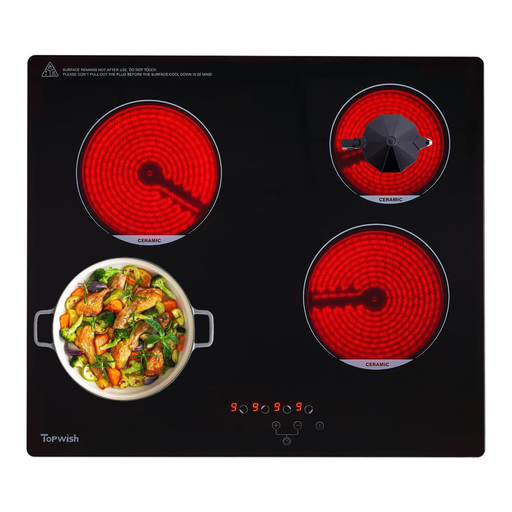 Image unavailable
Worth considering if you want to keep cookware without a ferromagnetic base. The stated cut-out is 560 × 490 mm: compare it with your opening and check the space beneath the worktop. The product details state that it connects without a plug and list two different total power ratings, 6 600 W and 6 000 W. Confirm which figure applies before having the electrical supply checked.
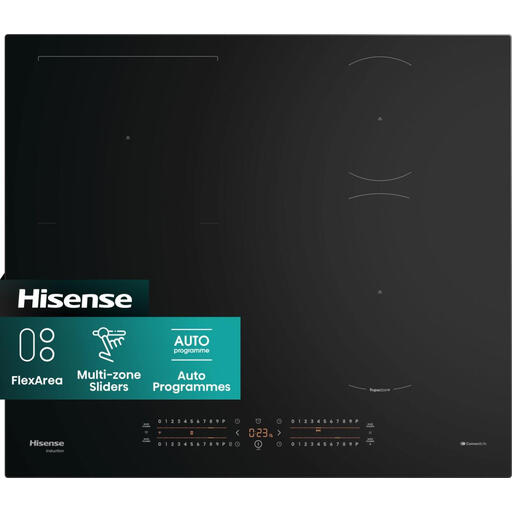 Image unavailable
Worth considering if the saucepans you want to keep are suitable for induction. Before choosing this built-in hob, check the niche dimensions, the space beneath the worktop and the connection requirements in the model’s instructions.
 Image unavailable
If you want to keep your magnetic cookware, start by testing the pans you rely on every day. The stated cut-out is 565 × 495 mm; compare it with your worktop. It connects without a plug, with a stated maximum power of 7 200 W, so have a professional check that your installation is suitable.
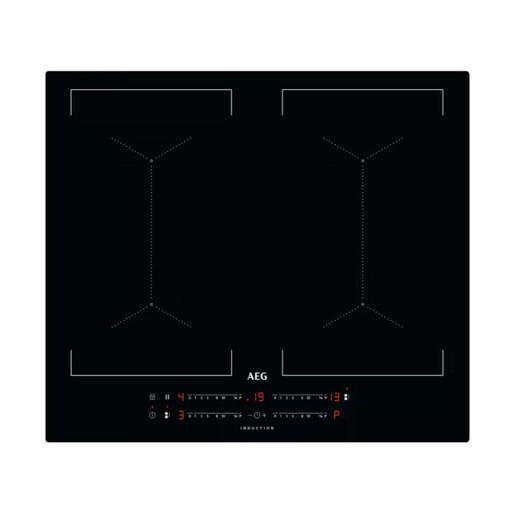 Image unavailable
Worth considering if your essential cookware is induction-compatible and you want flexible zones for larger pans. Check the cut-out required in the instructions for the exact model. The product details state 7,4 kW; have the required electrical supply checked too.
Hold a magnet against the base of each pan you want to keep: if it sticks, the base contains iron, according to the test recommended by UFC-Que Choisir. Also look for the induction symbol or check the cookware manufacturer’s guidance.
No. Compare the cut-out, the space beneath the worktop and the installation diagram, not just the external width. For example, Electrolux France lists a surface measuring 590 × 520 mm and a cut-out of 560 × 490 mm for models DIT60331BK and EHF6547FOK; other models may have different measurements.
Compare the requirements in the instructions for the exact model with the available circuit and power supply. Promotelec specifies a dedicated 32 A circuit for an electric cooker or hob; have your existing installation assessed rather than judging compatibility by the appearance of the plug or cable.
It may let you use cookware that isn’t induction-compatible on its gas burners, while reserving the induction zones for pans with suitable bases. However, check that the cooking-zone layout suits the way you cook and that the hob can be fitted and connected.