Households looking to keep their cookware
You already use several pots and pans and would rather not replace them all. If you’re considering induction, first check which items have compatible bases.


If the bases of the pots and pans you use most often are ferromagnetic, an induction hob could be an option. If you want to keep using cookware that isn’t compatible, consider a ceramic hob instead. A combination induction and gas hob, or replacing just a few items of cookware, could suit a mixed collection. Before choosing, check the hob zones and the model’s cut-out and power requirements against your kitchen.
You already use several pots and pans and would rather not replace them all. If you’re considering induction, first check which items have compatible bases.
You’re looking for fast, targeted heating while keeping energy use in mind. You’ll need compatible cookware and a hob that suits your kitchen.
You have a mix of cookware that is and isn’t compatible with induction. A ceramic hob, a combination hob or replacing a few items may be worth considering, depending on how you cook.
Start with the cookware you use regularly: compatibility can help determine which technology is right for you. Then compare how you cook and check that your chosen hob will fit the available space and existing power supply.
| Criterion | What to check | Who it matters to |
|---|---|---|
| Cookware compatibility | Test the bases of the items you use most with a magnet; also compare their diameter with the hob zones. | I want to keep using my usual pots and pans without finding out after I buy a hob that they won’t work with induction. Around 36% of consumers concerned put compatibility first. |
| Energy use and heating | Compare the technologies based on how often you cook, rather than applying an annual average to your own energy use. | If I cook often, I want to consider electricity use as well as how the hob heats. For around 29% of consumers concerned, running costs are the main priority. |
| Different cooking needs | Check the number and type of hob zones. On a combination hob, identify which zones use induction and which use gas. | I want to keep using some cookware that isn’t compatible with induction without giving up my other cooking habits. This flexibility comes first for around 21% of consumers concerned. |
| Space and power supply | Compare the existing cut-out with the model’s instructions, and check the stated voltage and total power rating. | I’m replacing a hob and need to make sure the new model suits the existing space and installation. Around 14% of consumers concerned put this fit first. |
With induction, it’s the ferromagnetic base that matters. UFC-Que Choisir recommends using a magnet as a first check: cookware without a suitable base won’t activate the cooking zone.
Test every item you want to keep, and only plan to replace the ones that aren’t suitable for the way you use an induction hob.
ADEME gives annual reference figures of 200 kWh for a ceramic hob and 115 kWh for an induction hob, based on 409 cooking cycles. Your energy use will depend on how you cook, so these averages don’t guarantee the same difference in your home.
When comparing the two technologies, take these figures into account alongside how often you cook.
Cut-out dimensions, total power and voltage vary by model. Choosing a technology that works with your cookware doesn’t necessarily mean the hob itself will suit your kitchen.
Measure the available space and check the exact hob model’s instructions for its specifications and installation requirements.
An unsuitable cut-out may mean you need to modify your worktop.
Worth considering if you’re comparing built-in induction hobs based on each model’s specifications.
Worth considering if you’re choosing between ceramic and induction and want to keep using your cookware.
Worth considering if a combination induction and gas hob would let you keep cooking in different ways.
Consider these ceramic hobs if you want to keep using non-magnetic cookware rather than switch entirely to induction. Before choosing, check your cookware dimensions and each model’s installation specifications.
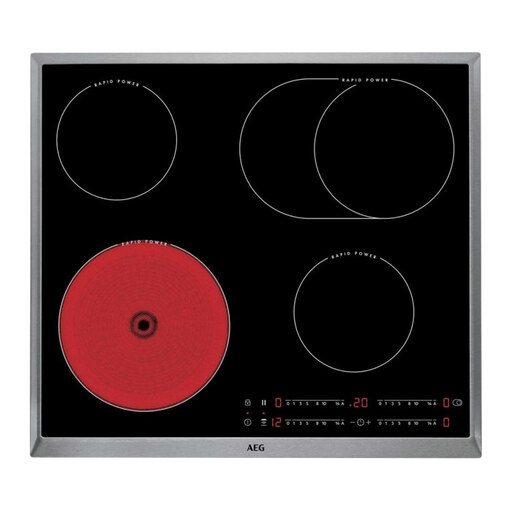 Image unavailable
An option to consider if you want to keep using non-magnetic cookware rather than choose induction.
Check the instructions for the cut-out dimensions and electrical specifications, and make sure your cookware is suitable for the hob zones.
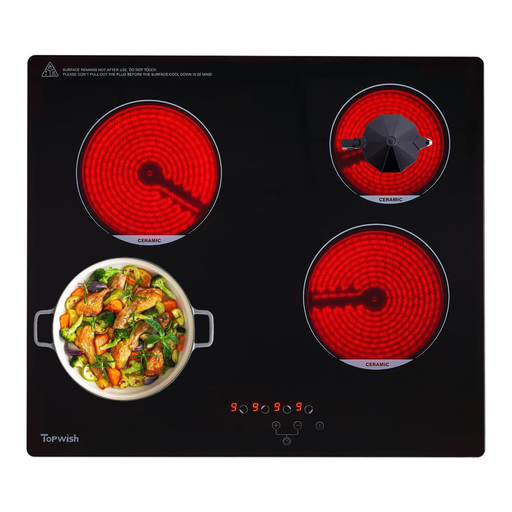 Image unavailable
Worth considering if you want to keep using non-magnetic cookware and have four cooking zones.
The model is listed with touch controls, a child lock and a residual heat indicator. Check its total power rating in the product documentation before confirming it’s suitable for your installation.
Place a magnet against the base of each item: if it sticks, the base may be suitable for induction, according to the test recommended by UFC-Que Choisir. Also look for an “induction” label and check that the base is the right size for the hob zone.
Not necessarily in every kitchen. ADEME gives reference figures of 115 kWh a year for induction and 200 kWh a year for ceramic hobs, based on 409 cooking cycles. Your energy use will depend in part on how often and how you cook.
No. Check the cut-out dimensions against the available space before ordering. Also check the total power rating, voltage and installation requirements in the instructions for your chosen model.