If you want to keep your saucepans and frying pans, start by testing their bases with a magnet: induction requires a ferromagnetic base, unlike a ceramic hob. If your cookware is a mixed bag, a combined induction and gas hob or replacing just a few pans may be a good option. Be sure to check the connections and the instructions for the model you’re considering.
Who are these options for?
Households looking to keep almost all their cookware
If replacing your hob shouldn’t mean replacing most of your saucepans and frying pans, first compare how well your cookware works with each type of hob. UFC-Que Choisir points out that not all pans are suitable for induction.
People who already have magnetic cookware
If a magnet sticks to the base of the pans you use most, induction is worth considering without automatically buying a whole new set. Test each item and check the hob size requirements in the instructions.
Households with a mix of cookware
If only some of your pans are suitable for induction, you could compare a combined induction and gas hob with replacing just the incompatible items. A combination hob also means checking the installation requirements for both types of cooking.
What should you check first?
Start by sorting through the pans you actually use, then decide whether you want to keep your cookware, switch to induction or make the change gradually. Before choosing a hob, check its instructions against the available space and connections in your kitchen.
| Priority | What to check | Who this applies to |
|---|
| Keeping your cookware |
Identify the essential pans whose bases don’t attract a magnet, then check the instructions for using them on a ceramic hob. |
I want to replace my hob without having to get rid of the saucepans and frying pans I still use. Around 31% of consumers would make keeping their cookware a priority. |
| Using cookware that’s already compatible |
Test the bases of your everyday pans with a magnet, then check the hob instructions for the size requirements. |
My usual pans attract a magnet, and I want to know which ones I can use on my new hob. For around 31% of consumers, compatibility would be their main concern. |
| Switching to induction gradually |
Separate the compatible pans from the others. If you’re considering a combined induction and gas hob, check the requirements for each section. |
I’d like to try induction while still using a few pans that aren’t suitable for it. A gradual switch would be the priority for around 23% of consumers. |
| Keeping cookware replacements to a minimum |
Identify any essential pans that aren’t compatible, then check the instructions and connections for the induction hob you’re considering. |
I’m happy to replace a few pans to switch to induction, but not the ones I can already use. Around 15% of consumers would prioritise replacing only the items they need to. |
Mistakes to avoid
-
Relying on the material name alone
The label “stainless steel” doesn’t, by itself, tell you whether a saucepan’s base will work on an induction zone. UFC-Que Choisir recommends checking whether a magnet sticks to the base of the pan.
Test the pans you need before choosing a hob, then make a note of only the ones you’d need to replace.
-
Confusing the ceramic glass surface with the type of hob
Hobs with a similar-looking surface don’t necessarily heat in the same way: induction requires a ferromagnetic base.
Check the type of hob in the product details rather than going by the appearance of the surface.
-
Ordering without checking the connections
The hob you choose must be suitable for your home’s installation. Promotelec explains the principle of a dedicated circuit for cooking appliances, but this alone doesn’t determine what work may be needed in your home.
Compare the instructions with your existing installation. If you’re unsure, ask a professional to confirm they’re compatible.
-
Assuming a combination hob needs no further checks
Combining induction and gas lets you use different types of cookware, but each section has its own usage and installation requirements.
Check your kitchen layout and the requirements for both sections in the instructions for the model you’re considering.
Brands to know when comparing ranges
Bosch
In France, Bosch offers induction hobs as well as electric and ceramic hobs.
- These categories let you compare a cooking method that requires magnetic cookware with an option that doesn’t work on that principle.
- Check the zones, dimensions and features for the specific model.
Electrolux
Electrolux France’s range includes induction, ceramic, gas and combination hobs.
- This gives you several options to compare if you want to keep your cookware or make a partial switch to induction.
- Features and cut-out dimensions vary by model; a ceramic surface may stay hot after the hob is switched off.
Whirlpool
Whirlpool offers induction, gas, ceramic and combination hobs.
- Combination models are worth considering if not all your cookware is suitable for induction.
- Check the configuration and connections in the documentation for the model you choose.
Ceramic hob to consider on Joybuy
This ceramic hob is worth considering if you’re replacing your hob and want to keep using non-magnetic cookware. Check the model’s instructions to make sure it suits your pans and installation.
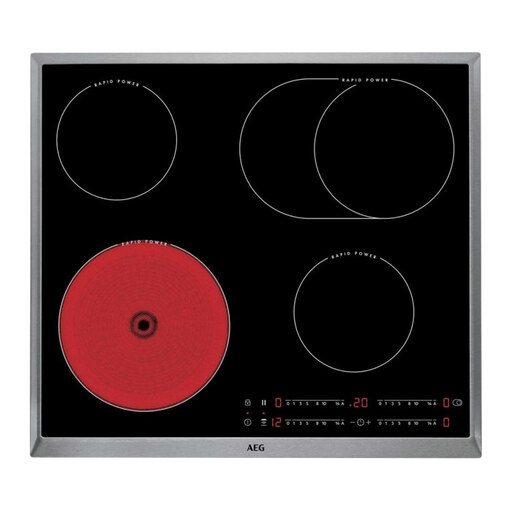 Image unavailable
HK654850XB Series 3000 ceramic hob, 60 cm
Worth considering if you want to keep using non-magnetic cookware rather than switch entirely to induction.
Listed as 60 cm wide: check the cut-out dimensions and connection requirements in the instructions.
The surface may stay hot after the hob is switched off.
View on Joybuy
Frequently asked questions
How can I test my saucepans before choosing induction?
Hold a magnet against the base of each pan you use regularly. If it sticks, the base passes the compatibility test described by UFC-Que Choisir. Also check the pan’s own information and the instructions for the hob you’re considering.
Is a magnetic base enough to use any induction zone?
No. Check the pan size requirements for the zone in the model’s instructions too, particularly if you have very small saucepans or large pans.
What should I check before buying an electric hob?
Compare the cut-out dimensions and connection requirements in the instructions with your existing installation. Promotelec describes a dedicated circuit for a hob. If you’re unsure whether your set-up is suitable, ask a professional to assess it.
Can a ceramic hob be used with cookware that isn’t suitable for induction?
It’s an option worth considering, as its zones don’t rely on a ferromagnetic base in the same way as an induction hob. Check the instructions for the cookware requirements of the model you choose, and bear in mind that its surface may stay hot after it’s switched off.


