
Livraison le jour même ou le lendemain

Qualité garantie

Débloquez vos offres de bienvenue: Livraison GRATUITE | Jusqu'à -80 % | 30 jours d'essai gratuits à JoyPlus
Téléchargez l'application
A high-speed ionic hair dryer can reduce drying time and make styling easier, but product specifications do not always tell the full story. Motor speed, electrical power, ionic technology, attachments and noise level all matter. Comparing these criteria methodically is the best way to avoid buying a model that does not suit your needs.
This Joybuy selection guide compares the advertised features of several models to help you choose according to your hair type, budget and everyday use in France.
A motor rated at 110,000 rpm may automatically appear superior to a model rated at 19,000 or 21,000 rpm. However, these figures alone are not enough to measure actual airflow. The shape of the air channel, turbine, wattage and concentration of the airflow also play a decisive role.
To assess a hair dryer’s performance, compare several specifications: advertised motor speed, power, air speed when provided and available settings.
Negative ions are generally marketed as a way to reduce static electricity and frizz. In practice, the result also depends on temperature, the distance between the appliance and the hair, hair porosity and drying technique.
Claims such as “1 billion ions” or “anti-frizz” reflect the information provided in product listings. They do not guarantee identical results for every user.
A high-performance appliance can quickly become uncomfortable to use if it strains the wrist or if its filter clogs easily. For long, thick hair, regularly cleaning the intake grille is essential to maintain strong airflow and reduce the risk of overheating.
A quiet hair dryer should also be compared using a decibel rating whenever one is available. Subjective impressions of comfort are no substitute for this measurement.
Brushless motors are used in several high-speed models. They are designed to reach high rotational speeds while reducing mechanical wear. Their lifespan still depends on build quality, maintenance and operating conditions.
Power, expressed in watts, indicates maximum energy consumption and heating potential, but it is not enough to determine drying efficiency. A 1,600–1,900 W appliance may be suitable for everyday use, while a 2,300 or 2,400 W model will generally deliver more powerful airflow, at the cost of higher energy consumption.
For fine, coloured or already dry hair, multiple heat levels help prevent unnecessary exposure to high temperatures. For thick or long hair, powerful airflow combined with moderate heat can speed up drying without keeping the appliance too close to the hair fibre.
Models with intelligent temperature control use sensors or internal regulation advertised by the manufacturer. This feature does not eliminate the need to maintain a reasonable distance or move the hair dryer regularly.
A concentrator directs airflow towards a specific area and is suitable for blow-drying and styling. A hair dryer with diffuser is better suited to distributing airflow over curly or wavy hair. Additional attachments can be useful, but check how securely they fit, how they are stored and whether they are compatible with your routine.
For use in France, also check the rated voltage, required regulatory information, instructions in French and the contact details of the responsible party established in the European Union, where applicable.
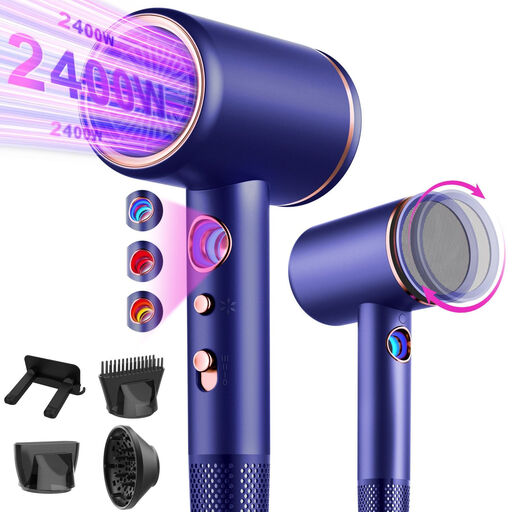
Why it suits this profile: With 2,400 W of power, three temperature settings and multiple attachments, it is an appealing choice for a first home hair dryer.
Clearly labelled settings make it easier to look beyond vague claims about speed.
AC motor, diffuser and three included nozzles, with an advertised output of 2,400 W.
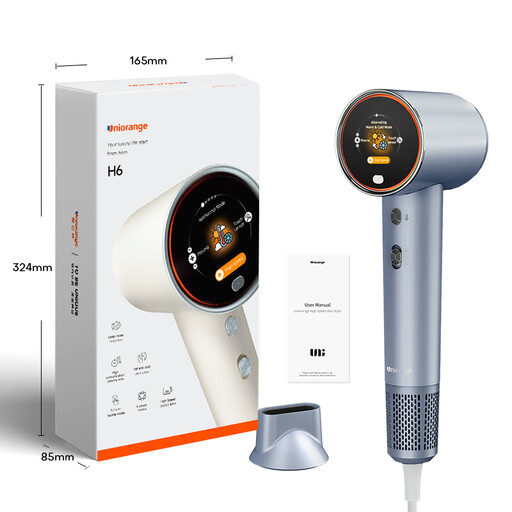
Why it suits this profile: Its LCD display, five modes and motor rated at 110,000 rpm are designed for users who want precise control over every session.
Operating information remains visible on the display, while the filter and thermal protection make everyday use easier.
Brushless motor rated at 110,000 rpm, five modes and a grip sensor.
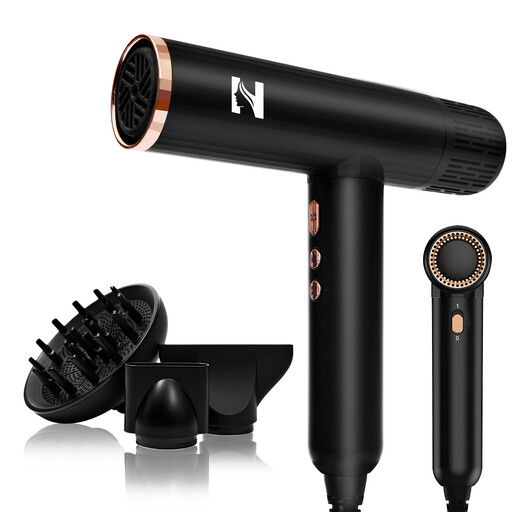
Why it suits this profile: The included diffuser and three airflow levels meet the styling needs of curls and high-volume hair.
The diffuser removes the need to purchase a separate attachment, while the advertised thermal control reduces reliance on constant high heat.
Brushless motor rated at 110,000 rpm, diffuser and two magnetic concentrators.
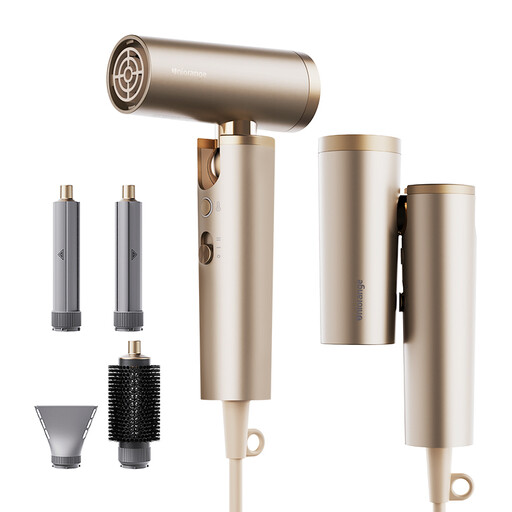
Why it suits this profile: Its foldable design and dual voltage of 100–240 V make it practical for international travel, provided you use the appropriate plug adapter.
The removable filter and reverse-cleaning mode address the common issue of buildup while travelling.
Foldable design, dual voltage of 100–240 V and four advertised styling attachments.
For fine or short hair, a 1,400–1,600 W appliance may be sufficient, especially when the motor produces well-concentrated airflow. For long, thick or very abundant hair, 1,800–2,400 W can reduce drying time, with energy consumption increasing in proportion to the power rating and operating time.
A fast-drying hair dryer is not necessarily the one that consumes the most energy. Efficient airflow, suitable settings and a clean filter can have a greater impact on actual drying time.
We have brought together an updated selection of products that meet these selection criteria and the safety requirements applicable in France.
No. The advertised motor speed is a technical indicator, but the result also depends on airflow, power, internal design and attachments. It is better to compare several specifications rather than focus on a single figure.
It can be, provided you choose a model with a diffuser and use moderate heat. A diffuser distributes the airflow and can help preserve curl definition. The effect on frizz varies depending on the hair’s natural characteristics and condition.
Reduce operating time by properly towel-drying your hair, choose a suitable temperature and clean the filter regularly. A 1,600 W appliance uses less energy per hour than a 2,400 W model, but total drying time must also be taken into account.