
Livraison le jour même ou le lendemain

Qualité garantie

Débloquez vos offres de bienvenue: Livraison GRATUITE | Jusqu'à -80 % | 30 jours d'essai gratuits à JoyPlus
Téléchargez l'application
A good set of highlighters should make reading clearer, not turn a page into an unreadable rainbow. There is certainly no shortage of choice: fluorescent or pastel models, mini formats, chisel tips or retractable versions. The number of colours alone is not enough to guarantee the right choice.
To avoid a disappointing purchase, focus above all on ink quality, tip precision and ease of storage. Here are the criteria to consider before choosing highlighters for lessons, the office, note-taking or a creative notebook.
A comprehensive set may seem appealing, but some shades will probably remain at the bottom of your pencil case. For revising lessons, four to six clearly distinct colours are generally enough. For bullet journalling or lettering, a pastel palette with complementary shades will often be more useful than a collection made up exclusively of fluorescent colours.
The simplest approach is to assign a function to each colour: yellow for key concepts, pink for definitions, blue for examples and green for dates or references. This visual code reduces unnecessary purchases and makes your notes much easier to scan.
Whether a highlighter bleeds depends as much on its ink as on the paper used and the drying time. A thin exercise-book page, an inkjet printout or a Bible page will not react in the same way. Water-based inks are often valued for their transparency, but they can show through lightweight paper if the tip deposits too much ink.
Before ordering, check whether the product description mentions use on photocopy paper, printed documents or thin pages. For an important document, always test it in an inconspicuous corner first.
A highlighter that dries out quickly will end up costing more, even if it was cheap to buy. Anti-drying highlighters can be left open for the period stated by the manufacturer, but this does not mean you should not replace the cap after use. Heat, direct sunlight and storing them tip-down can also affect the flow of ink.
Chisel-tip markers are the most versatile. The fine edge lets you underline or frame a word, while the broad edge quickly covers an entire line. STABILO BOSS ORIGINAL models offer a 2 mm and 5 mm tip, while the STABILO Swing Cool Pastel is listed with widths of 1 mm and 4 mm.
For annotating handouts, a fine tip is particularly useful in the margins. For preparing revision cards, a broad tip makes highlighting quicker. Bullet-journal enthusiasts may prefer a flexible or narrower tip for decorative details.
A transparent water-based ink will generally keep printed text easy to read. It is suitable for standard highlighting, framing text and certain stationery projects. However, be aware that “water-based” does not mean the ink will be compatible with every type of paper and printing.
Also check the information about drying time, resistance to photocopying and the risk of transfer. The Maped Fluo’Peps Classic range states that it uses quick-drying ink that resists smudging on several types of paper. This claim should nevertheless be considered alongside the type of material you actually use.
A set of 4 to 6 highlighters covers essential uses and is easy to carry. Ten colours offer more possibilities for organising several subjects or creating a detailed visual code. Large office sets become worthwhile when they are shared by several people or when you alternate between revision, organisation and decoration.
The packaging also deserves your attention. A pencil case protects the tips in a bag, while a display stand keeps the colours clearly visible on your desk. A slim barrel with a clip, meanwhile, can be attached to a notebook or folder.
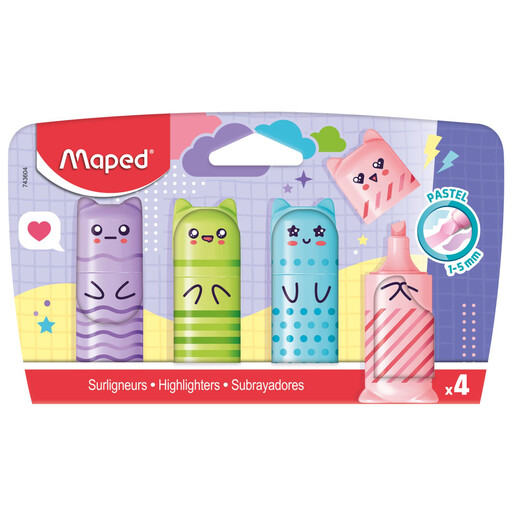
Why this choice suits this profile : At 7 cm long, it slips easily into a pencil case or pocket. Its four pastel shades are ideal for starting to organise your lessons or diary without building up a collection of different products.
The limited number of colours means you do not pay for shades that are rarely used. The water-based ink is described as suitable for marking without easily showing through the paper.
Compact format, 1 to 5 mm chisel tip, interchangeable caps and recyclable cardboard packaging.
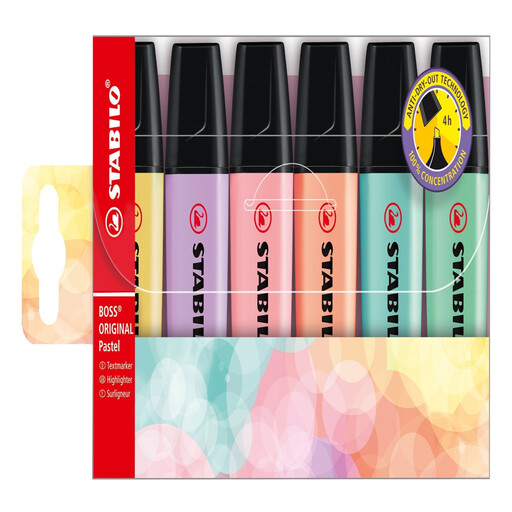
Why this choice suits this profile : This STABILO set brings together six pastel shades, a pouch and a dual-width tip, making it equally at home on work documents and in a bullet journal.
The product description states that its anti-drying technology keeps it usable for up to 4 hours without a cap – a real advantage during long annotation sessions.
Transparent water-based ink, 2 mm/5 mm tip, stated writing length of up to 375 metres per highlighter and a pouch made from 100% recycled materials.
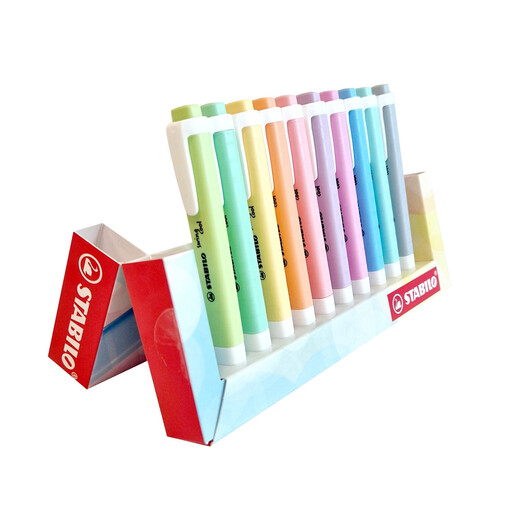
Why this choice suits this profile : With ten colours, a slim barrel and a clip, this model is ideal for students who colour-code several subjects and for anyone who carries their highlighters around every day.
The fine 1 mm tip complements the 4 mm width, so there is no need to buy an additional pen for precise annotations.
Ten fluorescent and pastel shades, water-based ink, anti-drying technology stated to work for up to 4 hours and a cardboard display stand.
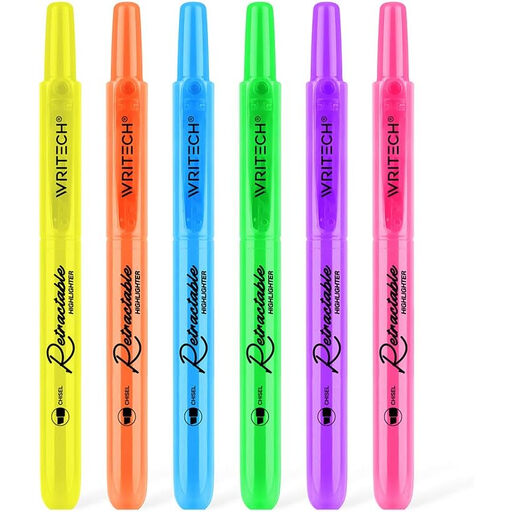
Why this choice suits this profile : Its click mechanism is ideal for people who annotate while standing, on the move or in an environment where a cap could easily be lost.
The tip retracts into the barrel, reducing the risk of marks inside a bag and limiting its exposure to air between uses.
Six assorted colours, chisel tip, ergonomic barrel and ink designed to minimise smudging and transfer.
We have put together a complete, real-time updated list of products that fully meet these strict selection criteria and European safety regulations.
For school or professional use, a set of 4 to 6 colours will generally cover everyday needs. Ten colours are better suited to organising several subjects, bullet journalling or creative projects.
Choose a transparent water-based ink and check the guidance regarding the type of paper being used. Glide the tip across the page without pressing too hard and allow it to dry before layering another colour. No model can guarantee identical results on every paper weight.
Some models claim to resist drying out for up to 4 hours without a cap. However, this period varies depending on the conditions of use. To preserve the ink flow and colour intensity, always recap the highlighter as soon as you have finished annotating.