
Livraison le jour même ou le lendemain

Qualité garantie

Débloquez vos offres de bienvenue: Livraison GRATUITE | Jusqu'à -80 % | 30 jours d'essai gratuits à JoyPlus
Téléchargez l'application
A good set of highlighters is about more than just a pretty palette of colours. Whether you're in class, at the office or organising your diary, the tip can wear down quickly, the ink can bleed through the paper and the lids can go missing. So before you head to the checkout, it's worth distinguishing the features that are genuinely useful from the marketing claims that are harder to verify.
A very intense fluorescent highlighter catches the eye immediately, but it can also make dense text less pleasant to re-read. For long study sessions, pastel or natural shades are generally easier on the eyes. Fluorescent colours, on the other hand, are particularly well suited to priority information.
The transparency of the ink also plays an important role. A water-based transparent ink can help preserve text readability, but the result also depends on the weight and quality of the paper.
Round-tipped models aren't always the most practical for neatly underlining a line. Chisel-tip highlighters are more versatile: their fine edge is ideal for annotating or framing an element, while the wide part lets you cover a sentence quickly.
Check the stated widths. Depending on the model, these can range from 1 to 4 mm or 2 to 5 mm. A few millimetres can make a real difference in a small school textbook, a narrow margin or a bullet journal heading.
Anti-dry highlighters can reduce the risk of drying out during a short break, but no model lets you skip putting the lid back on after use. Products with a retractable tip reduce the risk of losing the lid, while classic models are often simpler to store and replace.
To extend their lifespan, store your highlighters in a dry place away from heat, and follow the manufacturer's recommendations.
For annotating course notes or administrative documents, go for a chisel tip that offers two line widths. 2 mm / 5 mm formats work well for both broad highlighting and small details. 1 mm / 4 mm formats are a good choice if you often write in the margins.
A flexible tip can be pleasant for lettering and decoration, but it requires a steady hand to keep the width consistent.
Water-based ink is common on highlighters intended for notebooks and documents. It sometimes makes layering colours easier, but no ink guarantees it won't bleed through on every type of paper. Test it on a page similar to your usual materials, especially with thin sheets, diaries and printed books.
Metallic inks, like those in the Faber-Castell TL 46 Metallic highlighters, add an interesting visual effect. However, they are more suited to creative projects and should be handled with care around fabrics.
A multicolour highlighter set of four to six shades is usually enough to set up a simple revision system. Boxes of ten to twenty-four pieces are more suited to people who use a detailed colour-coding system, work across several subjects or want a full palette at the office.
Before choosing a large set, define your colour code. For example: yellow for definitions, pink for dates, blue for examples and green for points to review.
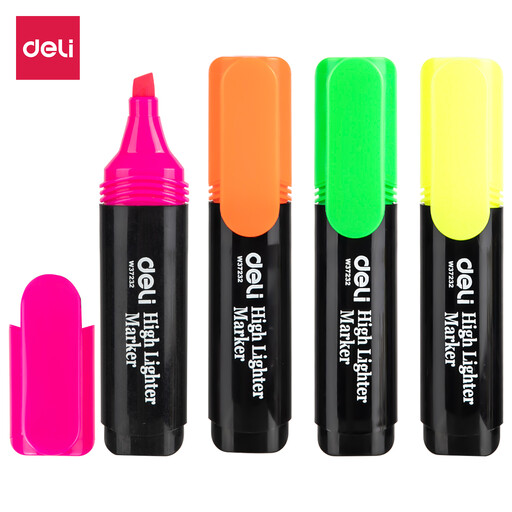
Why this choice suits this profile: a compact format to start using a colour-coding system at school, university or the office without multiplying the number of references.
With only four colours, this set stops you paying for shades that would just sit at the bottom of your pencil case. Still, check how it looks on your paper before using it in an important textbook.
Four matching colours and a design suited to school and office supplies.
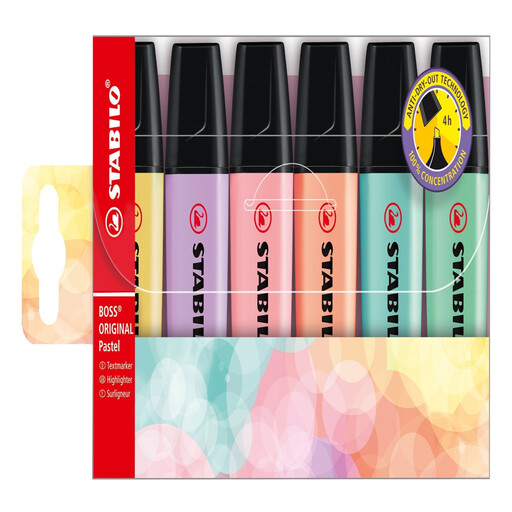
Why this choice suits this profile: the six pastel shades work well for lecture notes, diaries and bullet journal creations.
The chisel tip offers 2 mm and 5 mm lines. According to the product sheet, STABILO's stated technology allows the pen to be left uncapped for up to four hours.
A water-based transparent ink and a wallet made from recycled materials, according to the information provided.
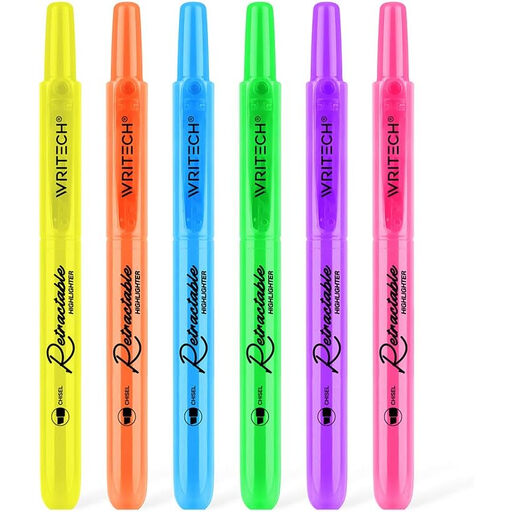
Why this choice suits this profile: the click mechanism makes for quick annotations in meetings, at the library or during a study session.
The tip retracts after use, which reduces the risk of losing a lid or staining the contents of your pencil case.
A chisel tip and matching fluorescent inks, in a format designed to minimise smudging on most papers.
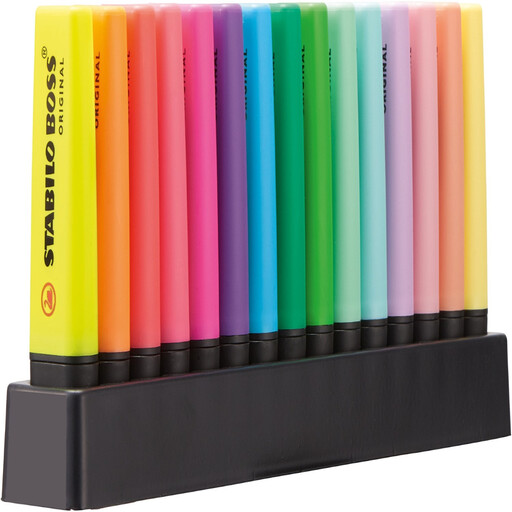
Why this choice suits this profile: the display stand fits neatly on a shared desk, in a classroom or for someone who uses multiple colour codes.
The display stand keeps things tidy and the colours within easy reach. The stated performance figures, such as 375 metres per pen, are still values provided by the brand.
Fifteen references, a 2 to 5 mm tip and a water-based ink for marking, annotating and bullet journaling.
We've put together an updated selection of products suited to different marking, organising and creative needs.
It all depends on how often you use it, how much pressure you apply and the surface area you cover. The writing lengths stated by brands correspond to their own test conditions. To prevent drying out, always close the pen and store it in its wallet or display stand.
That depends on the paper, the amount of ink applied and the writing speed. A transparent ink can improve readability, but it doesn't guarantee no transfer. With thin sheets, diaries and some book pages, it's still best to test first.
A chisel tip with two widths suits most uses. The wide side lets you cover a sentence, while the fine edge is for underlining a word or framing information. For very small annotations, go for the smallest stated width on the model.