
Livraison le jour même ou le lendemain

Qualité garantie

Débloquez vos offres de bienvenue: Livraison GRATUITE | Jusqu'à -80 % | 30 jours d'essai gratuits à JoyPlus
Téléchargez l'application
Choosing a set of highlighters seems simple… until the first use. A nib that snags on the paper, ink that's too runny, colours that are hard to tell apart, or pens that dry out in a matter of weeks – some flaws just don't show up in a product photo.
Whether you're annotating lecture notes, organising a work folder, or decorating a bullet journal, the right choice really comes down to the format, the nib, the ink, and the number of shades. Here are the criteria to check before you order pastel highlighters, fluorescent highlighters or coloured markers.
A big set isn't necessarily the most practical one. For revision, four to six colours are usually enough to distinguish definitions, dates, examples and key concepts. On the other hand, a teacher, a professional, or someone who loves visual planning might appreciate a wider palette.
So take the time to check the exact contents of the set. Some boxes mix fluorescent tones, pastel shades, natural colours, and sometimes even a black marker. You gain more options, but you also pay more and take up more space in your pencil case.
The shade you see on your screen can be quite different from the result on white paper, a printed textbook, or a photocopy. Very pale colours risk lacking contrast, while some fluorescent inks can bleed through thin paper.
To reduce nasty surprises, go for a water-based transparent ink and, if you can, test the marker on the type of paper you use every day. Manufacturers may quote specific performance figures, but the result also depends on the surface, the pressure you apply, and your writing speed.
A highlighter pen is sensitive to air. Even if it claims to have anti-dry-out technology, it's best to put the cap back on after every use. Storing them horizontally or in the case provided also helps keep the nib properly supplied.
Retractable-nib models reduce the risk of losing a cap. On the downside, the mechanism can be bulkier and less convenient for those who want a nib that's ready to use straight away.
Chisel-tip highlighters are particularly versatile. The wide side covers a line of text quickly, while the narrow edge lets you underline, circle, or make notes in the margin. The stated widths vary between ranges: some models offer around 2 and 5 mm, others 1 and 4 mm.
For lectures and administrative documents, choose a stable nib that glides without snagging. For lettering or bullet journals, the flexibility and consistency of the line become more important.
A water-based transparent ink that dries quickly is generally suitable for both printed documents and notebooks. But be careful: the term "anti-bleed" doesn't mean the ink will work perfectly on every paper. On very absorbent paper, it can soak through; on a freshly printed document, it can also cause some inks to run.
Leave it a few seconds to dry before closing a notebook or running your hand over the text. For creative use, also check whether the colour stays readable when layered over another one.
Product descriptions may mention a cap-off time or a marking length – for example, up to 375 metres per highlighter for certain STABILO references. This is a figure provided by the manufacturer, not a guarantee that applies under the same conditions for everyone.
If you work for long periods without a break, this criterion might matter. For occasional use, the quality of the cap, how you store them, and how often you use them will usually count for more than the theoretical yield.
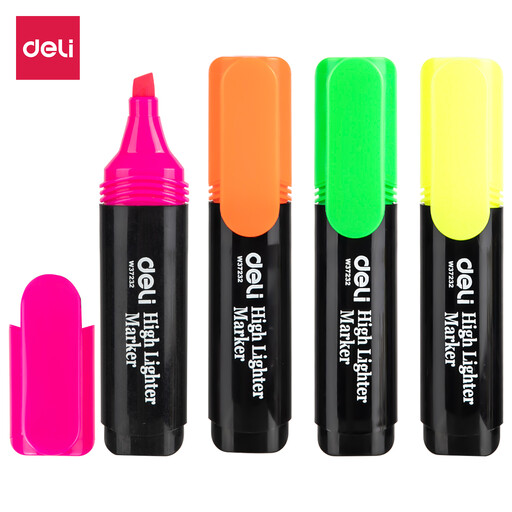
Why this choice suits this profile: A set of four colours is enough to get started, take notes, do homework, and organise your documents without stockpiling lots of different pens.
The compact format means you don't pay for colours you won't use, and it fits easily into a pencil case.
Set of 4 colours in a format suited to school and office supplies.
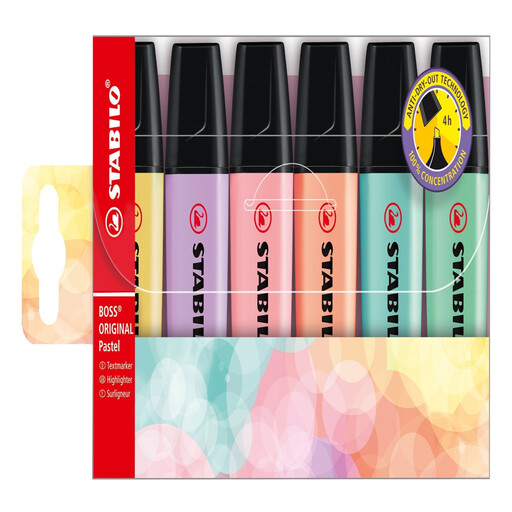
Why this choice suits this profile: Those who care about finish, line consistency, and soft shades will appreciate a pastel palette that works well for both notes and notebooks.
The six pastel shades and transparent ink reduce the risk of text looking too busy.
Chisel tip of 2 and 5 mm, with anti-dry-out technology claimed to last up to 4 hours without the cap.
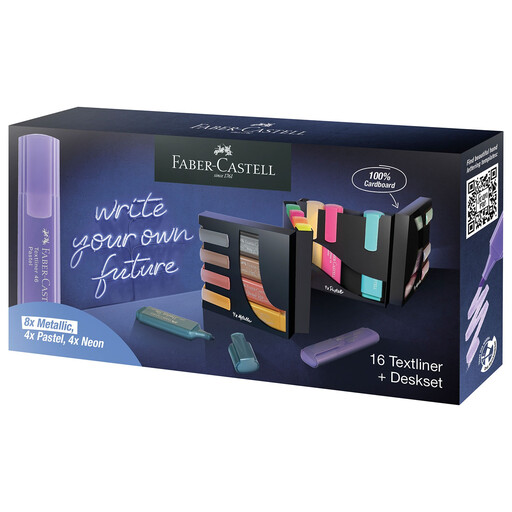
Why this choice suits this profile: People who regularly annotate several different materials can rely on an assortment of 16 colours and a practical desk organiser.
The display stand stops the pens from getting scattered and lets you quickly find each colour during a work session.
16 chisel-tip markers with a water-based ink claimed to be quick-drying and resistant to bleeding.
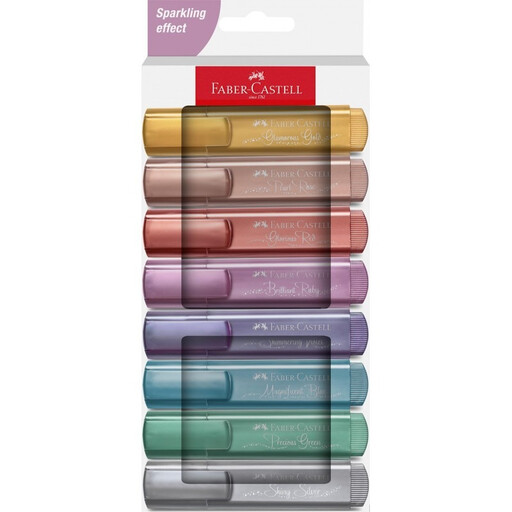
Why this choice suits this profile: Creative users can use the metallic shades for lettering, borders, cards, and page decoration.
The chisel tip isn't just for broad highlighting – it also lets you make finer lines for details.
Set of 8 metallic colours, water-based ink, and a cardboard box for storage.
We've put together a complete, real-time selection of products that meet these exacting criteria, while also complying with European safety regulations.
A set of four to six colours is often enough to organise the main information. A chisel tip offering two line widths lets you highlight, underline, and frame without switching tools. Fluorescent tones give strong contrast, while pastel shades offer a more subtle look.
It all depends on the ink formulation, the quality of the cap, and storage conditions. Some STABILO references claim up to four hours of use without the cap thanks to anti-dry-out technology. This duration is based on information provided by the manufacturer. To keep your pen in good condition for as long as possible, still put the cap back on as soon as you've finished.
There's no universal answer. The result depends on the thickness of the paper, its coating, and the amount of ink applied. Do a test on a similar page before highlighting a notebook, textbook, or bullet journal.