
Livraison le jour même ou le lendemain

Qualité garantie

Débloquez vos offres de bienvenue: Livraison GRATUITE | Jusqu'à -80 % | 30 jours d'essai gratuits à JoyPlus
Téléchargez l'application
Roots still damp after several minutes of drying, frizz appearing at the first sign of humidity, tired arms or a diffuser that turns your curls into an undefined mass: choosing a hair dryer is about far more than checking its wattage. A high-speed ionic hair dryer can reduce drying time, provided you do not get distracted by marketing claims.
Here are the main pitfalls to avoid and the criteria to consider when comparing models for everyday use, whether at home or in a salon.
A motor advertised at 110,000 rpm certainly grabs attention. But this figure does not tell you everything about airflow. The design of the air channel, turbine, outlet speed and attachments also play an important role. Two devices with the same rotational speed can therefore deliver very different results.
If you have long or thick hair, look for a well-directed airflow, a precision concentrator and several fan-speed settings. A brushless motor can be appealing for its compact design and generally smoother operation, but it does not eliminate the need to check the available settings.
Ionic technology is designed to reduce static electricity. It can leave hair feeling smoother, particularly when it is dry or prone to frizz. However, claims such as “billions of ions” are based on figures supplied by manufacturers and, on their own, do not provide a genuinely comparable measurement from one product to another.
The result also depends on the temperature, the distance between the device and your hair, the attachment being used and the nature of the hair fibre. For a more practical comparison, look for an anti-frizz hair dryer with a cool-shot button, concentrator and separate temperature and speed controls.
A device ordered online must be compatible with your electrical system. Check its voltage, the type of plug supplied and whether all required regulatory information is provided. Some imported models arrive with a UK plug and require a suitable adapter. That does not make them models fitted with a French plug.
The rear filter also deserves your attention. If it can be removed and cleaned, it helps limit the build-up of dust and hair, which can reduce airflow or trigger overheating protection. As for weight, a 400–600 g device may look lightweight on paper, but handle balance matters just as much.
Expressed in watts, electrical power indicates the device’s rated power consumption, not its drying speed on its own. A professional hair dryer rated at 1,600–2,400 W can suit many uses, but a fast motor paired with well-engineered airflow will often be more practical than a very powerful yet poorly balanced device.
Models equipped with a high-speed brushless motor, often advertised at around 110,000 rpm, are generally compact. For thick hair, focus above all on the following:
A hair dryer with intelligent temperature control measures and adjusts heat according to the operating method specified by the manufacturer. This technology does not make the device completely risk-free: hot air directed too close to the scalp can still dry out the hair fibre or cause discomfort.
To limit heat exposure, use a medium temperature, keep the device moving and finish with a cool shot. Fine or colour-treated hair generally responds better to moderate heat. Thick hair primarily needs effective airflow rather than the highest possible temperature.
A hair dryer with diffuser is particularly well suited to curly or coily hair: it distributes the air and prevents strands from being scattered during drying. The concentrator is better suited to blowouts and straightening, while a wide attachment can speed up pre-drying.
If you travel frequently, check the folding mechanism, compatible voltage and cable length. A compact model is not necessarily compatible with every voltage. The product listing should state this clearly before purchase.
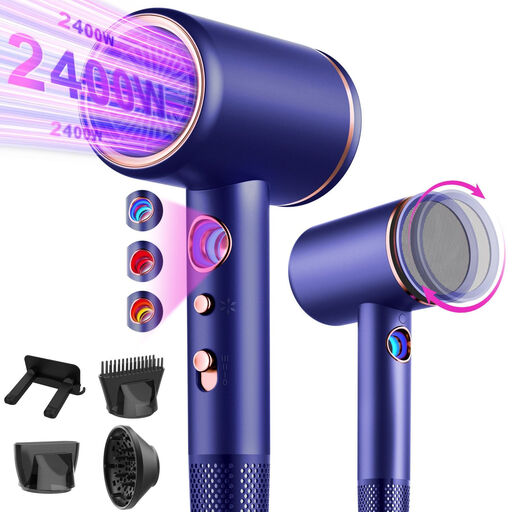
Why this model may suit you: with its advertised 2,400 W rating and range of attachments, including a diffuser, it is designed for versatile family use, from everyday drying to styling.
The product listing specifies three temperature settings and several attachments, allowing you to tailor the drying process rather than relying solely on maximum heat.
Advertised 2,400 W rating, ionic technology and diffuser included according to the product listing.
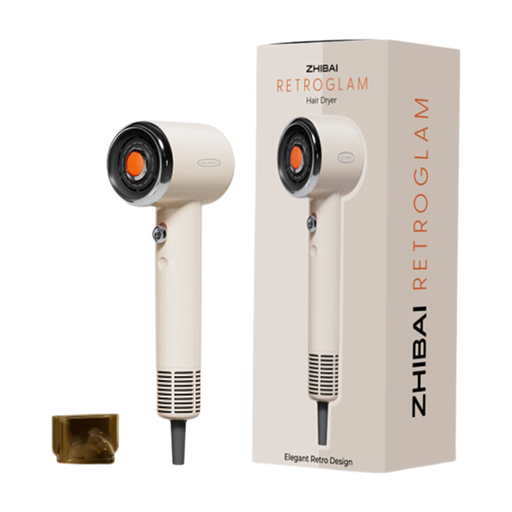
Why this model may suit you: its advertised 378 g weight, stated 56 dB noise level and four temperature settings are designed to make everyday use more comfortable.
The advertised constant temperature of 57°C and removable filter provide concrete details to assess beyond the simple number of ions being promoted.
Motor advertised at 110,000 rpm, 378 g weight, 56 dB noise level and removable rotating filter according to the available information.
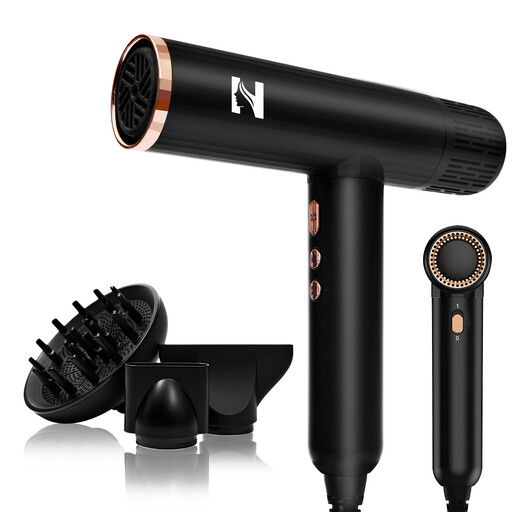
Why this model may suit you: its three speeds, four temperature settings and three attachments, including a diffuser, let you adapt drying to curly, coily or voluminous hair.
The diffuser is explicitly included, so you will not discover after purchase that you need to order a separate attachment or find a compatible model.
Brushless motor advertised at 110,000 rpm, 1,900 W power, 23 m/s air speed and stated weight of 570 g.
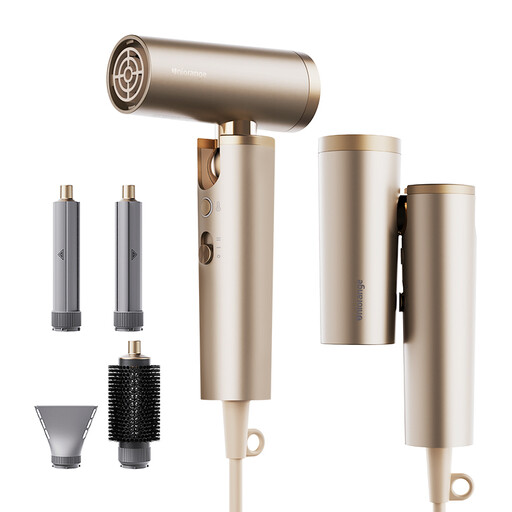
Why this model may suit you: its foldable design, compact form and advertised dual voltage of 100–240 V are convenient when travelling, provided you check which plug type is required.
The advertised dual-voltage design reduces unwelcome surprises when travelling abroad, while the removable filter makes maintenance easier.
Foldable design, advertised dual voltage and four attachments included according to the product listing.
Explore a regularly updated selection of hair dryers with a range of features, including models designed for fast drying, curly-hair care, lightweight travel or everyday styling.
Not necessarily. Motor speed must be considered alongside airflow, the power actually delivered, outlet design and the attachment being used. A high temperature does not guarantee faster drying either. To save time, divide your hair into several sections and start at the roots with an appropriate airflow setting.
Use a medium temperature for pre-drying, keep the device moving and avoid holding it too close to your hair. Use the cool setting to finish your style. Intelligent temperature control can help stabilise heat, depending on the model’s specifications, but it does not replace sensible use.
Unplug the device and allow it to cool before regularly removing hair and dust that have accumulated on the filter. Never block the air intake or outlet. Avoid using the hair dryer near a bath, sink or shower, and check the condition of the cord before every use. Models with a removable filter make this routine easier and help preserve airflow over time.