
Livraison le jour même ou le lendemain

Qualité garantie

Débloquez vos offres de bienvenue: Livraison GRATUITE | Jusqu'à -80 % | 30 jours d'essai gratuits à JoyPlus
Téléchargez l'application
Long hair that stays damp at the roots, frizz after every blow-dry, a tired arm or a diffuser forgotten at the back of a drawer: choosing a high-speed ionic hair dryer involves more than simply checking its wattage. The latest models combine brushless motors, intelligent temperature regulation and concentrated airflow. However, some marketing claims deserve closer scrutiny.
Here are the key criteria to check before buying, along with a selection of recommended models for different uses in France.
A specification such as “110,000 rpm” refers to the motor’s rotational speed—not necessarily the time required to dry your hair. Airflow volume and speed, expressed in m/s for example, as well as the shape of the nozzle and how precisely the airflow can be directed, matter just as much.
A hair dryer equipped with a 110,000-rpm brushless motor may be compact and highly responsive. You should also check its temperature settings, whether it includes a concentrator nozzle and whether it is compatible with the French electrical supply.
Ionic technology is designed to reduce static electricity and smooth unruly strands. However, the number of ions claimed by a brand is not enough to predict results across every hair type. When choosing an anti-frizz hair dryer, also check for adjustable temperature settings, a cool-shot button and a suitable operating distance.
Claims such as “1 billion ions” or “200 million negative ions” should be treated as product specifications provided by the brand, not as a guarantee of results.
A filter clogged with hair and dust will eventually reduce airflow. The motor may then run hotter and trigger its safety shut-off. A removable filter or reverse-cleaning function can make maintenance significantly easier.
Weight matters too. A model weighing between 390 and 570 g may be far more comfortable than a traditional professional hair dryer, particularly when drying thick hair or carrying out a prolonged blow-dry.
High-speed models often use a brushless motor, also known as a BLDC motor. This design generally enables a compact form factor and high rotational speeds. Some models claim 110,000 rpm, while traditional AC-motor hair dryers tend to focus on high power ratings of around 2,300 or 2,400 W.
For everyday use, don’t focus solely on wattage. Also look at:
Higher power can speed up drying, but it also increases electricity consumption. To estimate running costs, divide the wattage by 1,000, then multiply the result by the operating time in hours and your electricity tariff.
A hair dryer with intelligent temperature control measures or adjusts heat to limit excessive fluctuations. The Laifen Neo specification sheet states that it performs adaptive measurements 100 times per second, while the Zhibai S1 is listed as maintaining a constant temperature of 57°C. These figures reflect the specifications provided for these models and do not constitute a promise of absolute protection.
For fine, colour-treated or dry hair, choose a moderate temperature and keep the appliance moving. For thick hair, powerful airflow may be more useful than maximum heat.
A concentrator nozzle is suitable for straightening and drying hair section by section. For curly or wavy hair, a diffuser is the better choice: it distributes airflow more evenly and helps preserve curl definition. A volumising brush or styling attachments can replace several separate tools, provided you check how securely they attach and how they can be stored.
In France, also check the voltage indicated on the appliance: models designed for 220–240 V are compatible with the French domestic power supply. For a travel hair dryer, dual-voltage support from 100–240 V is convenient, but it does not guarantee that the plug will fit every socket. An adapter may still be required.
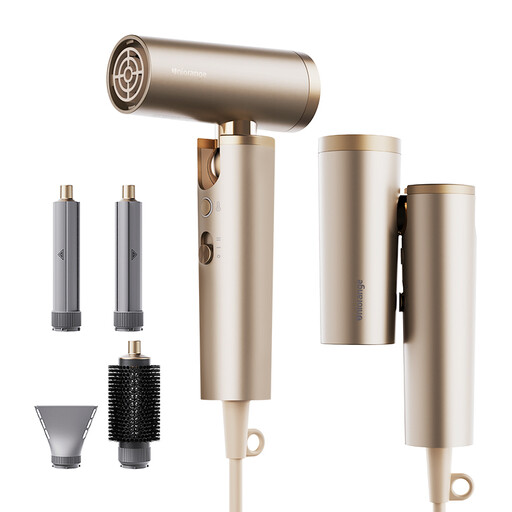
Why it suits this profile: Its foldable design and 100–240 V dual-voltage support make it a practical compact choice for home, the gym or travel.
The removable filter and reverse-airflow cleaning mode simplify maintenance. Its settings and attachments also encourage you to assess more than the advertised ion count alone.
Advertised 110,000-rpm motor, foldable design, dual-voltage support and four styling attachments.
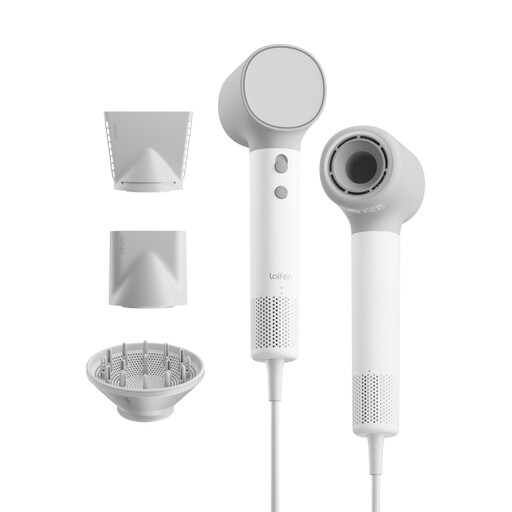
Why it suits this profile: With an advertised weight of 390 g, an airflow speed of 22 m/s and three attachments, it is designed for users who want to save time without handling a bulky appliance.
Adaptive temperature regulation encourages you to look beyond the manufacturer’s advertised motor speed alone.
Advertised 110,000-rpm motor, 200 million negative ions according to the specification sheet, diffuser, concentrator and smoothing nozzle.
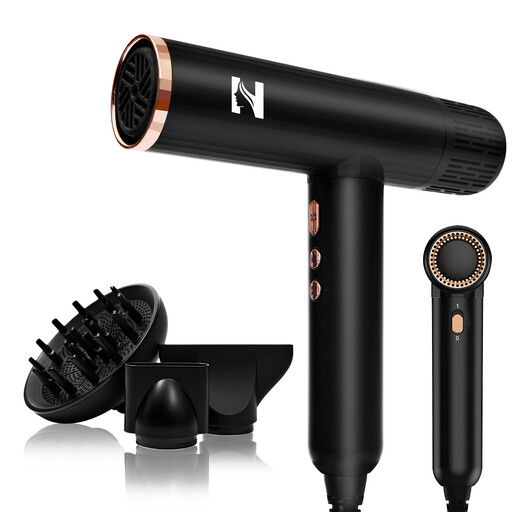
Why it suits this profile: The included diffuser and two concentrator nozzles address the styling needs of curly, wavy, long or thick hair.
It does not rely on ionic technology alone: the specification sheet also lists four temperature settings, three speeds and a removable filter.
Advertised 110,000-rpm brushless motor, listed weight of 570 g, noise level below 65 dB according to the specification sheet and a 2-m cable.
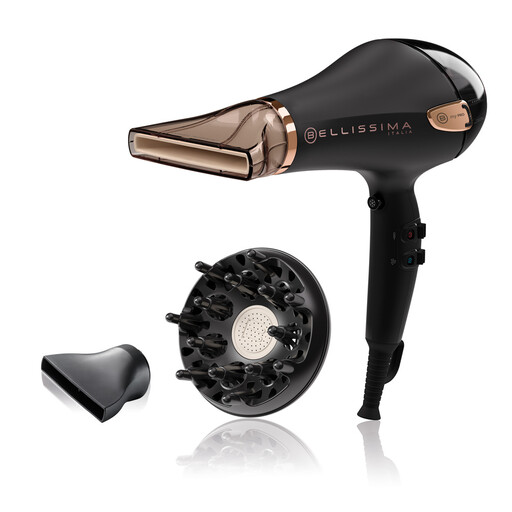
Why it suits this profile: This 2,300 W professional hair dryer is well suited to frequent blow-drying and to users who prefer dedicated attachments over a minimalist design.
The AC motor, removable rear filter and 3-m cord provide tangible specifications to compare with performance claims.
Two speeds, three temperature settings, cool-shot button, two ceramic concentrator nozzles and a diffuser.
We have put together an up-to-date selection of products that meet these criteria and are suited to common electrical systems in France.
Finally, check that the product includes the required regulatory information, instructions in French, 220–240 V compatibility, details of an EU-based responsible person where applicable, and clear warranty and returns conditions. These points are often more useful than an isolated figure printed on the packaging.
Not necessarily. Consumption depends primarily on the wattage and how long the appliance is used. A faster-drying model may reduce operating time, but you should compare both figures rather than assume that a high-speed motor is automatically more economical.
Yes, provided the appliance includes a diffuser and sufficiently gentle settings. Motor speed alone does not determine how curls will look: the diffuser’s shape, temperature and the ability to reduce airflow all play a decisive role.
It depends on the appliance’s design, how often it is used and how well it is maintained. Regularly cleaning the filter, keeping the vents clear and storing the appliance away from moisture can reduce the strain placed on the motor. Before ordering, check the warranty, the availability of spare parts and the manufacturer’s instructions.