
Livraison le jour même ou le lendemain

Qualité garantie

Débloquez vos offres de bienvenue: Livraison GRATUITE | Jusqu'à -80 % | 30 jours d'essai gratuits à JoyPlus
Téléchargez l'application
A shower with low pressure, white marks on the fittings or water that leaves your hair feeling dry and coarse can make you want to replace your shower head straight away. But promises of 20-layer filtration, high-pressure spray or water savings are not enough to distinguish between models.
In France, the right choice mainly depends on compatibility with your installation, maintenance costs and everyday comfort. Here are the criteria to consider before buying a high-pressure filtered shower head.
A high-pressure shower head can make the spray feel more powerful thanks to finer nozzles or an optimised internal design. However, it cannot work miracles if the mains pressure is very low, the hose is blocked or a limiter is incorrectly adjusted.
Before placing your order, check the condition of the hose, seal and wall connector. A model fitted with a flow or pressure limiter can also be useful if the spray is too powerful or becomes uncomfortable.
The term ‘20 layers’ refers to a combination of filter media, but on its own it says nothing about how long the filter will last or how much water it can treat. Cartridges containing, according to the product specifications, KDF, calcium sulphite, activated carbon, vitamin C or mineral beads need to be replaced regularly.
Filtration built into a shower head does not turn hard water into soft water in the way a domestic water softener does. It can complement bathroom maintenance, but it does not replace a system designed to treat all the water in your home.
Even a high-performance shower head loses much of its value if the hose leaks, twists or has an incompatible thread. The G1/2 connection, which is very common in bathroom fittings, makes installation easier. It is still best to check the diameter and condition of the seal before removing the old model.
When choosing an anti-limescale shower head or a shower filter for hard water, look for a cartridge that is easy to access and clear information about replacement. Some manufacturers recommend changing the cartridge every three to four months, but the actual frequency depends on water consumption, water hardness and any reduction in flow.
Claims about removing chlorine, heavy metals or impurities should be understood as performance claims made by the manufacturer, not as a medical guarantee. These products are intended for shower water and are not drinking-water treatment devices.
A water-saving shower head generally relies on micro-nozzles or a flow limiter. Comfort then depends on finding the right balance between spray coverage, speed and the volume of water used. A large face plate, such as 124 × 124 mm, can distribute the flow over a wider area.
A water-saving claim such as ‘up to 30%’ should be considered in the context of the conditions under which it was measured. Actual consumption varies according to mains pressure, shower duration and the mode selected.
A 5- or 6-spray shower head lets you switch from a rainfall spray to a massage, concentrated or gentle mode. For a bath, washing your hair or cleaning the enclosure, a handheld shower head paired with a hose offers much greater control than a fixed model.
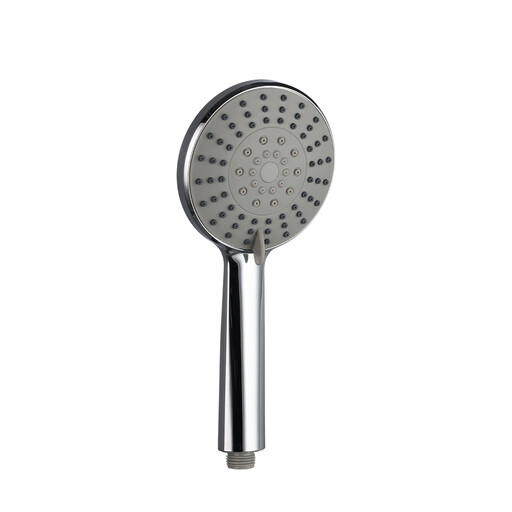
Why this suits this profile: This model is ideal for a first installation or replacing a standard shower head. It offers five spray patterns and a diverter for switching between the shower and bath.
The number of spray patterns is clearly stated. This means you avoid paying for a filtration function you do not need when versatility is your priority.
Five spray patterns and stated compatibility with both showers and baths.
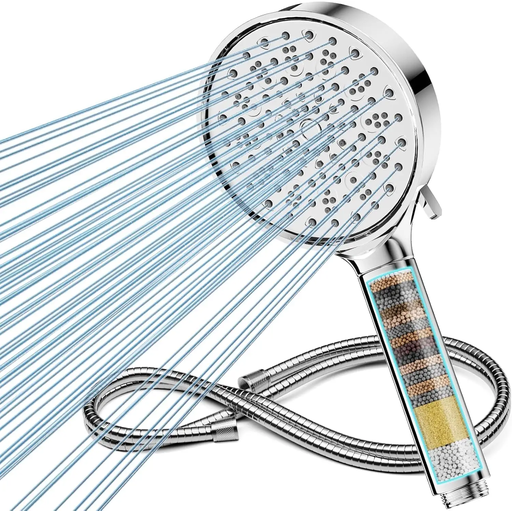
Why this suits this profile: With its metal body, hose and 124 × 124 mm face plate, this set is aimed at people looking for a more complete bathroom solution.
The hose and universal G1/2 connector are clearly specified, reducing the risk of unpleasant surprises caused by an incomplete installation.
Stated 20-layer filtration, six spray modes and technology designed to reduce water consumption.
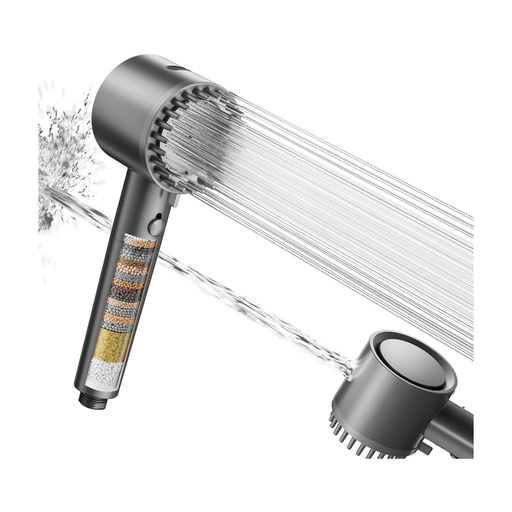
Why this suits this profile: Its 1.5 m hose, five modes and pre-installed cartridge make it convenient for family use, washing hair and cleaning the bath.
The suggested replacement interval — every three to four months or when the flow decreases — makes maintenance easier to plan.
Standard 1/2-inch connector, pre-installed filter, cleaning tool and hose described as tangle-free.
Installing a shower head with a hose and G1/2 connector can generally be done without calling a plumber:
To limit limescale build-up, regularly wipe the silicone nozzles with a soft cloth. Avoid abrasive products, which may dull a chrome or black finish. Replace the cartridge according to the instructions, while taking the water quality and changes in flow into account. If the spray becomes uneven, remember to clean the hose and inlet filter as well.
We have put together a complete, real-time updated selection of products that meet these demanding criteria as well as European safety standards.
It can make the spray feel more powerful thanks to its fine nozzles and improved distribution of the flow. However, it does not increase the pressure in the pipes. If the flow remains low, check the tap, hose, inlet filter and the general water pressure in your home.
Its lifespan depends on water consumption and water quality. Some models recommend replacing the cartridge every three to four months, or as soon as the flow decreases. To keep running costs under control, compare the price and availability of replacement cartridges before buying.
It can trap certain impurities and reduce exposure to components such as chlorine, depending on the technology used. It does not replace a water softener for the whole home. When choosing an anti-limescale shower head, therefore, examine the cartridge composition, maintenance frequency and the manufacturer’s precise specifications.