
Livraison le jour même ou le lendemain

Qualité garantie

Débloquez vos offres de bienvenue: Livraison GRATUITE | Jusqu'à -80 % | 30 jours d'essai gratuits à JoyPlus
Téléchargez l'application
Limescale can leave white marks on shower walls, clog the nozzles and make rinsing less enjoyable. It can also cause a tight feeling after showering or make detangling your hair more difficult. A high-pressure filtered shower head can improve everyday comfort, provided you look beyond the claims printed on the packaging.
Choosing the right model becomes more complicated when listings combine filtration, water saving, enhanced pressure and multiple spray settings. Here are the criteria to check before placing your order, along with a selection suited to different needs.
A shower filter can retain or reduce certain elements, depending on its composition. However, it does not necessarily replace a domestic water softener. Dissolved limescale, in particular, does not simply disappear with a cartridge containing activated carbon, calcium sulphite or mineral beads.
When choosing a shower head for hard water, check:
Terms such as ‘anti-limescale’ or ‘anti-chlorine’ indicate a claimed function. On their own, they are not enough to guarantee universal effectiveness.
The sensation of pressure depends on the pressure available in your plumbing system, the diameter of the nozzles and the water flow rate. A shower head may produce a more concentrated spray without actually increasing the pressure in the mains.
Thanks to fine nozzles and an optimised internal design, some models do genuinely make the spray feel more powerful. However, a system with low water pressure will not necessarily be transformed by a new high-pressure hand shower.
Multi-layer filtration is only genuinely useful if the cartridge is replaced at the recommended intervals. Deposits can also clog the silicone nozzles and reduce the flow rate.
Be wary of models that state a usage period without specifying the number of users, shower frequency or water quality. In a family household, the filter will generally need replacing more often than in a single-person household.
In France, the most common standard is the G1/2 connection, which is compatible with many shower hoses. Even so, check the thread on your existing installation before ordering. A shower head with hose can make replacement easier, particularly if the old hose is rigid, too short or already heavily affected by limescale.
A length of 1.5 m is suitable for most bathrooms. For a bath, a family shower or cleaning the enclosure, a longer hose may be more practical.
A shower head with a 20-layer filter may seem particularly appealing, but the number of layers alone is not enough to compare two cartridges. Instead, look at the detailed composition, such as:
Claims about reducing chlorine, heavy metals or impurities should be treated as information provided by the manufacturer, unless they are supported by independent, verifiable evidence. A shower filter does not make water drinkable and does not replace the recommendations of local water authorities.
A water-saving shower head should provide enough comfort while keeping the flow rate under control. Micro-perforated nozzles can concentrate the spray, while a flow limiter reduces the amount of water delivered. However, the result depends on the pressure in your water system.
Several spray settings can be useful if you switch between rinsing your hair, a gentle shower, massage and cleaning the enclosure. Make sure the selector is easy to operate with wet hands and that its mechanism does not seem unnecessarily complicated.
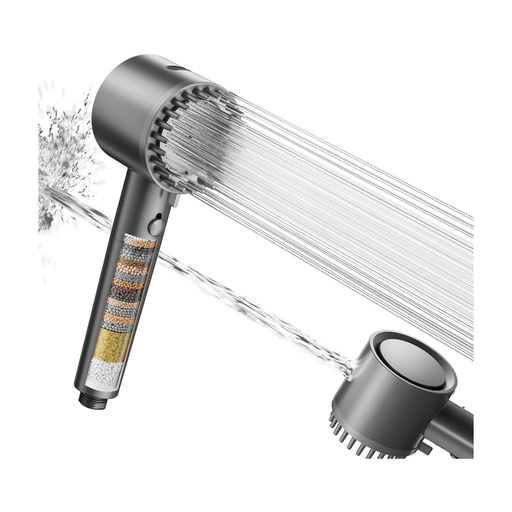
Why this choice suits this profile : This model combines a 20-layer cartridge, five spray settings and a 1.5 m hose with a standard 1/2-inch connection. It is ideal for a first installation, with no building work or plumber required.
The product information specifies the connection type, the indicative replacement period — three to four months — and the inclusion of a pre-installed filter. This lets you plan maintenance instead of relying solely on the ‘high pressure’ promise.
Five settings, a manufacturer-claimed tangle-free hose, a 20-layer filter and an ABS body presented as heat-resistant.
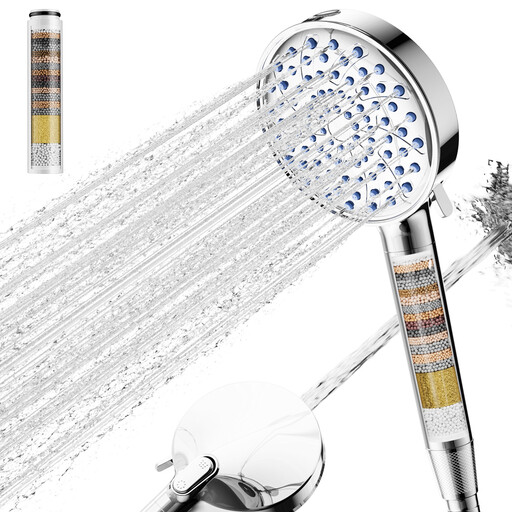
Why this choice suits this profile : Its large 124 × 124 mm panel and six settings are aimed at those looking for a more versatile experience, with rain, massage or powerful spray options to suit different needs.
The six functions are clearly identified, and the product information recommends replacing the filter every three to four months, or as soon as the flow rate decreases. This helps minimise unpleasant surprises caused by clogging.
20-layer filtration according to the product information, G1/2 connection, pre-installed filter and the option to add a flow limiter supplied separately.
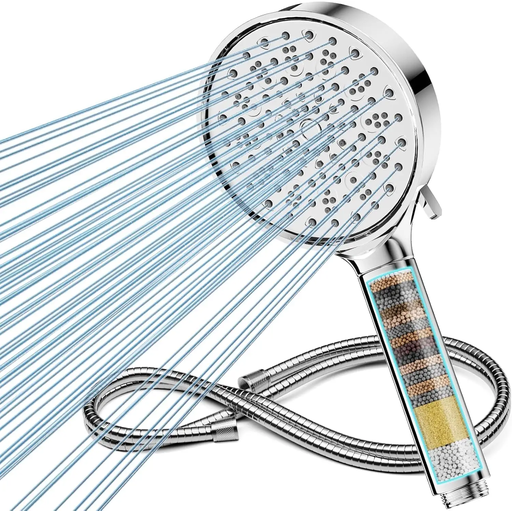
Why this choice suits this profile : Its metal body, 124 × 124 mm panel and six spray types make it suitable for families, repeated use and bathroom cleaning.
The product information distinguishes between the internal filter, spray settings and nozzle maintenance. It also states that a limiter can reduce an excessive flow rate, which is useful when pressure varies between domestic installations.
Metal housing, universal G1/2 connection, six settings and a filtration system advertised as having 20 layers.
We have put together a complete selection, updated in real time, of products that meet these demanding criteria while also taking European safety regulations into account.
Before screwing on the new shower head, turn off the water supply and remove any remaining tape or seal from the connection. Clean the thread, check the condition of the flat washer, then tighten by hand before making a slight adjustment. Overtightening could damage the connection.
To maintain a consistent flow rate:
If your installation includes an instantaneous water heater or a specific electrical device, check that the shower head is compatible before fitting it.
No. Depending on the cartridge used, it may act on certain components of the water, but it should not be confused with a water softener. To find out how hard your water is, consult the information provided by your local council or water supplier.
The frequency depends on the model, the number of users and the volume of water consumed. Several products recommend replacing the filter every three to four months, but a drop in flow rate is also a useful indication. Always consult the instructions for your chosen product.
Not necessarily. Consumption depends on the actual flow rate, shower duration and available pressure. To reduce your consumption, choose a model with a limiter or one designed with fine nozzles, then compare the stated flow rates whenever this information is available.