
Livraison le jour même ou le lendemain

Qualité garantie

Débloquez vos offres de bienvenue: Livraison GRATUITE | Jusqu'à -80 % | 30 jours d'essai gratuits à JoyPlus
Téléchargez l'application
Very hard water can leave white marks on your taps and gradually clog the nozzles. A chlorine smell, uneven pressure or a spray that's too narrow can also spoil your shower experience. To tackle this, a high-pressure filter shower head typically combines a filtration cartridge with several spray settings.
However, marketing claims alone aren't enough to make an informed choice. Here are the criteria to consider before buying, along with a selection of models suited to different needs in the UK.
A shower head with micro-orifices can create the impression of a more powerful spray by concentrating the water. This doesn't mean the pressure in your plumbing system actually increases. The result also depends on your available flow rate, the height of your home, the condition of your hose and your household water system.
To avoid disappointment, check whether the product page clearly mentions a spray technology, a flow restrictor or compatibility with your setup. A high-pressure shower head won't fix insufficient pressure throughout your whole house.
A shower head with an anti-limescale filter or an anti-chlorine shower filter may contain activated carbon, calcium sulphite, KDF or other filtering materials. However, their effectiveness depends on your water composition, flow rate and how often you replace the cartridge.
Claims like "20 layers", "antibacterial" or "purified water" should therefore be seen as design features or manufacturer assertions, not as a health guarantee. A filter shower head does not replace a water analysis or a certified domestic water treatment system.
Even a well-designed unit can lose flow when its nozzles become scaled up. The cartridge also needs replacing depending on the quality and volume of water you use. Before ordering, check for a standard fitting, the hose length and what's included in the box.
For hard water, choose a cartridge that's clearly described and easy to access. Activated carbon is often associated with odour reduction, while calcium sulphite is frequently featured in solutions designed to filter chlorine. However, these components alone don't guarantee identical performance in every bathroom.
A pre-installed cartridge makes setup simpler, but make sure replacement cartridges are available. Without regular replacement, the practical benefit of the filter quickly diminishes.
Most UK installations use a standard shower fitting, typically G1/2. However, you should confirm this on the product page. A handheld shower with a hose is practical for a bath, shower cubicle or targeted cleaning.
Also measure the space available for the wall bracket. A hose of around 1.5 m offers comfortable reach, but a longer model can be useful for a bath or family shower.
A 6-mode shower head or a multi-jet shower head lets you switch from a rainfall spray to a more concentrated, massage or targeted jet. The number of modes isn't the only factor: the selector should be easy to turn with wet hands, and the nozzles should remain accessible for descaling.
To limit water consumption, look for a finer spray system or a flow restrictor. The savings claimed by the manufacturer vary depending on your pressure and habits. They shouldn't be taken as guaranteed in every home.
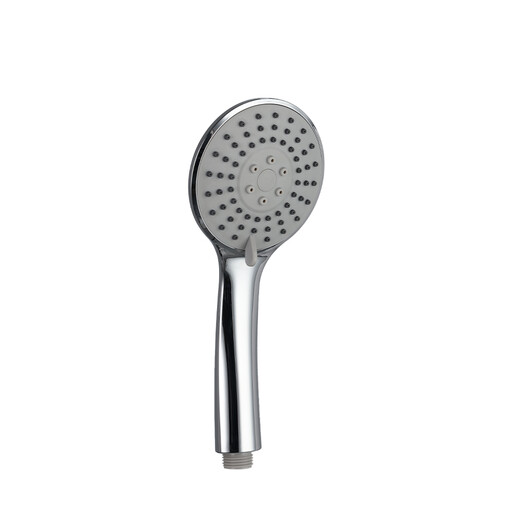
Why this model suits this profile: a compact hand shower with three modes and a switch, ideal for a bathroom where you want simple handling, for both the shower and the bath.
Choosing three modes means you don't pay for a more complex interface when filtration isn't your priority. Still, check the fitting type before ordering.
Compact design, three spray modes and built-in switch, according to the product page.
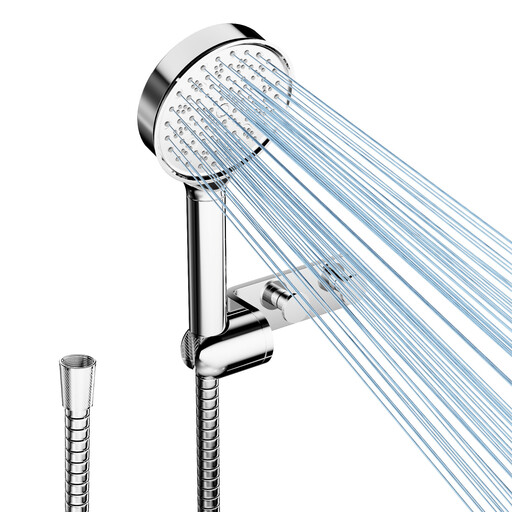
Why this model suits this profile: it combines a hose, bracket, six modes and a claimed 20-layer filtration system. It could suit households dealing with hard water or a chlorine smell, provided you check cartridge availability.
Filtration and accessories come together in one set: no need to buy a separate hose or compatible bracket.
Six spray modes, hose and bracket included, chrome finish and a filtration system described as having 20 layers.
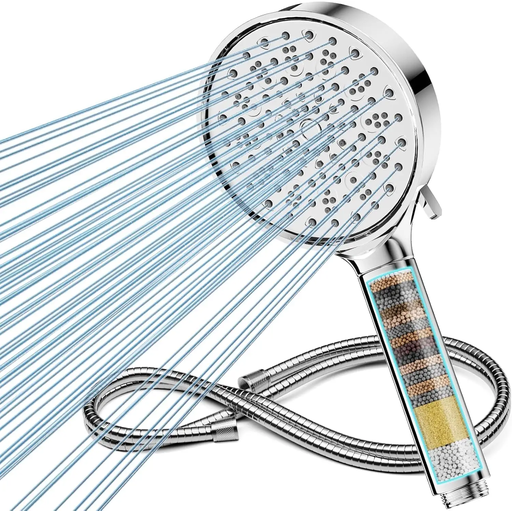
Why this model suits this profile: its 124 × 124 mm panel, six modes and advertised G1/2 threaded fitting target users who switch between a quick rinse, rainfall spray and more concentrated cleaning.
The product page states a replaceable cartridge and a universal G1/2 fitting. It's still essential to check your pressure and available space before installation.
Six spray types, 124 × 124 mm panel, hose included and water-saving technology mentioned by the manufacturer.
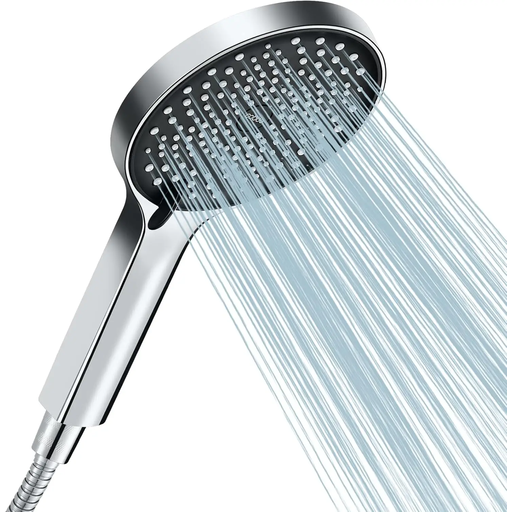
Why this model suits this profile: this water-efficient shower head has three modes, a 13.1 cm round panel and a 59-inch hose, which is approximately 1.5 m.
The claimed saving can reach 30 % according to the product page, but the result depends on your initial flow rate, pressure and shower duration.
Three modes — rain, pulse and massage —, a claimed tool-free installation and connection to a standard hose.
Before removing your old shower head, turn off the shower tap and protect the finish with a cloth. Unscrew the old fitting, clean the thread, then check the washer. Tighten the new shower head by hand, without using pliers on a chrome surface.
To maintain good flow:
To keep its shine, a chrome shower head should be cleaned with a soft cloth. Strongly acidic products and abrasive sponges can dull its surface.
We've put together an updated selection of products that meet these criteria for your bathroom.
It can help trap certain particles, depending on the cartridge used, but it doesn't replace a water softener. Check the filter composition, its lifespan and the availability of replacement cartridges.
The lifespan varies depending on the number of users, flow rate and water quality. Consult the manufacturer's guidelines and watch for a drop in flow, a change in smell or a visible change in the cartridge.
Not automatically. Some models combine micro-orifices with a flow restrictor, but actual consumption depends on your pressure and how long you spend in the shower. Compare the flow rates stated under similar conditions.