Who is this advice for?

Parents of children under 3

You’re looking for a product that’s suitable for your child’s age and fits into their breakfast routine. Manger Bouger reminds parents that from the age of one, milk remains part of a child’s diet, including at breakfast and teatime.

Parents who keep an eye on fibre and sugars

You want to check the nutritional information and ingredients list, without assuming that a “high in fibre” claim makes a cereal suitable for a toddler.

Parents who pay attention to allergens and texture

You need to check the allergen information for the specific product and its texture once prepared, especially if it’s a cereal with flakes, granola or pieces.

What should you check first?

For a toddler, start with the recommended age and texture. Then compare the fibre content with the rest of the information on the label.

What to check Look for Who it matters to
Age and preparation The recommended age, preparation instructions and texture when served. If my child is still very young, I want to avoid giving them cereal or a portion intended for an adult. Around 50% of consumers would make age suitability their top priority.
Ingredients and nutrition Fibre, sugars and salt per 100 g, followed by the ingredients and nutrition per portion, if shown on the pack. I’m looking for a recipe with ingredients I can understand, rather than relying on a high-fibre claim. Around 30% of consumers would put checking the label first.
Allergens and pieces Allergen information, any warnings about traces, and whether the product contains nuts, seeds or pieces. If I need to be mindful of texture or allergens, I want to know exactly what’s in the food I’m serving. Around 20% of consumers would put this need first.

Mistakes to avoid

  • Using an adult cereal serving as a guide

    Carrefour lists a 40 g serving of All-Bran Fibre Plus as a guide for adults. It doesn’t tell you how much to serve a child under 3.

    Before choosing a product or following its preparation instructions, look for guidance that’s suitable for your child’s actual age.

  • Looking at fibre alone

    According to Kellogg’s France, All-Bran Fibre Plus contains 27 g of fibre, but also 18 g of sugars and 0.9 g of salt per 100 g. Fibre content alone doesn’t tell you everything about a recipe.

    Read the nutritional information per 100 g alongside the ingredients list, and don’t assume that a high-fibre claim means the product offers a benefit for your child.

  • Assuming a simple-looking mix is straightforward

    Carrefour warns that its organic oat flakes may contain traces of several allergens. Jordans Almond, Hazelnut & Seed Granola contains nuts and seeds.

    Check the allergen information on the pack you choose and consider the texture of the product as it will be served.

Brands to know

Nestlé

The P’tite Céréale range includes a plain five-grain option which Auchan lists for babies and young children from 6 months.

  • This product has a clear age recommendation.
  • Check the preparation instructions, the gluten-containing cereals and any milk-related warnings on the product you choose. The age recommendation alone doesn’t tell you how much fibre it contains.

Carrefour Bio

Carrefour describes its small wholegrain oat flakes as having a short ingredients list, with just wholegrain oats.

  • The listed ingredients make it clear what this product contains.
  • These aren’t marketed as infant cereal. Carrefour warns that they may contain traces of other gluten-containing cereals, nuts, soya, sesame and mustard.

Kellogg’s

All-Bran Fibre Plus is an adult product that can be used as a nutritional comparison, rather than an automatic choice for a toddler.

  • Kellogg’s France lists 27 g of fibre per 100 g for this product.
  • The serving size listed by Carrefour is for adults and shouldn’t be used as a guide for a young child.

Quaker

Quaker France describes Quaker Oats as a wholegrain oat option with no added sugars, according to the brand.

  • The range offers rolled oats that you can compare with prepared breakfast cereals.
  • Before offering them to a toddler, check the recommended age, preparation instructions, texture and allergen information for the specific product.

Jordans

Almond, Hazelnut & Seed Granola is an example of a crunchy mix that needs careful consideration for its ingredients and texture.

  • Jordans lists the almonds, hazelnuts, seeds and cereals in this recipe.
  • These ingredients don’t mean that the granola is automatically suitable for a toddler’s age or ability to chew.

Two formats available on Joybuy

This selection includes a cereal labelled 6M and rolled oats. Check the recommended age, preparation instructions and texture before choosing either for a toddler.
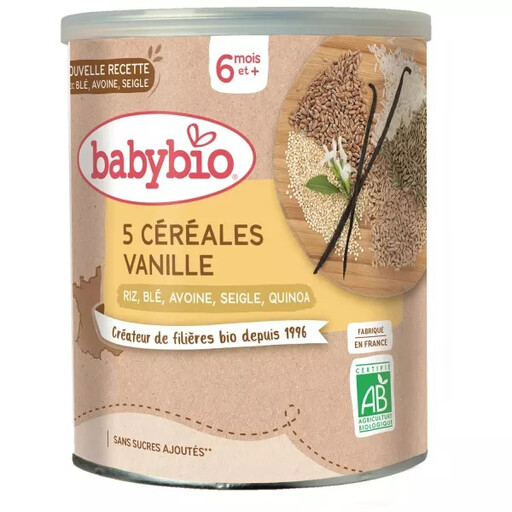
Baby Bio organic quinoa and vanilla cereal 6M, 220 g pack

Baby Bio Cereal Quinoa Vanilla 6M, 220 g

If you’re looking for a cereal with an age label, check that “6M” is suitable for your child’s age and follow the preparation instructions on the pack.

The pack is listed as 220 g. The product name alone doesn’t tell you its fibre content or allergens, so check the label on the pack you choose.

View on Joybuy

BJORG organic oat flakes, 500 g pack

BJORG Organic Oat Flakes, 500 g

If you’re considering rolled oats instead of a cereal with an age recommendation, check that the preparation method and texture when served are suitable for your child.

The pack is listed as 500 g. Check its nutritional information and allergen declaration before choosing it.

View on Joybuy

Frequently asked questions

Is a high-fibre cereal always suitable for a toddler?

No. Fibre content doesn’t replace an age recommendation or checks on texture and allergens. A serving size listed for adults, such as the one Carrefour gives for All-Bran Fibre Plus, doesn’t tell you how much to serve a young child.

Can cereal replace milk at breakfast for children aged 1 to 3?

Don’t treat it as an automatic substitute. Manger Bouger says that from the age of one, children still need around 500 mL of milk a day, including at breakfast and teatime. So consider any cereal as part of the meal as a whole.

What should you compare when two packs show different fibre amounts?

Compare fibre, sugars and salt on the same basis, such as per 100 g, then check the ingredients, suggested serving size and allergens. These figures alone can’t tell you whether the texture and instructions are suitable for your child’s age.

Should you check the allergens in plain rolled oats?

Yes. For its small organic oat flakes, Carrefour warns that they may contain traces of other gluten-containing cereals, nuts, soya, sesame and mustard. Check the information on the specific pack you intend to use.