Anyone who wants plain porridge to customise
Oats made from just one ingredient let you choose your own liquid and toppings, rather than starting with an already mixed cereal recipe.


To make porridge you can customise for pancake night, start with plain oats and compare fibre content on a like-for-like basis, per 100 g of dry product. If texture is your priority, check the size of the flakes and how they need to be prepared. If you need to avoid gluten, choose only a product explicitly labelled gluten-free. Crunchy muesli is a different option, and its ingredients are worth checking separately.
Oats made from just one ingredient let you choose your own liquid and toppings, rather than starting with an already mixed cereal recipe.
The word ‘oats’ alone isn’t enough: check that the specific product is labelled gluten-free and read the information about its other ingredients.
Large flakes may suit you if you prefer a more substantial texture. However, the size of the flakes alone doesn’t tell you how much fibre they contain or how long they take to prepare.
If you’re making porridge before serving pancakes, start by checking the nutritional information for the dry product, then look at how it’s prepared and the ingredients that matter to you.
| Criteria | What to check | Who is it for? |
|---|---|---|
| Fibre content | Compare the ‘fibre’ value per 100 g of dry product. For a product to qualify as ‘high in fibre’, the Union of Themed Catering Professionals states that it must contain at least 6 g per 100 g or 3 g per 100 kcal. | If I’m mainly looking for a verifiable fibre content, I want to be able to compare the packets before adding milk and toppings. Around 42% of consumers might make this their top priority. |
| Texture and preparation | Check the size of the flakes and the packet instructions. Distinguish between oats that need cooking, instant porridge and crunchy muesli. | If I want to serve the porridge at a particular time, I might prefer a quick option or, on the other hand, large flakes. This would be a priority for around 33% of consumers. |
| Ingredients and allergens | Read the ingredients list and allergen information for the specific product. If you need a gluten-free option, look for an explicit gluten-free label. | If there are ingredients I need to avoid, I should choose a suitable recipe rather than relying on the word ‘oats’ alone. Around 25% of consumers would put this need first. |
Muesli or granola may combine oats with other cereals, nuts or sweetening ingredients. It isn’t as easy to customise as a base made entirely from plain oats.
If you want to make your own porridge, read the full ingredients list before comparing fibre content.
Quaker France states that Quaker Oats may contain barley and wheat. The gluten-free label on one specific product doesn’t apply to other oat flakes.
If this matters to you, check the gluten-free label and allergen information on the exact packet you’re buying.
Adding milk, water or toppings changes what’s in a bowl. The values per 100 g of dry oats don’t automatically describe the portion you serve.
First compare the fibre content of dry products on the same basis, then take into account anything you add separately.
Quaker Oats is a familiar choice of wholegrain oats for making porridge.
The range includes large organic oats, as well as muesli and granola recipes that are different from plain oats.
The products listed are wholegrain oats, rather than ready-made porridge with added toppings.
These organic wholegrain oats give you a plain base for making porridge.
The plain oat products mentioned are made from wholegrain oats.
This selection includes oats for porridge you can customise, an instant porridge mix, an oat recipe with linseed and cocoa, and crunchy muesli to consider separately.
 Image unavailable
Worth considering if you want to make porridge shortly before serving the pancakes. Check the packet instructions and allergen information before choosing it.
 Image unavailable
Oats to consider if you’d rather add your own liquid and porridge toppings. Check the preparation instructions and, if needed, look for a gluten-free label on this exact product: ‘organic’ doesn’t mean gluten-free.
 Image unavailable
Oats to prepare yourself if you want to choose your own porridge toppings. Quaker France states that Quaker Oats may contain barley and wheat, so check the packet label if you need to avoid these cereals.
 Image unavailable
Worth considering if you want an oat recipe already combined with linseed and cocoa, rather than plain oats. Check the nutritional information, particularly the ‘sugars’ value, as well as the allergen information for this exact product.
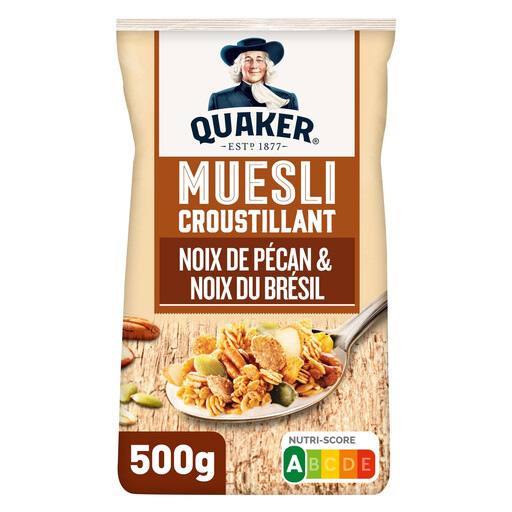 Image unavailable
This muesli is a good choice if you’re after a crunchy texture, but it isn’t a like-for-like substitute for plain oats when making porridge. It contains nuts, so read the full ingredients list, allergen information and nutritional values before comparing it with the other options.
Compare the fibre content per 100 g of dry product, and don’t confuse this figure with the amount in a prepared bowl. For a product to qualify as ‘high in fibre’, the Union of Themed Catering Professionals states that it must contain at least 6 g per 100 g or 3 g per 100 kcal.
Quaker France recommends using 40 g of oats and 250 ml of water or milk, then cooking for five minutes in a saucepan or two minutes in the microwave. For another product or type of oats, follow the instructions on its packet.
No. Quaker France states that Quaker Oats may contain barley and wheat. If you need a gluten-free product, look for that label on the exact product rather than relying on ‘oats’ as the only ingredient.
Not if you want the same preparation and ingredients. Muesli may contain other cereals, nuts and sweetening ingredients. Choose it for what it is, and compare its ingredients, sugars and fibre separately from plain oats.