People comparing fibre content
You want to see the amount of fibre on the pack rather than relying on the product name. The annex to Regulation (EC) No 1924/2006, published on EUR-Lex, sets out the conditions for using the claim ‘high fibre’.


For your weekly shop, choose a muesli that lists its fibre content per 100 g, then compare the sugars, ingredients and allergens in the specific recipe. A fruit version with no added sugars may still contain naturally occurring sugars, while a crunchy recipe may include added sugar.
You want to see the amount of fibre on the pack rather than relying on the product name. The annex to Regulation (EC) No 1924/2006, published on EUR-Lex, sets out the conditions for using the claim ‘high fibre’.
For weekday breakfasts, you want to distinguish between naturally occurring sugars in dried fruit and any added sugar. The fruit recipes described by Auchan and the crunchy recipe featured by Carrefour illustrate the difference.
You consider the grains, nuts, allergens and texture before buying a pack for several breakfasts. These can vary between the recipes described by Carrefour and Auchan.
Start with the nutrition information per 100 g: this lets you compare fibre and sugars on a like-for-like basis. Then check the ingredients list and allergen information for the recipe you’ve chosen.
| Criteria | What to check | Who is it for? |
|---|---|---|
| Fibre content | Check the amount of fibre per 100 g. Under the annex to Regulation (EC) No 1924/2006, published on EUR-Lex, the claim ‘high fibre’ requires at least 6 g per 100 g or 3 g per 100 kcal. | For my weekday breakfasts, I want to compare a stated amount rather than rely on the name on the pack; around 42% of consumers would put checking fibre at the top of their list. |
| Sugars and ingredients | Compare the sugars per 100 g, then look for dried fruit and any added sugars in the ingredients list. | When a muesli contains dried fruit, I want to know whether sugar has also been added; for around 33% of consumers, ingredients and sugars would be their top purchase priority. |
| A recipe that suits your household | Check the grains, allergens and any warnings about possible traces; also choose between a classic and a crunchy texture. | If several people share the pack, the recipe needs to suit their needs and tastes; around 25% of consumers would put this everyday suitability first. |
The threshold for the ‘high fibre’ claim relates to fibre, not sugars. Fruit recipes may contain naturally occurring sugars, while some crunchy recipes include added sugar.
Compare the ‘fibre’ and ‘of which sugars’ figures per 100 g, then read the ingredients list.
Auchan notes that its Bjorg fruit varieties labelled as having no added sugars contain naturally occurring sugars.
Check the amount of sugars listed on the pack and look for dried fruit in the recipe.
The Bjorg wheat bran variety described by Carrefour combines several grains and carries warnings about possible traces. Ingredients and warnings depend on the specific recipe.
Check the allergens and any possible-traces warnings on every pack you buy.
Manger Bouger notes that increasing your fibre intake too quickly can cause digestive discomfort for some people.
If you’re making a significant change to your diet, increase your fibre intake gradually and make sure you drink enough water.
Several organic recipes are documented, including a muesli with wheat bran, figs and prunes, and a crunchy recipe.
The 375 g organic fig and apple variety provides some figures for comparison.
Auchan describes an organic fruit and nut muesli with raisins, coconut and toasted hazelnuts.
These two products suit different preferences for weekday breakfasts: an organic BJORG muesli and QUAKER Cruesli Mixed Nuts cereal clusters. Before choosing, compare the nutrition information and ingredients on each pack.
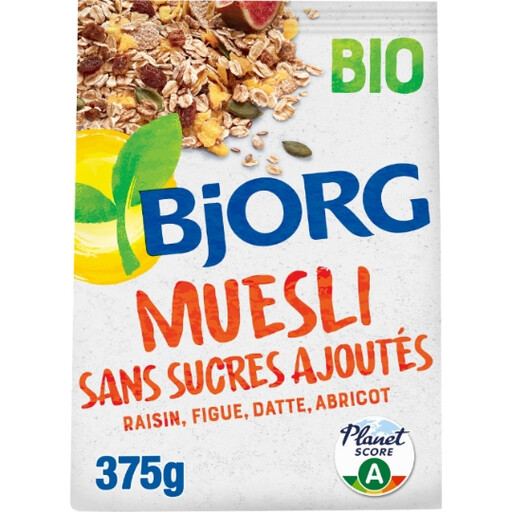 Image unavailable
Worth considering if you’re looking for a 375 g pack of organic muesli for weekday breakfasts. Check the fibre and sugars per 100 g, as well as the allergens, for the recipe on offer.
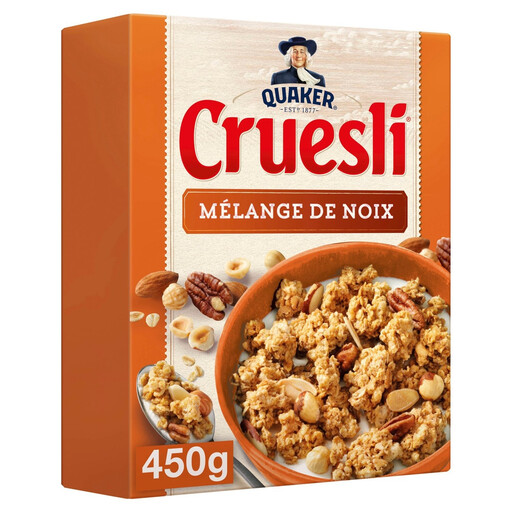 Image unavailable
Worth considering if you prefer nut clusters in a 450 g pack. To compare them with a high-fibre muesli, check the fibre content per 100 g, the ingredients and the allergens.
Under the annex to Regulation (EC) No 1924/2006, published on EUR-Lex, this claim requires at least 6 g of fibre per 100 g or 3 g per 100 kcal. Check the exact figure on the pack, too, so you can compare two recipes.
No. It may contain naturally occurring sugars. Auchan notes this for some Bjorg fruit recipes; check the ‘of which sugars’ figure and the ingredients list for the product you choose.
Check the specific recipe. Carrefour lists oats, rye, wheat and barley in a Bjorg wheat bran muesli, as well as possible traces of milk, nuts, sesame and soya. The label on the pack you buy is the best guide.
Manger Bouger advises increasing your fibre intake gradually and drinking enough water. Increasing it too quickly can cause digestive discomfort for some people.