Fibre content is your priority
You want to put together a bowl without spending ages preparing it, and compare the grams of fibre per 100 g rather than relying on the recipe name alone.


For a quick breakfast, start by choosing a muesli with a fibre content per 100 g that suits your priorities, then compare the sugars and ingredients. The words “no added sugars” don’t tell you the total sugar content on their own. If you need to avoid gluten or an allergen, check the specific product rather than relying on the general “muesli” category.
You want to put together a bowl without spending ages preparing it, and compare the grams of fibre per 100 g rather than relying on the recipe name alone.
You’re looking for something simple to prepare, but want to distinguish total sugars from the “no added sugars” claim on the packaging.
You need to check the ingredients and any “may contain” warnings for each product. Several of the recipes featured by Bjorg, Celnat and Kellogg’s contain gluten-containing cereals or nuts.
For a quick-to-prepare bowl, start with your main priority, then check it against the nutritional information and ingredients list for the recipe you choose.
| Criterion | What to check | Who is it for? |
|---|---|---|
| Fibre | Compare the fibre content per 100 g and check the ingredients list. | If fibre is my main criterion, I want to be able to compare two mueslis even when they come in different pack sizes. Around 36% of consumers put fibre content at the heart of their choice. |
| Sugars | Check the “of which sugars” figure per 100 g and distinguish it from the “no added sugars” claim. | When choosing a bowl with dried fruit, I want to know the total sugar content, even if no added sugar is listed. This is the main consideration for around 29% of consumers. |
| Gluten and allergens | Check the ingredients, any “may contain” warnings and, if needed, whether the specific product is explicitly labelled “gluten-free”. | If I need to avoid an ingredient, whether the recipe is suitable comes before its fibre content. This is the top priority for around 14% of consumers. |
| Preparation and pack size | Check the suggested serving, preparation instructions, net weight and storage instructions after opening. | On busy mornings, I mainly want a bowl that’s easy to prepare with what I have to hand. Around 21% of consumers prioritise this convenience above all else. |
These claims describe different characteristics. Kellogg’s lists 8.1 g of fibre and 19 g of sugars per 100 g for Country Store; Auchan’s product details for Jordans no added sugar muesli show 8.5 g and 18.9 g per 100 g respectively.
Compare the fibre and “of which sugars” figures on the same per-100 g basis, then check the ingredients.
The recipes featured by Bjorg, Celnat and Kellogg’s don’t all contain the same cereals or carry the same allergen warnings. A gluten-free product in a range doesn’t mean the other products in that range are suitable for avoiding gluten.
If you need to avoid gluten or an allergen, check the label on the specific product you’re buying, including any relevant “may contain” warnings.
The figure shown per 100 g isn’t the amount you’ll actually eat; that depends on the portion you serve.
Manger Bouger recommends gradually increasing your intake of foods that provide fibre and drinking enough water.
The range includes a Fibre Muesli and a separate Superfruits product labelled gluten-free.
The Fibre and Digestion Muesli combines rye, wheat bran and dried fruit, among other ingredients.
The product featured by Auchan is an organic muesli with figs and apples.
The organic fruit and nut muesli featured by Auchan carries a “no added sugars” claim.
Country Store is a muesli made with cereals, fruit and hazelnuts, among other ingredients.
This organic muesli could be used to make a breakfast bowl. To see whether it suits your search for a high-fibre muesli, check its fibre content and the other information on the label.
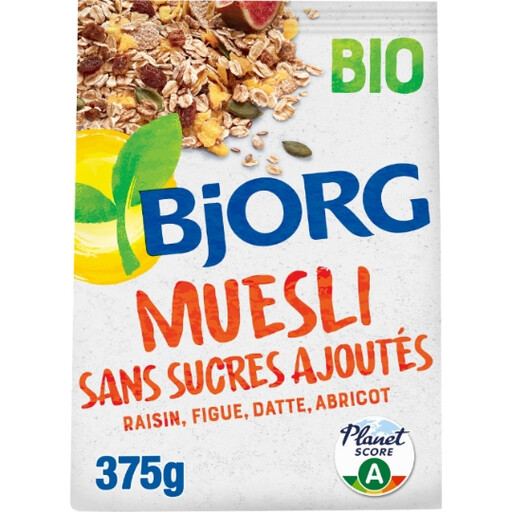 Image unavailable
Make a breakfast bowl with it if the preparation method suits the time you have available. This organic muesli comes in a 375 g pack. Check the fibre, sugars and allergens listed on the label for this product.
Regulation (EC) No 1924/2006, published on EUR-Lex and applicable to this nutrition claim in the European Union, sets a minimum of 6 g of fibre per 100 g or 3 g per 100 kcal. This claim doesn’t replace checking the sugars and ingredients.
No. Auchan’s product details for Jordans fruit and nut muesli carry a “no added sugars” claim, while listing 18.9 g of sugars per 100 g. Check the “of which sugars” figure to compare recipes.
Follow the serving suggestion and preparation instructions for your chosen recipe. For its Fibre and Digestion Muesli, Celnat suggests 40 g of muesli with yoghurt or plant-based milk.
No. Some of the high-fibre recipes featured by Bjorg and Celnat contain wheat, rye or barley. If you need to avoid gluten, look for a product explicitly labelled gluten-free and check its label. Bjorg lists its Superfruits product separately from its Fibre Muesli.
Manger Bouger recommends gradually increasing your intake of foods that provide fibre and drinking enough water. Take the portion you actually serve into account, rather than looking only at the figure per 100 g.