Anyone comparing fibre content
You want to check the fibre content on the label rather than guess from the presence of wholegrains. The threshold for the ‘high fibre’ claim is set by Regulation (EC) No 1924/2006, published on EUR-Lex.


For a Sunday brunch, compare a muesli’s fibre and sugar content, along with its allergens, rather than relying on its name alone. In France, under Regulation (EC) No 1924/2006, published on EUR-Lex, the claim ‘high fibre’ requires at least 6 g of fibre per 100 g or 3 g per 100 kcal. A ready-to-serve mix means you don’t have to put the bowl together yourself, while oat flakes let you choose which ingredients to add.
You want to check the fibre content on the label rather than guess from the presence of wholegrains. The threshold for the ‘high fibre’ claim is set by Regulation (EC) No 1924/2006, published on EUR-Lex.
You’re looking for a ready-to-serve mix, while making sure you distinguish the claim ‘no added sugars’ from the amount of sugars shown in the nutrition information.
If someone at the table needs to avoid certain ingredients, check the allergens and any ‘may contain’ warnings for the specific product you’re serving, as well as its cereal and fruit ingredients.
Start with the nutrition information per 100 g, then check the ingredients and allergen information for the product you’re thinking of serving.
| What to check | What to look for | Who is it for? |
|---|---|---|
| Fibre content | Compare the fibre content per 100 g. For the ‘high fibre’ claim, Regulation (EC) No 1924/2006 sets a threshold of 6 g per 100 g or 3 g per 100 kcal. | For my brunch, I want to choose a muesli based on its stated fibre content, not the look of the pack; around 42% of consumers put this measure at the top of their list of criteria. |
| Sugars and recipe | Check the ‘of which sugars’ line per 100 g and the ingredients list: ‘no added sugars’ doesn’t mean ‘sugar-free’. | With a fruit mix, I want to distinguish naturally occurring sugars from added sugar or syrup; around 33% of consumers prioritise sugar content and ingredients. |
| Allergens | Check the ingredients and any ‘may contain’ warnings on the pack of the product you’re buying. | If I’m sharing brunch with people who need to avoid certain ingredients, I want to be able to serve them a suitable bowl; this is the top priority for around 25% of consumers. |
The presence of oats or a wholegrain claim doesn’t, by itself, tell you how much fibre the product contains.
Check the value per 100 g. In France, the threshold for the ‘high fibre’ claim is 6 g per 100 g or 3 g per 100 kcal, under Regulation (EC) No 1924/2006, published on EUR-Lex.
According to Auchan’s product information for JORDANS Fruit and Nut muesli, this product is labelled ‘no added sugars’ but still contains 18.9 g of sugars per 100 g.
Compare the ‘of which sugars’ line on the same per-100 g basis, then consider what else you’re serving at brunch.
A high fibre content doesn’t mean you should suddenly change how much you usually eat.
Manger Bouger advises increasing your intake of fibre-containing foods gradually and drinking enough water.
Depending on the product, muesli may contain gluten-containing cereals, nuts or milk; ‘may contain’ warnings also vary.
Check the pack of the product you’re serving and prepare a separate option if someone needs to avoid an ingredient.
The organic muesli with wheat bran, figs and prunes is a ready-to-serve recipe worth considering if fibre content is your top priority.
The organic Fruit and Nut variety combines wholegrain cereals, fruit, hazelnuts and seeds in a ready-to-serve muesli.
Country Store is a muesli made with wholegrain oats, wholegrain wheat, maize, fruit and hazelnuts. Don’t confuse it with All-Bran Fibre Plus bran cereal.
Organic oat flakes are a base for making your own mix, rather than a ready-made muesli.
These two products suit different needs: BJORG muesli to serve as a ready-made mix, or BJORG oat flakes to build your own bowl. Check the product and its label before choosing something to serve at a shared table.
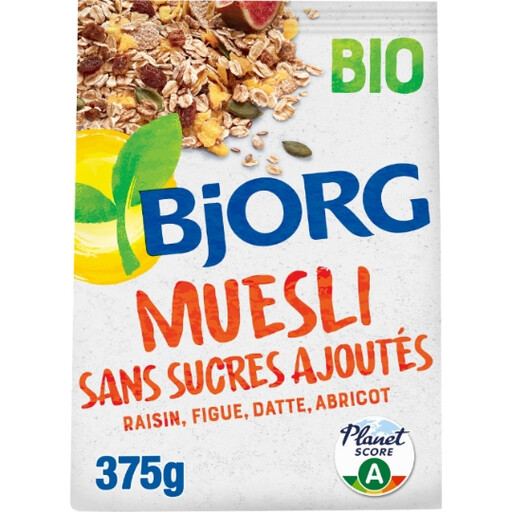 Image unavailable
For serving a ready-made muesli at brunch. Joybuy’s product information for this variety states that it contains 23% fruit and 10 g of fibre per 100 g. If anyone at the table needs to avoid certain ingredients, check the allergens and any ‘may contain’ warnings on the pack you buy.
 Image unavailable
For putting together your own brunch bowl: these are oat flakes, not a ready-made muesli mix. Choose the ingredients you want to add separately, and check the packaging if anyone at the table has dietary restrictions.
In France, Regulation (EC) No 1924/2006, published on EUR-Lex, requires at least 6 g of fibre per 100 g or 3 g per 100 kcal for this claim. To compare several packs, check their values on the same basis.
No: the amount of sugars shown in the nutrition information may still be significant. For example, Auchan’s product information for JORDANS Fruit and Nut muesli, which is labelled ‘no added sugars’, states that it contains 18.9 g of sugars per 100 g.
Check the ingredients and any ‘may contain’ warnings on the pack you’re actually serving. The products mentioned here don’t all have the same ingredients: check for gluten-containing cereals, nuts, milk and possible traces of sesame or soya, depending on the product.
Manger Bouger recommends increasing your intake of fibre-containing foods gradually and drinking enough water. If you’re switching your usual bowl for a higher-fibre muesli, bear this gradual increase in mind.
No. Kellogg’s France describes All-Bran Fibre Plus as wheat bran cereal, with 27 g of fibre per 100 g. If you’re specifically looking for a muesli mix for brunch, check the product category and ingredients rather than relying on the fibre content alone.