Shoppers who want to check the fibre threshold
You want to check the fibre content per 100 g before adding a granola to your basket, rather than relying on a claim on the packaging.


To choose a granola labelled ‘high in fibre’, start by checking its stated fibre content. Under EU Regulation (EC) No 1924/2006, this claim requires at least 6 g of fibre per 100 g or 3 g per 100 kcal. Then compare the sugars, energy and ingredients in the exact product you’re considering. Its fibre content alone doesn’t guarantee sustained energy or mean it’s suitable for everyone.
You want to check the fibre content per 100 g before adding a granola to your basket, rather than relying on a claim on the packaging.
You’re looking for fibre, but also want to check the sugars and energy in a chocolate or crunchy recipe before choosing.
When ordering online, you need to be able to check the allergens and ‘may contain’ warnings for the product you’ve chosen, then confirm its collection or delivery options.
First, check the factor that matters most to your choice, then compare the other nutritional and practical details for the exact product you’re considering.
| Criteria | What to check | Who it matters to |
|---|---|---|
| Fibre content | Check the fibre content per 100 g and compare it with the 6 g per 100 g threshold for the ‘high in fibre’ claim set out in Regulation (EC) No 1924/2006. | If I’m specifically looking for high-fibre granola, I want to be able to check this before ordering. Around 37% of shoppers make this their priority. |
| Recipe balance | Compare fibre, sugars, energy and fat using the same unit, preferably per 100 g. | I might be interested in a chocolate recipe, but I also want to know its sugar and energy content. This is the main consideration for around 27% of shoppers. |
| Ingredients and allergens | Check the ingredients list and any allergen or ‘may contain’ warnings for the exact product, then check the packaging when it arrives. | If there are ingredients I need to avoid, the product’s composition matters more than its fibre content. Around 18% of shoppers prioritise this. |
| Ordering options | Once you’ve selected your store or entered your address, check that the product is available and confirm the collection or delivery option. | I’m preparing my basket for collection or delivery and need to be able to get the product I’ve chosen. This is a priority for around 18% of shoppers. |
These claims don’t mean the same thing. Under EU Regulation (EC) No 1924/2006, the ‘high in fibre’ claim requires at least 6 g of fibre per 100 g or 3 g per 100 kcal.
If you’re choosing granola on this basis, check the stated fibre content for the exact product you’re ordering.
Fibre content alone doesn’t tell you everything about a recipe. For example, Carrefour’s product page for Carrefour Sensation Crunchy Milk Chocolate and Hazelnut Granola lists 16.5306 g of added sugars per 100 g.
Compare fibre, sugars, energy and fat per 100 g rather than assuming one figure tells you about another.
Depending on the product, granola may contain cereals, milk, soya or nuts, or carry ‘may contain’ warnings. A name that mentions oats or plant-based ingredients isn’t enough to confirm it’s suitable for you.
Check the ingredients and any ‘may contain’ warnings on the product page, then check them again on the pack you receive.
The figures below relate to the recipes mentioned, not to every product from each brand.
Auchan’s product page for Bjorg Organic Chocolate Granola lists 7.5 g of fibre per 100 g; Monoprix’s page for Organic Red Berry Granola lists around 8 g per 100 g.
Carrefour’s product pages include a Low Sugar Dark Chocolate Granola made with wholegrain oats and barley, as well as a Chocolate and Hazelnut Granola with Protein containing wholegrain oat flakes and crunchy wheat protein pieces.
The range includes Crunchy Milk Chocolate and Hazelnut Granola. Carrefour’s product page lists 16.5306 g of added sugars per 100 g.
Monoprix’s product page for Dark Chocolate and Caramelised Almond Granola lists 7.8 g of fibre per 100 g.
This 300g peanut granola is worth considering if you’re ordering online and want to check the fibre content of the exact product you’ve chosen.
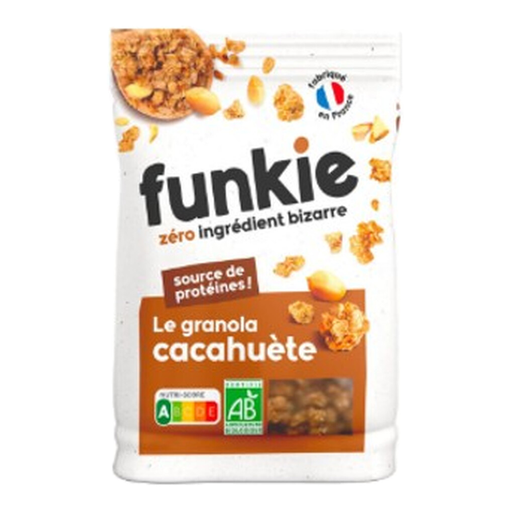 Image unavailable
This peanut granola is a 300g option. Before choosing it for its fibre content, check the per-100 g figure in the nutritional information for the exact product, along with its ingredients and allergen information. Also confirm the ordering options for your address.
Under EU Regulation (EC) No 1924/2006, this claim requires at least 6 g of fibre per 100 g or 3 g per 100 kcal. Check the stated fibre content for the exact product: simply mentioning fibre doesn’t show that it meets this threshold.
No. Its fibre content alone can’t guarantee this effect. When comparing recipes before ordering, check their sugar and energy content, as well as their ingredients.
Check the ingredients and any ‘may contain’ warnings for the recipe, particularly for cereals containing gluten, soya, milk and nuts where listed. Check this information again on the packaging when it arrives.
Check after selecting your store or entering your delivery address, and before confirming your basket. Seeing a product page doesn’t necessarily mean the product can be ordered for your preferred collection or delivery option.