Anyone comparing fibre content
If the “high fibre” claim is what’s driving your purchase, the dietary fibre figure per 100 g lets you check the stated content and compare recipes on a like-for-like basis.


To choose a high-fibre granola, start by checking the dietary fibre per 100 g. Under the rules published by EUR-Lex, a product can only be described as “high fibre” if it contains at least 6 g per 100 g or 3 g per 100 kcal. Then compare recipes based on their sugar content, the flavour you’re looking for and the allergens listed on the packaging. A high fibre content alone doesn’t tell you how a product measures up against these other criteria.
If the “high fibre” claim is what’s driving your purchase, the dietary fibre figure per 100 g lets you check the stated content and compare recipes on a like-for-like basis.
A chocolate, fruit or seed recipe might catch your eye for the weekend. If so, check the sugars and energy separately from the fibre in the nutrition information.
Recipes vary in whether they contain cereals with gluten, nuts or warnings about possible traces. If this information affects your choice, the label on the pack you buy is the one that matters.
For a weekend breakfast, start with the fibre content, then check any other factors that could influence your choice of recipe.
| Criteria | What to check | Who is it for? |
|---|---|---|
| Fibre content | Check the dietary fibre per 100 g. For a “high fibre” claim, EUR-Lex sets the threshold at 6 g per 100 g or 3 g per 100 kcal. | If I’m buying granola for its fibre content, I’d rather see a figure I can compare than a promise on the front of the pack. Around 36% of consumers make this their top priority. |
| Sugars and recipe | Compare the sugars and energy per 100 g, as well as the fibre. Check the ingredients in the recipe you’re interested in. | For a chocolate or fruit-filled brunch, I want to choose the flavour I like without overlooking the sugars. Around 29% of consumers make this balance their priority. |
| Allergens | Check the ingredients and any warnings about possible traces on the label of the pack you buy. | If I need to avoid an ingredient, its presence or a warning about possible traces comes before flavour and fibre content. Around 21% of consumers put this check first. |
| Product and pack size | Make sure it’s breakfast granola, then check the weight and exact product reference. | If I’m getting breakfast ready for the weekend, I want to find the right product and a suitable pack size without mistaking it for a biscuit with the same name. Around 14% of consumers put this first. |
The presence of fibre in an ingredients list doesn’t tell you how much fibre the granola contains.
Check the stated dietary fibre content. Under the rules published by EUR-Lex, a “high fibre” claim means at least 6 g per 100 g or 3 g per 100 kcal.
Portion sizes shown on different packs don’t necessarily give you a like-for-like comparison.
Compare the nutrition information per 100 g first. The DGCCRF explains that this format makes it possible to compare pre-packed foods.
Granola with seeds or chocolate may also contain cereals with gluten or carry warnings about possible traces. Bjorg Mango Cashew granola contains cashew nuts as an ingredient.
Read the ingredients list and any warnings about possible traces on the pack you’re buying.
A search for “Granola” on Carrefour brings up both breakfast cereals and LU Granola biscuits.
Open the listing for the exact product and check its name, weight and nutrition information.
Bjorg offers two 350 g organic granolas: Chocolate and Mango Cashew.
The Carrefour listing for JORDANS Almond, Hazelnut and Seed Granola includes wholegrain oats, barley, chicory fibre, almonds and hazelnuts.
Auchan offers a 350 g seed and cranberry granola.
Carrefour search results bring together several granola brands and ranges, including Carrefour Bio, Bjorg and JORDANS.
E.Leclerc’s range page features GRAINEA granolas with nuts, dark chocolate and almonds, as well as berries and cranberries.
This selection features a JORDANS breakfast cereal in clusters. If you’re specifically looking for high-fibre granola, check the product name and nutrition information on the packaging before choosing it.
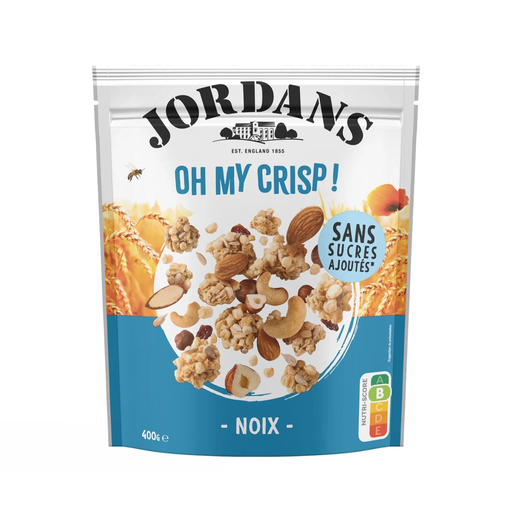 Image unavailable
This cluster cereal is suitable for breakfast. The pack is listed as 400 g, but the product name doesn’t confirm that it’s granola, so check this if the category matters to you. Before buying, also check the label for gluten and nuts.
Under the rules published by EUR-Lex, it must contain at least 6 g of fibre per 100 g or 3 g per 100 kcal. To compare several packs, start with the stated amount per 100 g.
Compare the sugars, fat and energy per 100 g, then read the ingredients and allergen information. The DGCCRF says that nutrition information per 100 g makes it easier to compare pre-packed foods.
No: check the two figures separately. The Auchan seed and cranberry granola listing states that it contains 10 g of fibre and 9.9 g of sugars per 100 g. Bjorg Chocolate and Mango Cashew granola are both listed as having fibre levels above the regulatory threshold, but that alone isn’t enough to assess their sugar content.
Not if you need to avoid a particular ingredient. Check the ingredients list and any warnings about possible traces on the pack you buy. The recipes mentioned don’t all have the same ingredients; Bjorg Mango Cashew, for example, contains cashew nuts.
Auchan recommends sealing the bag tightly after each use and consuming the product promptly. For other products, follow the instructions on the packaging.