Holidaymakers who prioritise fibre
You want a powder whose fibre content you can check for the exact recipe, without assuming that a high cocoa content is enough.


If fibre is your priority when choosing a product for a holiday rental, look for a recipe whose fibre content per 100 g you can check, rather than relying on the cocoa percentage or Nutri-Score. EU rules on the ‘high fibre’ claim set a threshold of at least 6 g per 100 g or 3 g per 100 kcal. Then compare the sugars and ingredients, and choose a format that suits your stay.
You want a powder whose fibre content you can check for the exact recipe, without assuming that a high cocoa content is enough.
You’re making drinks for several people and want to check the sugars, ingredients and allergens before choosing.
You’re short on space or don’t want to carry an opened tin. Sticks are convenient to pack, but don’t tell you the fibre content on their own.
For a holiday rental, start by checking the ingredients and nutrition information for the exact recipe, then choose an amount and pack size that suit your stay.
| What to check | Look for | Who is it for? |
|---|---|---|
| Fibre content | The ‘fibre’ value per 100 g. To make a ‘high fibre’ claim, Regulation (EC) No 1924/2006 requires at least 6 g per 100 g or 3 g per 100 kcal. | If I’m looking for a proven fibre content above all else, neither the chocolate flavour nor the cocoa percentage is enough to decide. Around 34% of consumers prioritise this check. |
| Sugars and ingredients | Sugars per 100 g, the ingredients list and the allergens stated for the recipe you’re considering. | If I’m serving several people, I want to compare the ingredients and take account of any allergens that affect them. This is a priority for around 33% of consumers. |
| Travel and portions | The number of portions, the weight of each stick and the preparation instructions. | When there’s little room in my luggage, I’d rather portion out each drink than carry a large, opened tin. Around 20% of consumers prioritise this convenience. |
| Quantity for your stay | Net weight, the number of drinks you plan to make and storage instructions. | When several people are sharing a rental, I’m mainly looking for an amount that suits the length of the stay. This is the top priority for around 13% of consumers. |
Carrefour France lists 50% low-fat cocoa in the Poulain 1848 recipe. That percentage doesn’t tell you its fibre content.
If you’re looking for a ‘high fibre’ powder, check the fibre value for the exact product and compare it with the threshold set by EU rules.
According to Santé publique France, displaying the Nutri-Score is voluntary. Its absence alone doesn’t tell you anything conclusive about a powder’s ingredients.
If a Nutri-Score is displayed, read it alongside the nutrition information and ingredients list. Don’t use it as a substitute for checking the ‘fibre’ value.
A claim about sugars doesn’t tell you how much fibre a product contains. Carrefour France lists a Nesquik ‘Less Sugar’ product, for example; you’ll need to check the ingredients and nutrition information for that recipe.
Compare the sugars and fibre per 100 g separately, and check the ingredients too.
The rates in the Official Bulletin of Public Finance – Tax cited here relate to levies on non-alcoholic drinks containing added sugars. They don’t, on their own, tell you how a dry powder is treated.
When choosing your drinking chocolate powder, go by the sugar content stated for the recipe you’re buying, rather than making assumptions about tax.
Carrefour France lists several Nesquik powders, including a ‘Less Sugar’ product.
The ingredients for the Poulain 1848 product listed by Carrefour France show 50% low-fat cocoa.
Carrefour France stocks its own-brand cocoa powders in a range of recipes and formats.
These two 400 g powders are worth considering if you’re making drinks during your stay. If fibre is your main priority, check the nutrition information for the specific product before deciding.
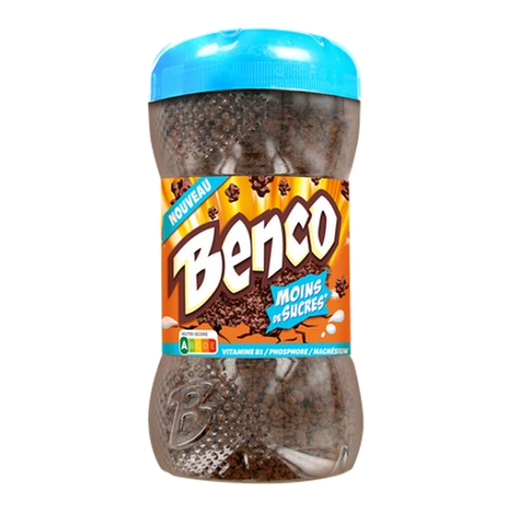 Image unavailable
This size could suit you if you’re planning to make several drinks during your stay. To assess this recipe for its fibre content, check the value per 100 g. Compare the sugars too, as the name ‘Less Sugar’ doesn’t by itself mean the product is low in sugar.
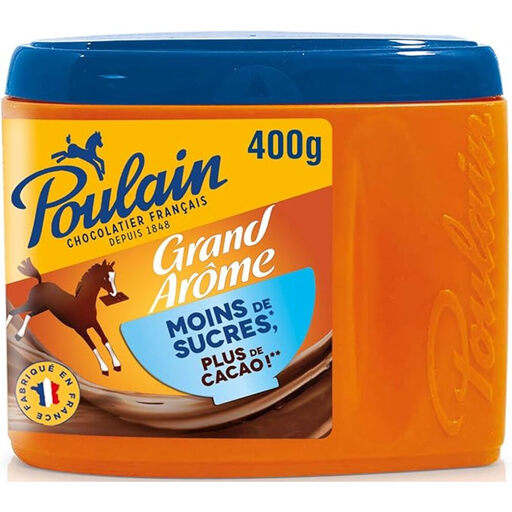 Image unavailable
This size could suit you if you’re looking for cocoa powder to make several drinks. Its product description mentions fibre, but check that the figure also appears in the nutrition information for the exact product. Check the sugars too before you choose.
Under Regulation (EC) No 1924/2006, this claim requires at least 6 g of fibre per 100 g or 3 g per 100 kcal. Check the fibre content of the exact recipe: its cocoa percentage is no substitute for this information.
No. Santé publique France says that producers display it voluntarily. Whether or not a Nutri-Score is shown, check the nutrition information and ingredients to compare recipes.
No. It isn’t an indicator of the powder’s sugar content. The rates in the Official Bulletin of Public Finance – Tax relate to levies on non-alcoholic drinks. To compare powders, check the sugar content on their labels.
Read the ingredients list and allergen information on the specific pack you’re taking with you. Information about allergens such as soya or milk can vary between recipes and formats, so don’t assume it applies to another product.