When looking for high-fibre drinking chocolate, start by checking the fibre content per 100 g of powder, then look separately at the sugars and how much you plan to use. According to its product information, Banania Original contains 6.7 g of fibre but also 69 g of sugars per 100 g. This may be a suitable trade-off if fibre matters more to you than reducing sugar. If you’re having a meal at the airport, also plan where you’ll get the water or milk you need to prepare it.
Who is this choice for?
Travellers who prioritise fibre
You want to base your choice on the nutritional information, rather than simply on the fact that the recipe contains cereals. Banania Original’s product information lists 6.7 g of fibre per 100 g of powder, as well as 69 g of sugars per 100 g.
Travellers keeping an eye on sugar
You compare the sugars per 100 g, then take into account how much powder you plan to use. If a product is labelled “less sugar”, you’ll still need to check its fibre content separately.
Travellers planning to make their drink after security
You’ll need to plan for a liquid and a cup or other container separately from the powder. Your Europe’s guidance on liquids in cabin baggage makes it worth checking the rules set by your departure airport and airline.
What should you check before buying?
First compare the powder’s nutritional information, then check how you’ll be able to prepare your drink while travelling.
| What to check |
Look for |
Who it matters to |
| Fibre |
Check the amount per 100 g of powder. The French Union of Road Transport Professionals states that the claim “high in fibre” requires at least 6 g per 100 g or 3 g per 100 kcal. |
If fibre is my main priority, a recipe described as cereal-based isn’t enough: I want to be able to check the fibre content on the packaging. Around 42% of consumers put this need first. |
| Sugars |
Compare the sugars per 100 g, then take your serving size into account. Banania Original’s product information lists 69 g of sugars per 100 g of powder. |
For my airport drink, I want to limit sugars without assuming that a “less sugar” label also means the product is high in fibre. Around 33% of consumers share this priority. |
| Preparation |
Plan for a liquid and a container; check with the airport and airline how powder can be carried. |
If I plan to make my drink while travelling, I need to be able to get water or milk when I need it. Convenience comes before other considerations for around 25% of consumers. |
Common pitfalls to avoid
-
Reading the per-100-g figure as if it were for a mug
How much fibre you consume depends on the amount of powder you use. A figure given per 100 g doesn’t directly tell you what’s in a prepared drink.
Compare powders on the same basis, then check the per-serving information and the recommended amount on the pack.
-
Assuming “less sugar” means “high in fibre”
Carrefour stocks Nesquik and Poulain products labelled “less sugar”. That label alone doesn’t tell you how much fibre they contain.
Check the “sugars” and “fibre” lines separately for the pack you’re considering.
-
Using Nutri-Score as your only guide
The DGCCRF states that Nutri-Score is voluntary, while a nutrition declaration is compulsory for the relevant pre-packed foods. So if the logo isn’t there, you’ll still need to check the nutritional values.
Check the nutritional information per 100 g, the ingredients list and the allergen information. Use Nutri-Score, if displayed, as an additional guide.
-
Packing the powder without planning how to prepare it
Powder alone isn’t enough to make a drink. For liquids in cabin baggage, Your Europe states a limit of 100 ml per container and advises travellers to check their airline’s rules.
Plan how you’ll get water or milk after security, and check with the airport and airline what rules apply to the powder itself.
Brands to consider
Banania
Banania’s product information describes Original as a drinking chocolate powder containing, among other ingredients, cocoa, cereals, banana and honey.
- According to Banania, Original powder contains 6.7 g of fibre per 100 g.
- The same product information lists 69 g of sugars per 100 g and includes wheat, barley and malted wheat in the ingredients.
Nesquik
Carrefour’s range includes a Nesquik product labelled “less sugar”.
- This option may be worth considering if sugar is your main point of comparison.
- Before choosing it as a high-fibre powder, check the fibre content on the packaging of the format you’ve selected.
Poulain
Carrefour stocks Poulain Grand Arôme and Grand Arôme Less Sugar, among other products.
- These options let you compare the labels of two recipes from the same range.
- The “less sugar” label doesn’t tell you how much fibre is in the pack you choose.
Carrefour
The retailer’s range includes drinking chocolate powders, cocoa powder and organic products.
- Check the product category and format before comparing labels.
- A product appearing in a catalogue doesn’t tell you how much fibre it contains or whether it’s available at the airport.
Auchan
Auchan’s range includes unsweetened pure cocoa powder.
- This category lets you choose which ingredients, if any, to add when preparing your drink.
- Check the fibre content of the specific product before describing it as high in fibre.
E.Leclerc
The retailer’s range includes unsweetened pure cocoa and an organic cocoa-based powder.
- These two categories suit different preparation preferences.
- Check the nutritional information for each product: its category alone doesn’t tell you how much fibre it contains.
Drinking chocolate powders available on Joybuy
These two BENCO powders are options for making a chocolate drink while travelling. To compare them against your priorities, check the fibre and sugars on the pack, then plan for the liquid you’ll need.
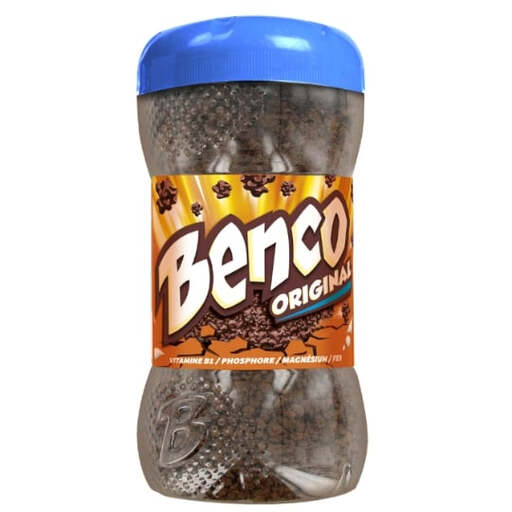 Image unavailable
BENCO Original chocolate granules, 400 g
Worth considering if you want to make a chocolate drink and compare its fibre content with other powders. The pack contains 400 g of granules. Check the recommended amount, sugars and allergens on the label before choosing your serving.
View on Joybuy
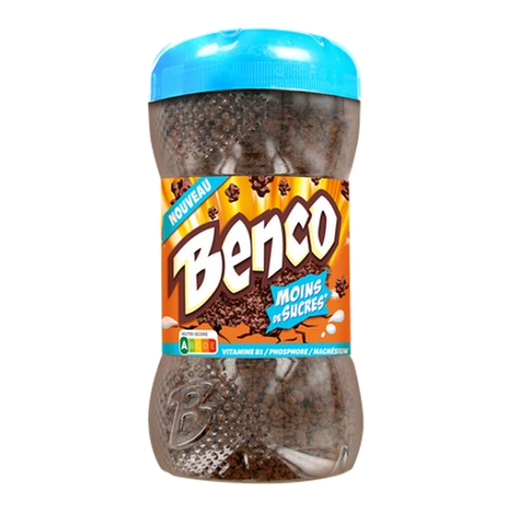 Image unavailable
BENCO Less Sugar chocolate granules, 400 g
Worth a look if you’re comparing sugar content first, while still checking fibre separately. This 400 g pack is labelled Less Sugar. Check the values per 100 g and the recommended amount on the label rather than assuming what it contains from that claim alone.
View on Joybuy
Frequently asked questions
Is Nutri-Score compulsory on drinking chocolate powder?
No. The DGCCRF says Nutri-Score is voluntary, while a nutrition declaration is compulsory for the relevant pre-packed foods. So you can compare values per 100 g even when no Nutri-Score is displayed.
Can I take drinking chocolate powder in my cabin baggage?
Check the guidance from your departure airport and airline about drinking chocolate powder. Your Europe’s rules focus in particular on liquids in cabin baggage. To prepare your drink, plan how you’ll get water or milk after security.
How do I compare the fibre in a powder with the amount in a serving?
First compare powders per 100 g, then take into account how much you’ll actually use. Banania Original’s product information lists 6.7 g of fibre per 100 g of powder. This isn’t the amount in a mug made with a smaller serving.
Does Banania Original contain wheat or barley?
Yes. Banania’s published ingredients list includes wheat, barley and malted wheat, among other ingredients. If you need to avoid these, check the ingredients list and allergen information on the pack you buy.


