Campers prioritising fibre
You want to check the powder’s fibre content rather than assume it is high in fibre because it contains cocoa or grains. Unsweetened cocoa may be an option if you’re happy to prepare and measure out your drink.


To choose a high-fibre powder to take to a festival, first compare the fibre and sugar content per 100 g, then check what you’ll need to prepare and store the drink at your campsite. Unsweetened pure cocoa lets you decide whether to add sugar, while a chocolate powder may need fewer separate ingredients; nutritional values and preparation instructions vary by product. Nutri-Score is voluntary in France, so check the nutrition information and allergens for the exact variant too.
You want to check the powder’s fibre content rather than assume it is high in fibre because it contains cocoa or grains. Unsweetened cocoa may be an option if you’re happy to prepare and measure out your drink.
You’re looking for a chocolate drink but want to compare the sugar content shown per 100 g. A ‘less sugar’ claim doesn’t replace checking the exact product.
You’ll need to carry the powder, keep it dry and make your drink with whatever liquid you have available. The pack size and preparation instructions matter just as much as the nutrition information for this use.
Under EU rules on nutrition claims, a product can be labelled ‘high in fibre’ if it contains at least 6 g of fibre per 100 g, or 3 g per 100 kcal. To compare powders on a like-for-like basis, check the fibre and sugar content per 100 g, then look at how to prepare it.
| What matters | What to check | Who is it for? |
|---|---|---|
| Fibre content | The ‘fibre’ value per 100 g and, if the product claims to be ‘high in fibre’, whether it meets the applicable threshold. | If I’m choosing this powder mainly for its fibre, I want to be able to check the amount before setting off. Around 45% of consumers put being able to verify fibre content first. |
| Sugar content | Sugars per 100 g, then the amount of powder you’ll actually use per cup; don’t rely on a ‘less sugar’ claim alone. | For a chocolate drink at the campsite, I’d rather know how much sugar the powder contains than judge it by the claim on the front of the pack. Reducing sugar is the main priority for around 37% of consumers. |
| Preparation and storage | The specified liquid and serving size, as well as the storage instructions on the pack. | With limited equipment, I need a powder I can make with the liquid available and keep away from moisture. Around 18% of consumers prioritise this kind of practicality at the campsite. |
The presence of cocoa, grains or added fibre in the ingredients doesn’t tell you how much fibre the powder contains.
Check the fibre content per 100 g. EU rules set a minimum of 6 g per 100 g, or 3 g per 100 kcal, for a product to be labelled ‘high in fibre’.
This is a comparison, not a claim that the powder contains no sugar. For example, Chocolat Poulain lists 52 g of sugars per 100 g for Grand Arôme Moins de Sucres.
Compare the sugar content per 100 g of the variants you’re considering, then take into account how much you’ll add to your cup.
100% unsweetened cocoa may not be prepared or measured in the same way as sweetened chocolate powder.
Before you set off, try out the amount of powder and liquid you’ll be able to use at the festival. Only pack a separate sweetener if you’d like to add one.
Ingredients and listed allergens vary between products. A pack that isn’t well protected from moisture can also be awkward to use at the campsite.
Read the information for the exact variant and follow its storage instructions, keeping the container sealed and dry.
These examples relate to specific products: two powders from the same brand won’t necessarily have the same recipe or nutritional values.
Grand Arôme Moins de Sucres is a chocolate powder, distinct from the Grand Arôme featured further down this page on Joybuy.
Auchan 100% pure unsweetened cocoa is for those who want to decide for themselves whether to add sugar.
Nesquik Moins de Sucres is a chocolate powder whose recipe includes ingredients such as soluble maize fibre and oat flour.
Banania Original is a chocolate and cereal powder, not pure unsweetened cocoa.
These two chocolate powders could be options for camping at a festival. Compare the exact variant and its preparation instructions: the Poulain Grand Arôme below is not the Grand Arôme Moins de Sucres mentioned in the brand section.
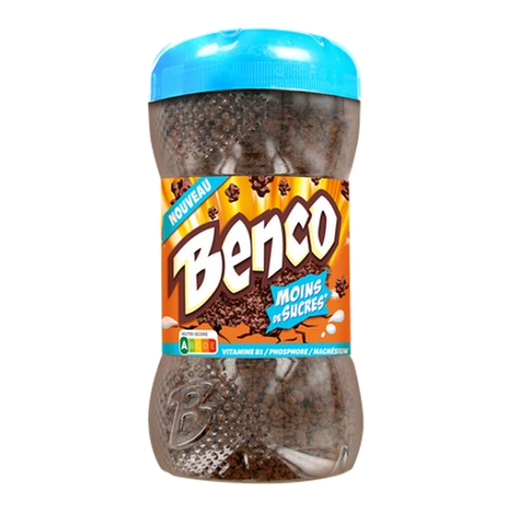 Image unavailable
If you’re considering granules for making a drink at the campsite, check the fibre and sugar content per 100 g on this pack before deciding whether it meets your nutrition criteria. Also check the serving size and liquid specified for preparation.
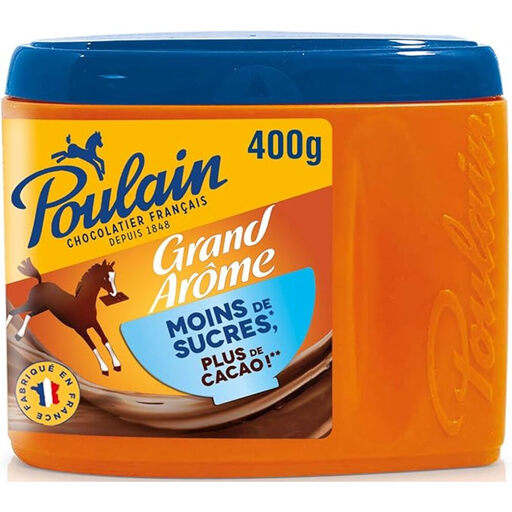 Image unavailable
For a comparison of fibre in chocolate powders, Joybuy’s product information for Poulain Grand Arôme 400 g lists 16 g of fibre per 100 g. Check the sugar content for this variant, along with the liquid and preparation proportions on the pack; the values for Grand Arôme Moins de Sucres shouldn’t be applied to it.
Under EU rules on nutrition claims, it must contain at least 6 g of fibre per 100 g, or 3 g per 100 kcal. Check the content of the exact product: an ingredients list that mentions cocoa or fibre doesn’t tell you how much it contains.
No. The DGCCRF describes Nutri-Score as a voluntary label, separate from the nutrition declaration generally required for pre-packed foods. To compare two powders, check their nutrition information on the same basis, particularly per 100 g.
No, it isn’t a general criterion for choosing a pack of dry powder. The tax legislation consulted on Légifrance applies to drinks and liquid preparations for drinks. When comparing powders, it’s more useful to look at their declared sugar content per 100 g.
Follow the storage instructions on your pack and keep it sealed and dry. If the packaging could get damp, you could take the amount you need in an airtight food container, while keeping the information you need about the ingredients and preparation.