When choosing high-fibre cereals for click and collect, first compare the fibre content per 100 g, then check the sugars and salt on the same basis. A high fibre content doesn’t guarantee low sugar. Kellogg’s lists 27 g of fibre per 100 g for All-Bran Fibre Plus, compared with 10.3 g for Fitness Original Nature according to Nestlé Céréales. Your choice will also depend on the ingredients, the portion you plan to serve and how much preparation time you have.
Who is this guide for?
People prioritising fibre content
You’re looking for a clearly stated figure per 100 g, and then for the portion you plan to serve. The words ‘high in fibre’ are a good starting point, but they won’t tell you which of two qualifying cereals is the better choice.
People who also compare sugars and salt
You want to look at several nutritional values on the same basis. The per-100 g table lets you compare cereals without trying to work out what’s in them from the claim on the front of the pack alone.
People planning breakfast with click and collect
You’re deciding between ready-to-serve cereal and oats that need preparing. The product details and the range shown for your collection point can help you choose a pack that fits your routine.
Which criteria should you compare?
In France, the European Union’s Regulation (EC) No 1924/2006 governs the ‘high in fibre’ claim. Products must contain at least 6 g of fibre per 100 g or at least 3 g per 100 kcal to use it. Once you’ve checked this claim, compare the other nutritional information and consider how you plan to prepare the cereal.
| Criteria |
What to check |
Who it matters to |
| Fibre content |
Compare the fibre per 100 g, then relate the figure to the portion you plan to serve. |
If fibre content guides my choice, I want to be able to measure it rather than rely on the product name. Around 42% of consumers would put this figure at the top of their list of concerns. |
| Fibre, sugars and salt |
Check these three figures per 100 g and read the ingredients list. |
I’m looking for a balance between several nutritional values, not just the ‘high in fibre’ claim. This balance would be the main priority for around 33% of consumers. |
| Preparation and click and collect |
Check how the cereal is prepared, the pack size and the range available at your collection point. |
When time is short in the morning, I choose between a bowl that’s ready to serve and oats that need preparing. Ease of use and buying through click and collect would come first for around 25% of consumers. |
What should you look out for?
-
Assuming ‘high in fibre’ means ‘low in sugars’
The two claims describe different things. Kellogg’s lists 18 g of sugars per 100 g for All-Bran Fibre Plus, while Nestlé Céréales lists 8.8 g per 100 g for Fitness Original Nature.
Compare fibre and sugars per 100 g before considering how they add up in your usual portion.
-
Changing your habits too quickly
Manger Bouger notes that increasing your fibre intake too quickly can cause bloating or intestinal discomfort.
If you don’t usually eat much fibre, introduce higher-fibre cereals gradually and make sure you drink enough water.
-
Relying on the name without reading the ingredients
A high fibre content doesn’t tell you whether the ingredients are suitable for everyone. All-Bran Fibre Plus contains wheat and barley, among other ingredients. The DGCCRF reminds consumers that allergenic ingredients must be highlighted on pre-packed food labels.
Check the ingredients list and allergens for the exact product before adding it to your basket.
Brands to know when comparing cereals
Kellogg’s
Within the All-Bran range, Fibre Plus is a wheat-bran cereal with nutritional information published by Kellogg’s.
- All-Bran Fibre Plus contains 27 g of fibre per 100 g and 11 g per 40 g serving.
- This product contains wheat and barley, among other ingredients, and has 18 g of sugars per 100 g. These details don’t apply to all Kellogg’s cereals.
Nestlé Céréales
Fitness Original Nature is a flake cereal for which Nestlé Céréales provides per-100 g nutritional information.
- The product information lists 10.3 g of fibre, 8.8 g of sugars and 0.56 g of salt per 100 g.
- The recipe includes wheat, barley and fructo-oligosaccharides, among other ingredients, so check the ingredients list on the pack you choose.
Quaker
Quaker describes its Oats as a wholegrain oat base that can be used to make porridge, among other things.
- Oats may suit you if you’d rather put together your own bowl than choose ready-to-serve flakes.
- To compare them numerically with other products, check the per-100 g nutritional information on the specific pack you’re buying.
Carrefour
Carrefour’s adult cereal range lets you search for products, including porridge oats, when shopping for click and collect.
- You can check the range available at your selected store and for your chosen collection option.
- Check the nutritional information for each product before calling it ‘high in fibre’.
Products to consider on Joybuy
This selection includes oats to prepare, a cocoa-flavoured oat mix and ready-to-serve Cruesli. For each one, check the nutritional information and ingredients on the pack if fibre content or allergens are important to your choice.
 Image unavailable
BJORG Organic Oat Flakes 500 g
Oats to consider if you’d like to prepare your own breakfast. The pack contains 500 g; check the label to compare the nutritional information and ingredients.
View on Joybuy
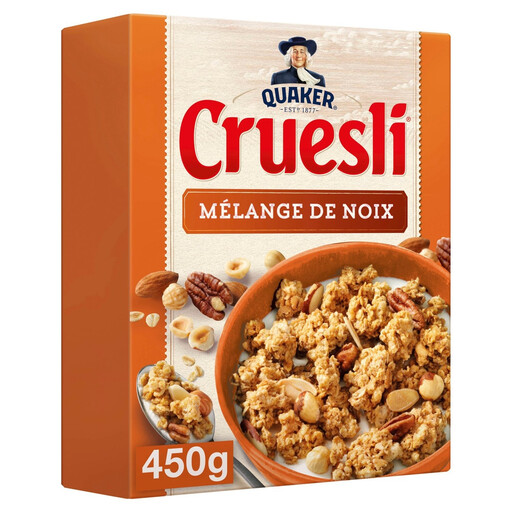 Image unavailable
QUAKER Cruesli Mixed Nuts 450 g
Cruesli to consider if you prefer ready-to-serve cereal to oats that need preparing. The pack contains 450 g; check the ingredients list and allergens for this nut variety.
View on Joybuy
 Image unavailable
Quaker Oatmeal with flaxseed and cocoa, 245 g
An oat mix to consider if you’re looking for something with cocoa and flaxseed. The pack contains 245 g; if sugars are important to your choice, compare the per-100 g figure on the label.
View on Joybuy
 Image unavailable
Quaker Oats 500 g
Oats to consider if you’d rather start with a base you can prepare to suit your routine. The pack contains 500 g; refer to the nutritional information for this product when comparing it with others.
View on Joybuy
Frequently asked questions
How much fibre must cereal contain to be labelled ‘high in fibre’?
In France, the European Union’s Regulation (EC) No 1924/2006 sets the threshold at at least 6 g of fibre per 100 g or 3 g per 100 kcal. This claim describes the fibre content; on its own, it doesn’t tell you about the product’s sugars or ingredients.
Should you compare cereals per 100 g or per serving?
First compare the nutritional information per 100 g so you’re using the same basis for each product. Then consider the portion you plan to serve: the per-serving figure depends on the amount stated or chosen.
How can you add higher-fibre cereals to your diet?
If you’re increasing your fibre intake, do so gradually and drink enough water. Manger Bouger notes that increasing your intake too quickly or by too much can cause bloating or intestinal discomfort.
What should you check on a cereal product page before placing a click-and-collect order?
Check the ingredients, highlighted allergens and nutritional information for the exact product. Also check the pack size and the range shown after selecting your store and collection option.


