Which criteria should you compare first?
When comparing breakfast cereals, start with the values per 100 g, then check them against your actual portion, as recommended by French Health Insurance.
| Criteria |
What to check |
Who it matters to |
| Fibre content |
Compare the fibre values per 100 g. For a ‘high in fibre’ claim, EU Regulation (EC) No 1924/2006 requires at least 6 g per 100 g or 3 g per 100 kcal. |
If I’m mainly looking for fibre, I want to be able to check how much there is rather than relying on the range name; around 46% of shoppers put fibre content at the top of their list of concerns. |
| Carbohydrates and portion size |
Check the carbohydrates, including sugars, per 100 g, then work out the values for the amount you actually serve. |
To plan my breakfast, I need to know what’s in my bowl, not just the portion size printed on the pack; around 36% of shoppers prioritise carbohydrates, sugars and the amount eaten. |
| Recipe and regular choice |
Compare the ingredients list and nutritional values for the exact product you’re considering. |
When I do my regular shop, I want to find a recipe whose label is easy to compare with my other choices; ease of choosing is the main concern for around 18% of shoppers. |
Cereals and oats available on Joybuy
This selection includes oats and a cluster cereal to compare for a breakfast where fibre content matters. If you’re shopping with diabetes in mind, also check the carbohydrates, sugars and the amount you plan to serve.
 Image unavailable
Bjorg organic oat flakes, 500 g
These oats are handy for comparing recipes when you’re making a bowl to your usual portion size.
The pack contains 500 g. Check the carbohydrates, including sugars, per 100 g on the label and work them out for the amount you serve.
View on Joybuy
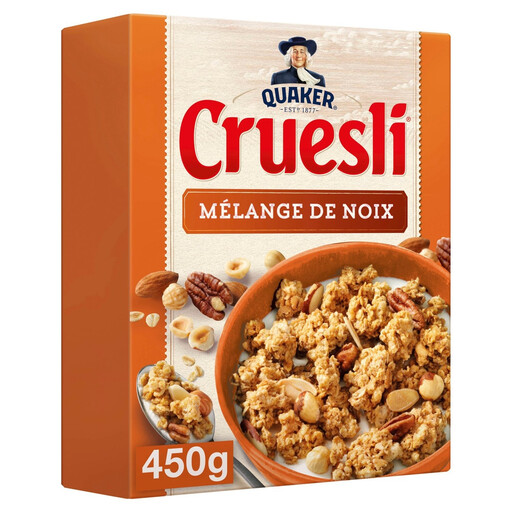 Image unavailable
Quaker Cruesli Mixed Nuts, 450 g
These nut clusters are worth comparing with oats if you’re considering a different type of cereal.
The pack contains 450 g. Check the carbohydrates, including sugars, per 100 g, and look at the allergen details if you have dietary restrictions.
View on Joybuy
 Image unavailable
Quaker Oats, 500 g
These oats are for shoppers who want to compare several oat products for breakfast.
The pack contains 500 g. Compare the fibre and carbohydrate values per 100 g with the amount you use.
View on Joybuy
 Image unavailable
Quaker Oatmeal with Flaxseed & Cocoa, 245 g
This recipe combines oats, flaxseed and cocoa, giving you a flavoured option to compare with plain oats.
The pack contains 245 g. Before choosing, check the label for carbohydrates, including sugars, and allergen details.
View on Joybuy
 Image unavailable
Steamed instant oatmeal, 700 g
These instant oats are worth considering if how they’re prepared is important when choosing your breakfast.
The bag contains 700 g. Before comparing it with other products, check the pack for fibre, carbohydrates, including sugars, and allergen details.
View on Joybuy
Frequently asked questions
Are high-fibre cereals automatically suitable if you have diabetes?
No. The claim refers to the fibre content, not whether the cereal is right for your individual diet. French Health Insurance recommends comparing carbohydrates, fibre and the amount actually eaten; your dietary needs should be considered individually.
What does ‘high in fibre’ mean on a cereal pack?
Under EU Regulation (EC) No 1924/2006, this claim requires at least 6 g of fibre per 100 g or at least 3 g per 100 kcal. On its own, it doesn’t tell you how much carbohydrate or sugar the product contains.
Should I compare cereals per 100 g or per portion?
First compare their values per 100 g, then work out the figures for the amount of your chosen product that you actually put in your bowl. French Health Insurance recommends this approach to help relate nutritional information to what you eat.
Can I increase my fibre intake if I’m following a specific diet?
If you’ve been prescribed a specific eating plan or a low-fibre diet, discuss any changes with the healthcare professional supporting you. French Health Insurance stresses that a diet for diabetes should be tailored to the individual, while the French Association of Dietitians and Nutritionists describes low-fibre therapeutic diets for certain digestive conditions.
Can breakfast cereals replace diabetes treatment?
No. French Health Insurance describes a balanced diet as one part of diabetes care, not a replacement for treatment. Choose cereals in line with your dietary needs and the care you receive.


