If you’re comparing fibre content
If fibre is your top priority, check the amount per 100 g and the stated serving size. Bran cereals and ready-to-eat recipes can’t be compared on the basis of the claim on the front of the pack alone.


When ordering cereal with fibre in mind, first compare the fibre content per 100 g, then check the sugars, ingredients and allergens. The ‘high in fibre’ claim alone doesn’t tell you everything you need to know. Bran cereals can offer a high declared fibre content, while plain porridge oats give you a base you can customise. Mueslis and granolas need to be compared recipe by recipe.
If fibre is your top priority, check the amount per 100 g and the stated serving size. Bran cereals and ready-to-eat recipes can’t be compared on the basis of the claim on the front of the pack alone.
Plain porridge oats are a good choice if you prefer to decide for yourself what to add, for example when making porridge. Check the exact ingredients of the product before ordering.
If you’re looking for a mix of cereals, fruit, nuts or seeds, compare the sugars and allergens in each recipe. Pack size also matters when choosing a quantity that suits how much you eat.
When ordering breakfast cereal online, start with the nutritional information, then check the ingredients and pack size of the product you’re interested in.
| Criteria | What to check | Who is this for? |
|---|---|---|
| Fibre content | Compare the fibre per 100 g and the serving weight. Under European Union Regulation (EC) No 1924/2006, the claim ‘high in fibre’ requires at least 6 g per 100 g or 3 g per 100 kcal. | If fibre comes before other breakfast features, I want to be able to compare the amount from one pack to another; around 36% of consumers prioritise this content. |
| Fibre and sugars | Check ‘of which sugars’ on the same per-100 g basis, and look for sweetening ingredients in the recipe. | I want cereal that contains fibre, but the sugar content matters too; this is the main criterion for around 29% of consumers. |
| Ingredients and allergens | Check the ingredients list and any allergens highlighted on the product page, then check the packaging you receive if you need to avoid an ingredient. | If some ingredients don’t suit me, I need to identify the exact recipe before eating it; around 21% of consumers prioritise this compatibility. |
| Order size | Check the pack’s net weight and the collection or delivery options available when you place your order. | For my regular shopping, I’m looking for a pack that suits the amount I consume and is easy to order; pack size is the top priority for around 14% of consumers. |
This claim refers to fibre content, not the overall nutritional profile. For example, Kellogg’s France lists 13 g of fibre and 18 g of sugars per 100 g of Special K Fibre.
Compare fibre and sugars per 100 g, then check the fat, salt and stated serving size.
Ingredients vary between products: a cereal described as wholegrain or plain isn’t necessarily free from an ingredient you need to avoid. The DGCCRF points out that allergens must be emphasised in the ingredients list on prepacked foods.
Check the allergens on the product page before ordering, and on the packaging you receive before eating the product if you need to avoid an ingredient.
Bran cereals and ready-to-eat recipes to compare based on their individual nutritional values.
A range to check product by product if you’re looking for wholegrain cereals in the ingredients list.
Porridge oats to consider as a base you can prepare and customise.
Mueslis to consider if the variety of cereals and other ingredients is one of your criteria.
Retailer own-brand products to consider if you’re ordering porridge oats, muesli or granola.
This selection includes oat-based products, a quinoa cereal mix and a nut Cruesli. To choose based on fibre or sugars, compare the nutritional information for each product.
 Image unavailable
An option to consider if you’d like an oat-based breakfast and want to choose what to add yourself.
500 g pack. Check the product page and packaging for the fibre content, serving size and any allergens that matter to you.
 Image unavailable
Worth considering if you prefer oats to prepare yourself rather than a ready-to-serve mix.
500 g pack. Check the ingredients list and nutritional information for this product before choosing.
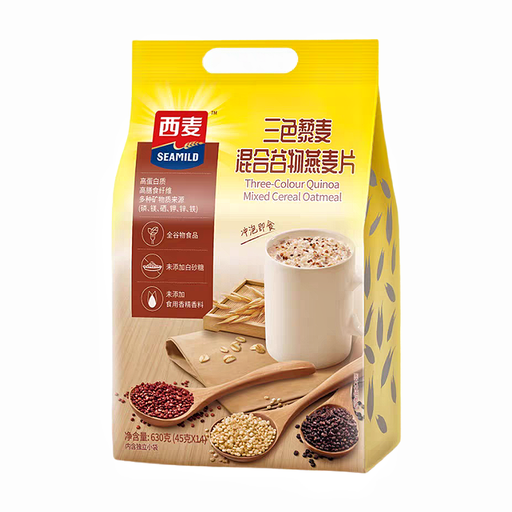 Image unavailable
This mix is for shoppers who’d like to consider a multigrain recipe rather than oats on their own.
630 g pack. Read the full ingredients list and check the allergens before ordering.
 Image unavailable
Worth considering if you’re looking for an oat preparation already combined with flaxseed and cocoa, rather than a plain base.
245 g pack. If sugars are a key consideration, check the amount in the product’s nutritional information.
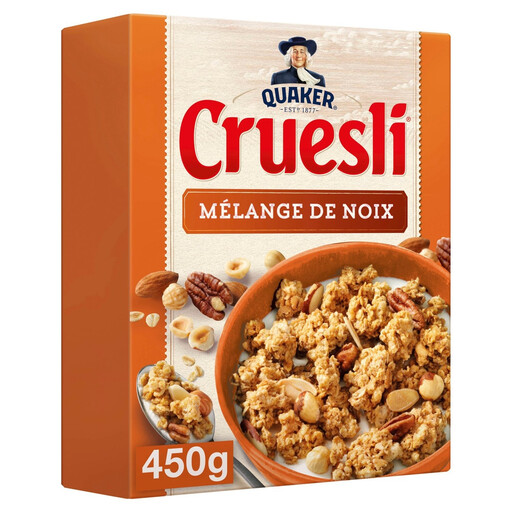 Image unavailable
This Cruesli is worth considering if you’re looking for crunchy cereal clusters with nuts, provided these ingredients suit your needs.
450 g pack. Compare its sugars and allergens with those of the other recipes you’re considering.
Under European Union Regulation (EC) No 1924/2006, this claim can be used if a product contains at least 6 g of fibre per 100 g or 3 g per 100 kcal. On its own, it doesn’t tell you about the sugars or allergens.
Check the ingredients list, allergens, nutritional information and net weight of the product you’ve chosen. If you need to avoid an allergen, check the packaging you receive too; the DGCCRF points out that allergens must be emphasised in the ingredients list on prepacked foods.
No. The amount of fibre you consume depends on the weight of your serving and the rest of your diet. To compare packs, start with the per-100 g figure, then work out how much that means for the quantity you plan to serve.