What should you check before serving?
First check the ingredients against residents’ individual guidance, then look at the organic labelling, choice of flavours and instructions for consistent preparation.
| Criteria |
What to check |
Who this matters to |
| Ingredients and individual guidance |
Read the full ingredients list, look out for liquorice and have relevant recipes checked against treatments and serving instructions. |
If I’m planning a drink to serve regularly to residents taking medication, I want to know which ingredients require professional advice; around 31% of consumers would put this compatibility first. |
| Organic labelling and ingredients |
Check the organic labelling on the product you choose, then distinguish between the plants, flavourings and any tea or maté it contains. |
When choosing an organic herbal tea, I need to understand exactly what’s in the box, beyond its name; around 25% of consumers would prioritise a clear ingredients list. |
| Flavour and drinks range |
Compare herbal and aromatic profiles after checking the ingredients, and follow individual guidance before serving the drink. |
I’m looking for a range of flavours to offer residents without assuming one recipe will suit everyone; around 25% of consumers would prioritise this variety. |
| Serving arrangements |
Check the number of bags and the water quantity and brewing time specified for the product you’re ordering. |
When several people prepare the drinks, I want instructions everyone can follow in the same way; ease of serving would come first for around 19% of consumers. |
Herbal teas to consider on Joybuy
These herbal infusions offer recipes to consider for care home mealtimes, from pure camomile to blends containing liquorice. Before choosing one to serve, check the organic labelling on the packaging, the preparation instructions and whether it fits with residents’ individual guidance.
 Image unavailable
DAMMANN FRÉRES Chamomile, 21 bags, 42 g
Worth considering if you’re looking for a pure camomile recipe to serve. The listed ingredients are 100% camomile from organic farming, and the 21 bags are individually wrapped. Check the organic labelling on the packaging, along with the water quantity and brewing time, before deciding how to prepare it.
View on Joybuy
 Image unavailable
ELEPHANT Organic Verbena Mint, 20 bags
Worth considering if you’d like to offer a verbena and mint flavour. The ingredients list names both plants as organically grown; the product listing specifies 20 bags and 200 ml of water per serving. However, it gives different brewing times, so check the instructions on the packaging, along with the organic labelling, before serving.
View on Joybuy
 Image unavailable
Pukka Organic Digestion herbal tea, 40 g
Consider this only if the blend’s ingredients can be assessed for the residents concerned. The ingredients include aniseed, fennel and liquorice; the stated preparation time is around 5 minutes in water at 100 °C. The liquorice means this should not be the default choice for serving to a group. Ask the relevant healthcare professional for advice, particularly if it may be consumed repeatedly, and check the organic labelling on the packaging.
View on Joybuy
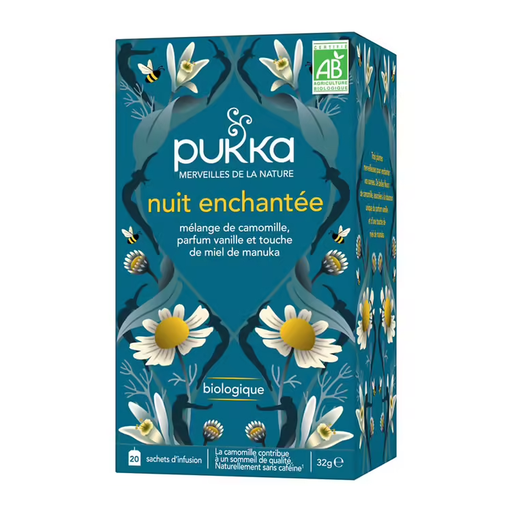 Image unavailable
Pukka Enchanted Night Organic herbal tea, 32 g
Consider this as a herbal blend, rather than assuming it will have an effect suggested by its name. The ingredients include camomile, fennel, flavourings and liquorice; the product listing gives a brewing time of around 5 minutes in water at 100 °C. Before serving it regularly, ask for the liquorice content to be assessed for the residents concerned, and check the organic labelling and instructions on the packaging.
View on Joybuy
Frequently asked questions
What does “organic” mean on a herbal tea?
It refers to the European framework for organic production and labelling, set out in particular by Regulation (EU) 2018/848. It guarantees neither a health effect nor that a recipe is suitable for every resident: always check the labelling and ingredients of the product you choose.
Can herbal tea replace the water offered to residents?
A suitable herbal infusion can add variety to the drinks on offer, but it should not automatically replace access to water or individual guidance. Anses recommends drinking throughout the day, particularly for older people, whose sense of thirst may be reduced.
Why check for liquorice?
According to Anses, high and repeated consumption of drinks or foods containing liquorice can lead to hypokalaemia and high blood pressure. If a recipe contains liquorice, ask the relevant healthcare professional to assess whether it is suitable for the residents concerned, especially before serving it regularly.
Which preparation instructions should you keep?
Keep the instructions for the specific product being served, including the water quantity and brewing time. For example, the product listing for Auchan Bio Evening Infusion specifies 200 ml of just-boiled water and a brewing time of 3 to 5 minutes; these figures do not apply to other recipes.
Is an organic herbal tea enough to meet a meal’s nutritional needs?
No. Choosing an organic drink is not, in itself, a way to assess the nutritional quality of a meal or meet an individual resident’s needs. The French decree of 30 January 2012 on catering in social and medico-social establishments concerns the nutritional quality of meals; the choice of herbal tea should remain separate from assessing the meal and care instructions.


