Fans of a pronounced ginger flavour
If you prefer a citrusy, spicy cup to a mild or floral infusion, check the proportion of ginger where it’s stated, then look at the recommended brewing time.


If you’re looking for a spicy-tasting cup, start by comparing the ingredients in ginger and lemon blends and their recommended brewing times. A mint or lemongrass infusion will offer a different flavour profile, but these ingredients don’t provide a common measure of ‘strength’. For a break without tea leaves, check the ingredients list and, if avoiding caffeine matters to you, look for an explicit statement on the product.
If you prefer a citrusy, spicy cup to a mild or floral infusion, check the proportion of ginger where it’s stated, then look at the recommended brewing time.
For a herbal break, check the ingredients rather than relying on the name of the aisle. If you also want to avoid caffeine, look for an explicit statement about the recipe you’re considering.
The number of tea bags, net weight and ingredients can help you find a format that suits your regular breaks. The word ‘wellness’ alone doesn’t tell you what’s in it.
First, decide what you mean by ‘full-flavoured’: a spicy taste, a herbal infusion without tea, or simply a more aromatic cup. Then compare the blends and their preparation instructions.
| Criteria | What to check | Who is it for? |
|---|---|---|
| Spicy flavour | The proportion of ginger, whether spices are included and the recommended brewing time. | If I mainly want to taste the ginger in my cup, a citrusy blend may not be enough. Around 36% of consumers would make this spicy flavour their top priority. |
| Infusion without tea | The ingredients list and, if needed, an explicit statement that it’s caffeine-free. | For my afternoon break, I prefer a herbal blend to a drink containing tea leaves. Around 29% of consumers would make this their priority. |
| Ingredients and precautions | Whether it contains liquorice and any warnings on the packaging. | Before drinking it regularly, I want to know whether the blend contains liquorice and take any associated precautions into account. Around 21% of consumers would put this check first. |
| Pack size | The number of tea bags and the net weight of the box. | When I restock an infusion with my groceries, I look for a pack size that suits how often I take a break. Around 14% of consumers would make pack size their main criterion. |
These words don’t prove that an infusion offers a health benefit. The DGCCRF points out that health claims on food products must be authorised under the applicable rules.
When choosing your drink, focus on the ingredients, the flavour you’re looking for and the preparation instructions, rather than promises suggested by its name.
Some blends contain liquorice. Anses has highlighted risks associated with high, repeated consumption of foods or drinks containing it, particularly for certain sensitive groups.
Read the ingredients list and warnings before making this kind of infusion a regular part of your routine.
Auchan’s range also includes blends made with black tea, matcha or mate. A Lipton green tea sold on Joybuy, for example, contains 86% green tea.
If you want a herbal infusion without tea leaves, check the ingredients of the specific product. If you also want to avoid caffeine, look for an explicit statement.
For a spicy ginger and lemon blend, Auchan lists a product containing 43% ginger, 25% lemon and 2% black pepper.
The Lemongrass Ginger blend listed by Carrefour combines 48% lemongrass and 28% ginger, and is labelled ‘naturally caffeine-free’.
Carrefour’s organic Ginger Lemongrass Lemon blend comes in a box of 20 tea bags weighing 30 g, with 51% lemongrass and 25% ginger.
The Mint Freshness box listed by Joybuy contains peppermint and recommends a brewing time of 3 to 5 minutes.
To compare the blends in Auchan’s wellness aisle, start with the ingredients in each box rather than the aisle name.
These two PUKKA blends in tea bags let you compare different ginger combinations for an afternoon break. Check the ingredients in each one if avoiding caffeine or liquorice is important to you.
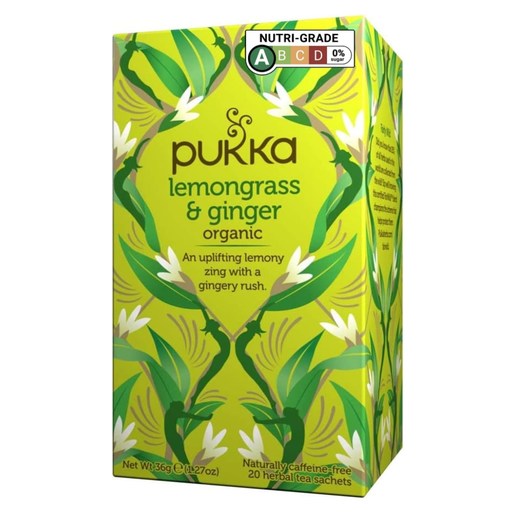 Image unavailable
A blend to consider if you’d like to pair ginger and lemongrass for your break. For this blend, Carrefour lists 28% ginger, 48% lemongrass, a brewing time of 5 to 15 minutes and the claim ‘naturally caffeine-free’. It contains liquorice: Anses advises caution with high, repeated consumption.
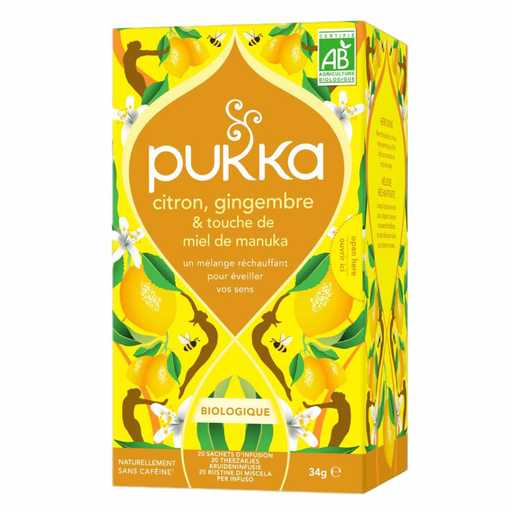 Image unavailable
The name of this blend brings together manuka honey, lemon and ginger for a different cup from the lemongrass and ginger mix. The box contains 20 tea bags. Check the ingredients list if you want to avoid liquorice or tea leaves.
The word doesn’t provide a comparable measure of flavour intensity. To choose between two blends, check the ingredients and their proportions where these are listed, then compare the recommended brewing times. Their flavours may differ even if both contain ginger.
No, its name doesn’t prove that it has a health effect. The DGCCRF points out that health claims on food products are regulated and require authorisation. For your everyday choice, consider this separately from the flavour and ingredients.
High, repeated consumption of products containing liquorice can carry risks highlighted by Anses, particularly for certain sensitive groups. Check the ingredients and warnings on the box, especially if you’re planning to drink it often.
Read the full ingredients list to rule out blends containing green or black tea, and check whether they contain mate or matcha too. If you want to avoid caffeine, look for an explicit statement on the product. Carrefour’s Pukka Lemongrass Ginger blend, for example, is labelled ‘naturally caffeine-free’.