
Livraison le jour même ou le lendemain

Qualité garantie

Débloquez vos offres de bienvenue: Livraison GRATUITE | Jusqu'à -80 % | 30 jours d'essai gratuits à JoyPlus
Téléchargez l'application
Pollen, dust, cooking fumes, pet dander and fine particles from road traffic: indoor air quality can vary considerably from one room to another. A HEPA air purifier can help reduce some airborne particles, provided you choose a model suited to the size of your room and maintain it properly.
However, product specifications can include figures that are difficult to compare. Here are the main pitfalls to avoid before buying an air purifier for allergies, a bedroom, a living room or a home office.
A device advertised as suitable for a large room won’t necessarily refresh the air effectively in every setting. Ceiling height, open doors, insulation and your ventilation system can all have a significant impact on performance.
CADR, measured in m³/h, indicates the volume of air filtered and then recirculated each hour under specified conditions. The larger or more heavily occupied the room, the more important this figure is. For a bedroom, start by measuring the floor area and take the ceiling height into account.
The term H13 HEPA filter refers to a filtration class defined by technical standards. However, marketing claims don’t always offer the same level of detail. Check in particular:
A HEPA filter mainly captures particles. It isn’t a substitute for proper ventilation and won’t deal with every source of indoor pollution.
An air purifier that’s quiet on its lowest setting can become noticeably louder at full power. This matters particularly in a bedroom, nursery or home office.
Also check how easy it is to access the filter, whether there’s a replacement indicator and how much the consumables cost. A device that’s affordable to buy may cost more to run if its filter needs frequent replacement or is difficult to find.
When comparing air purifiers, start with the CADR rather than a simple claim about the area covered. A device rated at 280 m³/h can’t be compared directly with a 450 m³/h model without considering noise levels, the setting used and the actual volume of the room.
In an open-plan living area, a PM2.5 purifier with a high airflow rate may be a better choice. For a small bedroom, a compact, quiet model is often better suited to everyday use.
A common set-up combines:
Always consider claimed effectiveness in context: particle size, fan speed and test conditions all matter. Performance figures in a product description aren’t a medical guarantee.
For overnight use, look for a night mode, the option to switch off the lights and several fan speeds. A timer can limit how long the device runs, while a child lock can be useful in a family room.
Place the device on a stable surface without blocking the air inlets or outlets. Follow the manufacturer’s instructions and unplug it before cleaning or carrying out any maintenance.
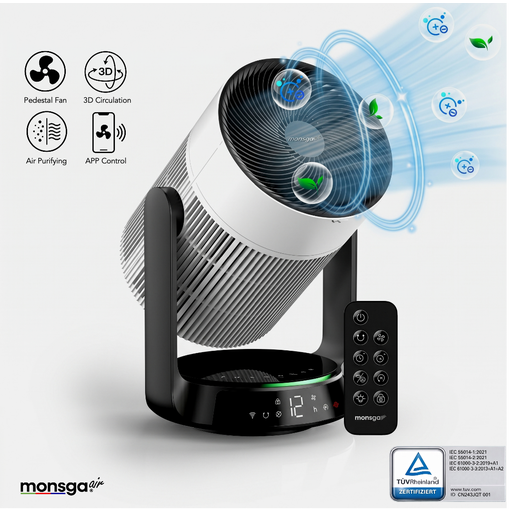
Why it suits this buyer: This device combines air circulation with purification. It may suit anyone looking to avoid buying two separate appliances for a moderately sized home.
The product description states a CADR of 280 m³/h and a noise level of 25 dB in sleep mode. Before buying, check that replacement filters are available and find out how noisy it is at higher speeds.
Advertised multi-directional oscillation, app controls, remote control and touch panel.
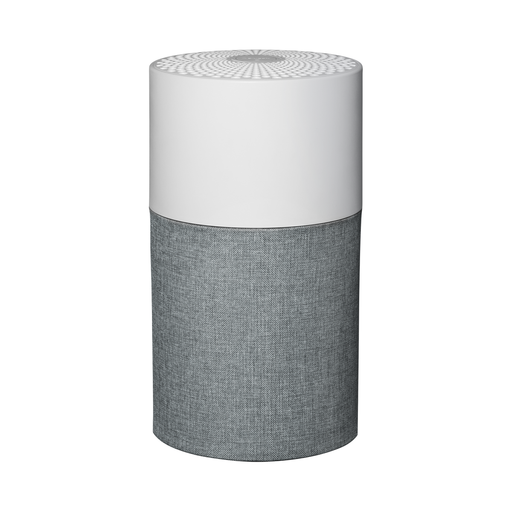
Why it suits this buyer: Its compact design and straightforward controls make it a good fit for a bedroom, nursery or home office, where space and noise levels are particularly important.
The product description states 24 dB on low speed and features HEPASilent dual-filtration technology. However, make sure the stated coverage area is suitable for the actual size of your room.
Listed dimensions of 34 × 20 × 20 cm, weight of 1.69 kg and a pre-installed filter, according to the product description.
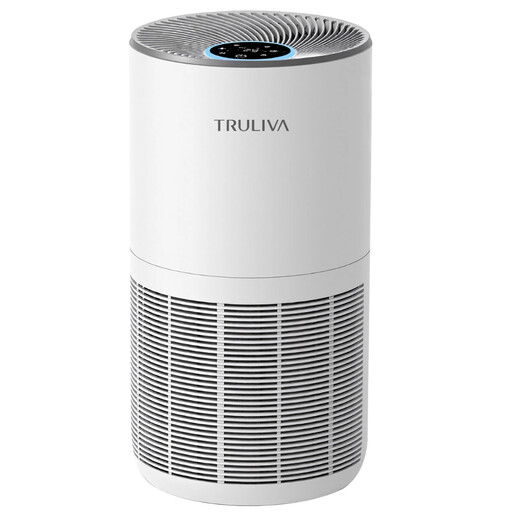
Why it suits this buyer: This model is aimed at households with pets, those exposed to smoke or cooking odours, and anyone looking to monitor PM2.5 particles in a larger room.
The product description lists a pre-filter, an H13 filter and activated carbon, as well as a PM2.5 display. As noise levels can reach 66 dB(A), night mode is a better choice for a bedroom.
Advertised CADR of 450 m³/h, 360° air circulation, a 24-hour timer and child lock.
We’ve put together a comprehensive, regularly updated list of products that meet these demanding selection criteria and European safety standards.
Place it on a stable surface, leaving enough space around the air inlets and outlets. Avoid putting it against a wall or next to a curtain or piece of furniture. An unobstructed position helps filtered air circulate properly.
How often you need to replace it depends on how long the purifier runs, whether you have pets, the amount of dust and the manufacturer’s recommendations. Check the replacement indicator, if there is one. Never wash a HEPA or activated carbon filter unless the instructions explicitly say it’s safe to do so.
Energy use depends on the appliance’s power rating, the speed you select and how many hours it runs. To keep your electricity bill down, use the automatic mode or timer if available. It’s also worth checking the power rating in the product specifications.