
Livraison le jour même ou le lendemain

Qualité garantie

Débloquez vos offres de bienvenue: Livraison GRATUITE | Jusqu'à -80 % | 30 jours d'essai gratuits à JoyPlus
Téléchargez l'application
Dust that quickly builds up again, cooking smells, spring pollen, smoke or pet hair: a HEPA air purifier can complement the daily ventilation of a house, flat or office. But product specifications do not always tell the whole story.
A device advertised for a large area may not provide enough airflow in an open-plan living room. A very discreet night mode may operate at reduced speed, while the maximum noise level can quickly become irritating. As for a particularly high-performance filter, it will only be genuinely useful if it is replaced at the intervals recommended by the manufacturer.
Here are the criteria to consider before choosing an air purifier for your home, bedroom or a room where pets live.
Manufacturers sometimes state a maximum area based on just one air change per hour. This figure does not guarantee fast and effective purification throughout the room. To compare two models, it is better to look at the CADR, meaning the clean air delivery rate, expressed in m³/h.
An air purifier intended for a large room should show an airflow rate suited to the volume being treated. In a 25 m² room with a ceiling height of 2.5 m, the volume is approximately 62.5 m³. A CADR of 150 m³/h will not provide the same air-change rate as a model rated at 450 or 550 m³/h.
A HEPA H13 filter is a useful technical indicator, but it is not enough to assess the appliance as a whole. Also check for a pre-filter, the airflow rate, the filter compartment’s seal and the availability of replacement filters.
The pre-filter traps hair, pet fur and larger particles. The HEPA layer targets fine particles, while activated carbon can help reduce certain odours. For a dust- or smoke-fighting air purifier, or one intended for allergy sufferers, this combination is generally more relevant than a simple marketing claim.
An appliance that is inexpensive to buy may require costly proprietary filters that can be difficult to find. Before placing your order, check the filter reference, its price and the replacement frequency stated in the product details or manual.
Where provided for by the manufacturer, a washable pre-filter can help limit dust build-up on the main filter. However, never wash a HEPA or composite filter unless the instructions explicitly allow it.
CADR makes it possible to compare appliances more meaningfully. As a general guide:
The coverage areas mentioned in product details should be treated as simple guidelines. A room with a high ceiling, doors that are often left open or a high concentration of particles will generally require greater airflow.
For a quiet air purifier intended for the bedroom, the night mode noise level is crucial. A device advertised at 20 or 25 dB on its lowest setting may become noticeably louder at full power. So compare the minimum and maximum noise levels whenever they are provided.
A night mode that switches off indicator lights, a timer and an automatic setting can significantly improve everyday comfort. The PM2.5 sensor can also adjust the ventilation when the appliance offers an automatic mode, although its accuracy depends on the integrated technology and its position.
For dust, pollen, pet dander and fine particles, look for a clearly identified HEPA filter. For smoke and odours, the presence of an activated carbon layer is also worth considering.
The capture claims presented below correspond to the information provided in the product details. They do not constitute a medical guarantee. An air purifier does not replace ventilation, cleaning or professional medical advice in the event of a health problem.
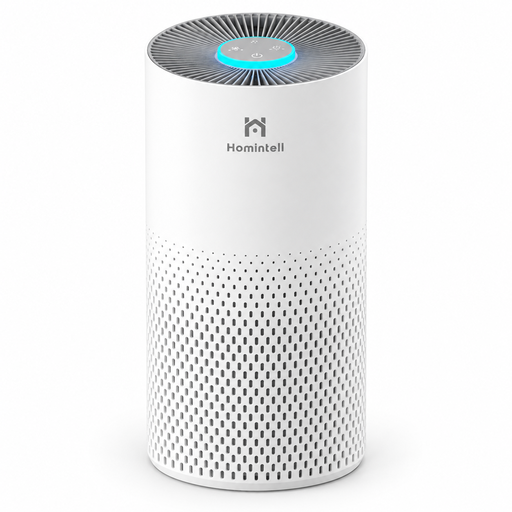
Why this choice suits this profile : With an airflow rate of 150 m³/h and stated coverage of up to 18 m², it is suitable for a bedroom, home office or small room. The touch controls, 2-, 4- or 8-hour timer and air-quality indicator make the appliance easy to use.
The product details specify the CADR and usage area, helping you avoid an estimate based solely on the design or number of functions.
Three-stage filtration, PM2.5 sensor, three speeds and filter replacement indicator.

Why this choice suits this profile : With a stated CADR of more than 700 m³/h and coverage of up to 154 m² depending on conditions, this model is designed for large living spaces. The app, voice control and automatic mode meet the expectations of a connected home.
The airflow rate, filtration technology and stated replacement frequency are explained in detail, making it easier to compare purification capacity with maintenance requirements.
Seven-stage filtration, laser sensors, mobile app and OdorFence layer stated by the manufacturer.
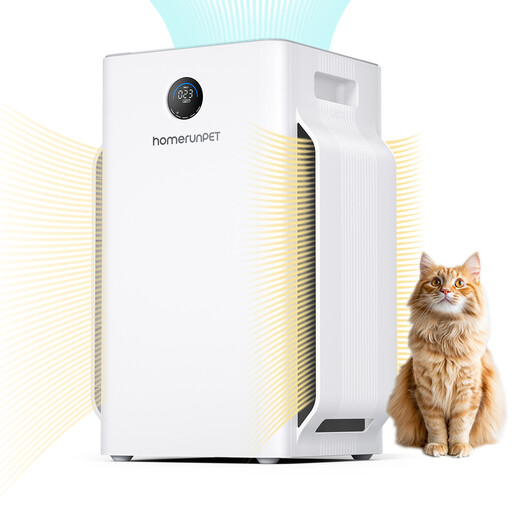
Why this choice suits this profile : Designed for households with pets, it combines a True HEPA filter, an activated-carbon pre-filter and an air-quality sensor. Its stated silent mode of up to 25 dB may be suitable for a bedroom or a room occupied at night.
The product details distinguish between particle capture and odour control, rather than presenting a single filter as a solution for every pollutant.
Anti-tip base, secure compartment, particle sensor and two-level odour control.
Place the air purifier on a stable surface, leaving enough space around the air inlets and outlets. Keep it away from curtains, enclosed furniture, heat sources and damp areas. In a bedroom, place it in a clear space near the bed but not right next to it, to help air circulate.
Before cleaning or replacing anything, unplug the appliance. Dust the pre-filter in accordance with the instructions, but never wash the HEPA or composite filter without explicit authorisation. Also check that the replacement filter reference is compatible with the model you have chosen.
We have put together a complete, real-time updated list of products that fully meet these strict selection criteria and European safety regulations.
Not necessarily. However, running it for longer at a moderate speed may provide more consistent performance than occasional operation at full power. It all depends on the particle levels, the size of the room, the amount of noise you are willing to accept and electricity consumption.
Its lifespan varies depending on the model, how often it is used and the amount of dust or smoke present in the home. Manufacturers often state several months, and sometimes longer. Rely on the replacement indicator, the instructions and the filter’s visible condition rather than a theoretical lifespan that applies in every situation.
Place it on a flat, unobstructed surface, away from water, radiators and fabrics that could block the grilles. Make sure the night mode has a noise level compatible with your sleep and that the indicator lights can be dimmed or switched off.