
当日/次日达

品质保障

开启新人专享福利: 全场免邮 | 低至 2 折 | 免费试用 30 天 JoyPlus 会员
下载 Joybuy
A well-organised garage, cellar, or workshop? It all starts with a reliable storage solution. However, choosing heavy-duty shelving can quickly become a headache. Between exaggerated load capacities and a jungle of materials, it's easy to make a mistake. You can end up with a product that buckles under the weight of your expectations... and your tools. As the head of product selection at Joybuy, I'm here to separate fact from fiction for you. Follow this guide to avoid the common traps and choose the shelving unit that's truly right for you.
The market is flooded with models that look sturdy but hide flaws that can cost you dearly in the long run. Here are three critical points to never overlook.
To make an informed choice, focus on a few key technical specifications that don't lie.
The most important specification is the maximum static load per shelf. This is the weight that each level can support evenly and permanently. The total load capacity, which is often highlighted, is simply the sum of each shelf's capacity. For storing tools, paint cans, or mechanical parts, a capacity of 120?kg to 175?kg per shelf is an excellent benchmark for home and semi-professional use. Also, check that the product includes an anti-tip kit for secure wall mounting.
The frame of a good heavy-duty shelving unit is almost always made of steel. Prioritise finishes that protect against corrosion, such as galvanized steel or powder coating. The shelves are typically made of MDF (Medium-Density Fibreboard), a material that is denser and more moisture-resistant than standard particle board. The presence of reinforcement crossbars under each shelf is an excellent indicator of strength, as they prevent the board from sagging under weight.
A modular shelving unit offers invaluable versatility. Most quality models can be assembled as a single tall column or split into two lower units, perfect for creating a storage workbench. Choosing a boltless shelving unit with an interlocking system greatly simplifies assembly. Not only is installation faster, but the structure also naturally becomes more rigid once loaded.
To put theory into practice, here is our selection of models suited for different uses.
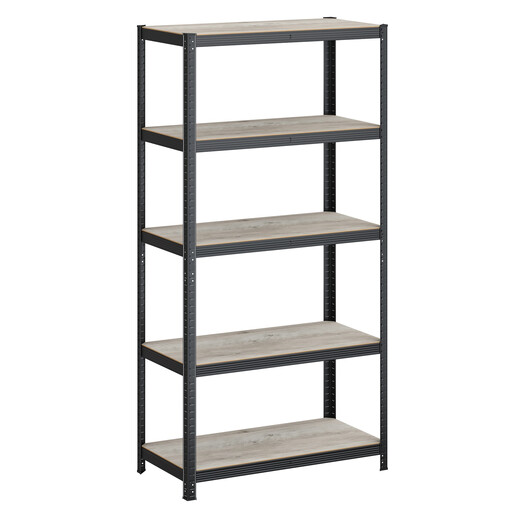
Why it's a great choice: Perfect for organising a garage or cellar with a reliable and versatile solution. It offers an excellent balance of capacity, size, and ease of assembly for standard home use.
The 120 kg per shelf capacity is clearly stated, preventing any unpleasant surprises. Its steel frame and MDF boards are designed for long-lasting use in dry environments, and its modular design allows it to be converted into two low workbenches.
Tool-free assembly thanks to the interlocking system. Shelf height is adjustable every 5 cm for maximum flexibility.
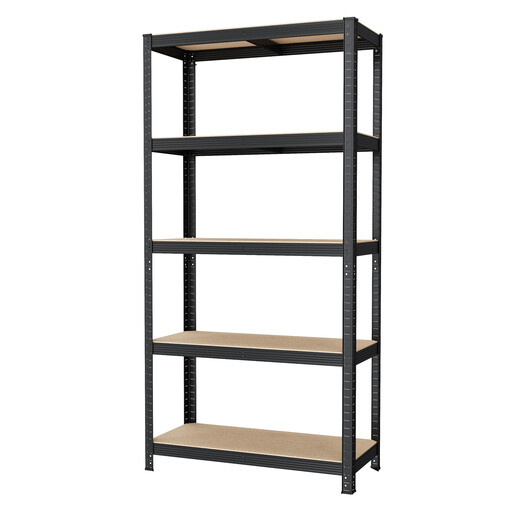
Why it's a great choice: Designed for tradespeople, professionals, or demanding DIYers who store heavy equipment. Its extremely high load capacity makes it a first-rate solution for a warehouse, workshop, or storage area.
Here, there's no compromise on sturdiness. The 175 kg per shelf capacity is built for heavy and concentrated loads. Its high-quality steel frame guarantees stability and longevity.
Impressive total load capacity of 875 kg. Also converts into two sturdy workbenches for maximum versatility.
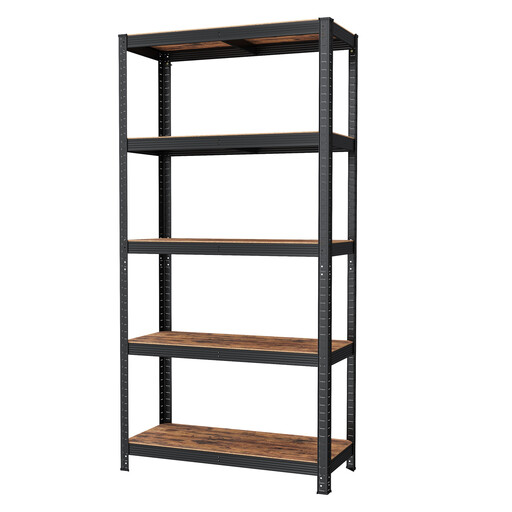
Why it's a great choice: For those who don't want to choose between high performance and refined aesthetics. Perfect for an open-plan workshop, pantry, or garage where looks matter as much as function.
This model combines a 175 kg per shelf load capacity with a stylish finish, proving that heavy-duty shelving can also have character. Its powder-coated steel frame and sturdy MDF boards ensure its longevity.
Its rustic brown finish sets it apart from purely utilitarian models. Highly versatile thanks to its ability to be configured as two separate workbenches.
Safety first. Quality heavy-duty shelving units almost always come with an anti-tip kit. Using it is essential: it allows you to securely fasten the top of the unit to the wall. Another safety habit is to always place the heaviest items on the bottom shelves. This lowers the centre of gravity and enhances the overall stability.
Yes, provided you choose the right materials. Opt for a frame made of galvanized or powder-coated steel, which offers excellent protection against rust. For the shelves, MDF is more resistant than particle board, but for a very damp cellar, 100% metal shelves remain the most durable option. Also, remember to properly ventilate the room to limit condensation.
Absolutely. A good interlocking assembly system is extremely sturdy. The parts (uprights, crossbars) clip and lock into one another. Once the unit is loaded, the applied weight stiffens the entire structure, making it perfectly stable. The key is to follow the instructions carefully and use a rubber mallet (often recommended) to ensure every component is securely clipped in place.