
Livraison le jour même ou le lendemain

Qualité garantie

Débloquez vos offres de bienvenue: Livraison GRATUITE | Jusqu'à -80 % | 30 jours d'essai gratuits à JoyPlus
Téléchargez l'application
A cluttered garage, a tricky-to-organise cellar or a workshop where tools pile up quickly can waste valuable space. A heavy-duty metal garage shelving unit offers a simple and effective solution – provided you don’t rely solely on the figure printed on the box.
Certain mistakes crop up time and again when buying:
To choose a suitable metal garage shelving unit, you need to look closely at the technical specifications, the shelf design and the conditions of use.
Static load refers to the weight the shelving can support when it remains stationary, installed on a stable floor and loaded evenly. It doesn’t mean you can concentrate all the weight in one spot.
A model advertised as 120 kg per shelf and 600 kg total, for example, offers five shelves that can each support 120 kg under the conditions specified by the manufacturer. To store boxes, containers, car parts or tools, spread heavy items across several shelves and place the heaviest loads on the bottom.
If the load is uneven, dynamic or intended for intensive professional use, allow a safety margin. The stated capacities generally refer to static loads and don’t replace a check of the structure, the floor and the fixing system.
A steel storage shelving unit is designed to support significant weight, but not all models are equal. Check in particular:
A structure 180 to 200 cm high must be installed on a perfectly stable floor and, when the manufacturer recommends it, fixed to the wall. This precaution is especially important in a garage used by children, a narrow cellar or a workshop where items are regularly moved.
Before ordering, measure the available width, the maximum acceptable depth and the ceiling height. Also remember to leave enough space to open a door, move around and handle boxes.
An industrial 5-tier shelving unit can be useful in a room with a high ceiling, but a 200 cm model won’t fit under a pipe or a low shelf. Adjustable shelves allow you to reserve one level for small boxes and another for bulkier equipment.
Adjustment every 5 cm, where available, offers great organisational freedom. A tool-free adjustable shelving unit with a clip-together design is also easier to dismantle and reconfigure than a fully bolted model. However, check that the tool-free assembly doesn’t mean you can skip wall anchoring.
Needs vary depending on whether you’re fitting out a flat cellar, a family garage or a workshop used every week. Here are several models for different uses.
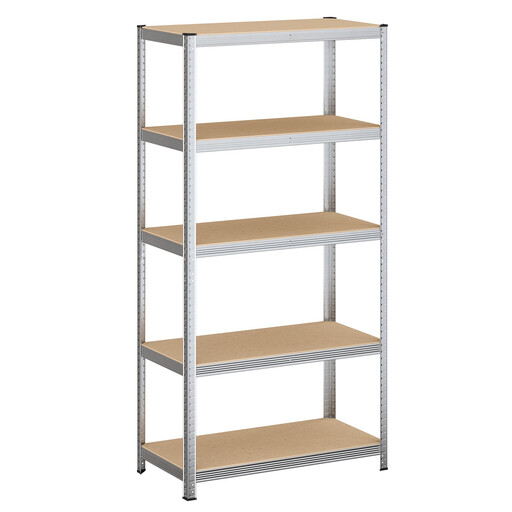
Why this choice suits this profile: With dimensions of 50 × 100 × 200 cm, this model is ideal for everyday storage in a garage, shed or cellar. Its clip-together assembly is said to be tool-free, and the shelves adjust every 5 cm.
The product page clearly distinguishes the load per shelf, stated at 120 kg, from the total capacity of 600 kg. An anti-tip kit is supplied and must be used in line with the instructions.
A galvanised steel structure, five adjustable shelves, the ability to split the unit into two separate sections and a stated total static capacity of 600 kg.
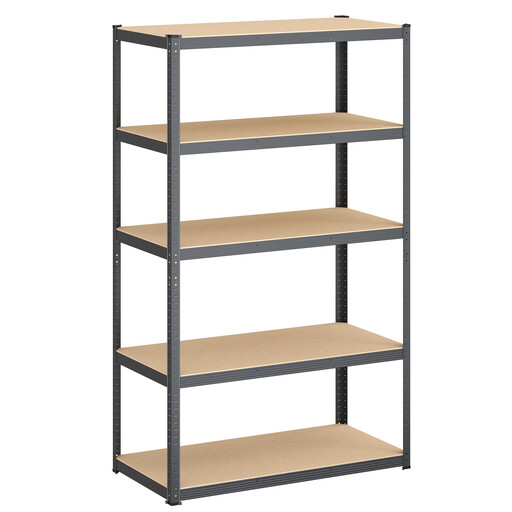
Why this choice suits this profile: Its 60 × 120 × 200 cm format offers a more generous storage surface, suitable for a workshop, large garage or small storeroom.
The product page states a maximum static load of 150 kg per shelf and 750 kg total. These values must be distributed across the different shelves.
Powder-coated steel, five adjustable shelves, a configuration that can be split into two units and an anti-tip kit supplied.
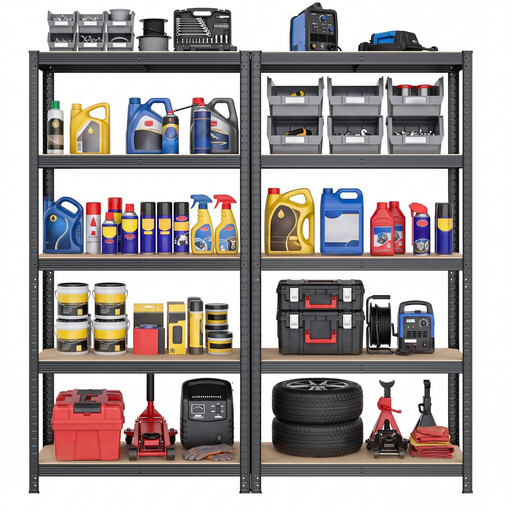
Why this choice suits this profile: This set of two units lets you spread stock between a garage, cellar or workshop. Each structure measures 40 × 90 × 180 cm.
The compact format makes installation easier in several areas. The manufacturer states 175 kg per shelf and 875 kg total for the set, with an anti-tip fixing included.
Two independent structures, five adjustable shelves per unit, powder-coated steel and a stated static load of 875 kg for the set.
To make a robust metal shelving unit last, a few precautions are essential:
To install shelving in a damp cellar or workshop, carefully check the anti-corrosion treatment and the room’s ventilation. In a professional setting, also take into account the requirements specific to your activity and the manufacturer’s safety recommendations.
We’ve put together a comprehensive, real-time updated selection of products that meet these demanding criteria as well as European safety regulations.
It depends on the model and its configuration. Check the maximum load per shelf and the total load separately. A stated capacity of 600 kg doesn’t mean each shelf can take 600 kg. The load must remain static, be properly distributed and be compatible with the floor.
For a tall structure, wall fixing is strongly recommended when an anti-tip kit is supplied. It reduces the risk of tipping over, but doesn’t replace correct installation or balanced weight distribution.
The lifespan depends on the quality of the steel, the weight supported, humidity, how often items are moved and the quality of the assembly. A protected structure, installed in a dry place, used without overloading and checked regularly will maintain its performance far longer than a model exposed to water or impacts.