
Livraison le jour même ou le lendemain

Qualité garantie

Débloquez vos offres de bienvenue: Livraison GRATUITE | Jusqu'à -80 % | 30 jours d'essai gratuits à JoyPlus
Téléchargez l'application
A well-organised garage, cellar, or workshop is the key to an efficient and safe workspace. The problem? Faced with a jungle of options, choosing the right heavy-duty garage shelving often turns into a headache. Between tempting marketing promises and technical reality, the risk of ending up with an unsuitable, flimsy, or even dangerous product is very real.
As a product expert at Joybuy, my mission is to guide you. Let's cut the jargon and get straight to the point. Here are the pitfalls to avoid and the real criteria to consider when choosing metal shelving that will stand the test of time, year after year.
A good storage investment should bring you peace of mind, not headaches. Here are three common mistakes that too often turn a well-intentioned project into a purchase you'll regret.
To make an informed choice, set the marketing aside and analyse these three technical points. They are the true DNA of a shelving unit for cellars or workshops worthy of the name.
The backbone of a heavy-duty shelving unit is its frame. Steel shelving remains the gold standard. Two surface treatments dominate the market:
The thickness of the steel is a direct indicator of rigidity. Aim for uprights of at least 0.8?mm for trustworthy stability.
It can't be said enough: forget the total capacity. The only figure that matters is the maximum load per shelf. This is what dictates what you can safely store. For heavy items (motors, large toolboxes, stacks of paint cans), a capacity of 120?kg per shelf is the minimum. Double-check that this value assumes a uniformly distributed load.
Modern boltless, interlocking systems have revolutionised assembly. They promise quick installation, often without any tools. Make sure the clips or rivets are well-designed and that everything locks firmly into place with no wobble.
Finally, a non-negotiable point: the inclusion of an anti-tip kit. This system, which anchors the shelf to the wall, is absolutely essential to prevent any accidents, especially if children are around or if the shelf is in a high-traffic area.
Because every project is different, here are three options that meet our criteria for sturdiness and practicality, each suited for a specific use.
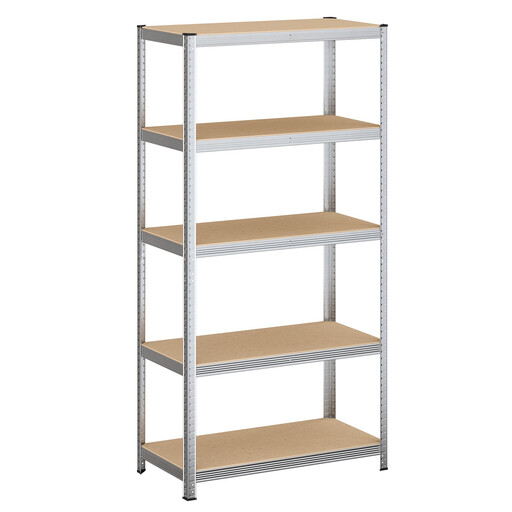
Why we chose it: Ideal for organising a garage or utility room with everyday loads. Its generous 100 cm width allows you to store crates and equipment without a second thought, and assembly is a breeze.
The 120 kg per-shelf capacity is clearly specified, clearing up any confusion about the total load. Its interlocking assembly system is designed for simplicity and requires no tools.
Its ability to be split into two lower workbenches offers welcome modularity, perfect for creating a work surface with integrated storage.
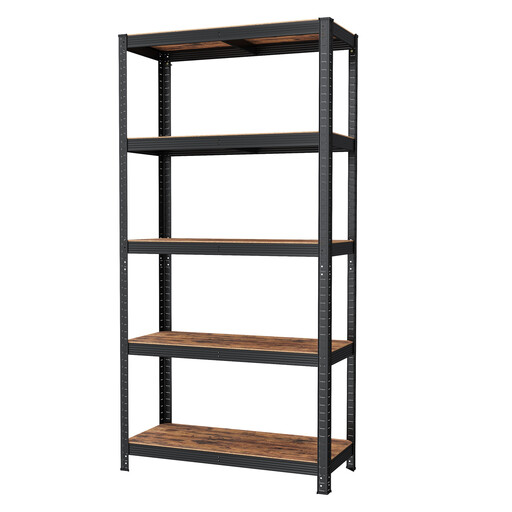
Why we chose it: Designed for demanding DIYers and tradespeople who store heavy equipment. Its very high load capacity and reinforced structure make it a safe bet for holding power tools, mechanical parts, or stocks of materials.
With 175 kg per shelf and a solid steel frame, it ticks all the boxes for sturdiness and puts any fears of instability to rest. The included anti-tip kit is an added guarantee of safety.
Its two-tone finish (rustic brown and black) gives it a polished look—a rare enough feature on such heavy-duty shelving to be worth highlighting.
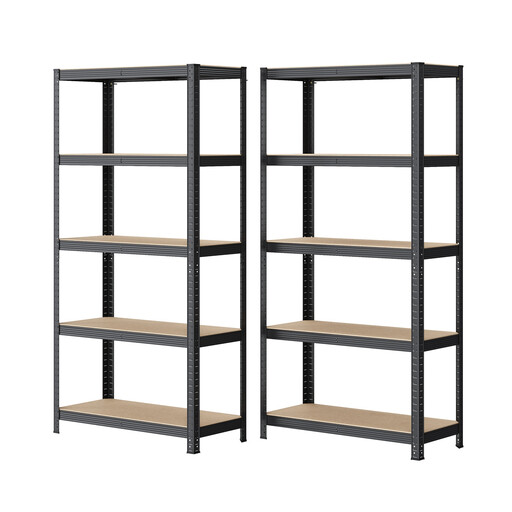
Why we chose it: The ideal solution for outfitting an entire wall or arranging a complete room. This set offers an unbeatable price-to-quantity ratio and a cohesive look, all with a colossal storage capacity.
By opting for a set of two identical, ultra-sturdy units (175 kg per shelf), you save yourself the headache of trying to match different models. The modularity is definitely there: each shelf can be split in two.
Total flexibility. Line them up to create an impressive wall of storage, place them in opposite corners, or transform them into four separate workbenches. You're in control.
Explore our full selection of metal shelving units, all rigorously selected for their sturdiness and safety.
Yes, it's more than recommended—it's a safety rule. Even the most stable model can tip over if it's bumped or if the load is poorly balanced. Using the provided anti-tip kit is a non-negotiable step to ensure your safety and the safety of those around you.
The golden rule: always place the heaviest items on the bottom shelves. This lowers the centre of gravity and stabilises the entire unit. Next, distribute the weight across the entire surface of the shelf, rather than concentrating it all in the middle. Finally, balance the load between the different shelves instead of putting everything on just one.
Galvanised steel is protected from corrosion by a zinc coating. It's a purely functional choice, ideal for damp cellars and garages. Powder-coated steel is coated with a powder paint that is then baked on. The result is more aesthetically pleasing and much more resistant to scratches and impacts. Both options are very durable, so the choice depends on the environment and your aesthetic priorities.