
Livraison le jour même ou le lendemain

Qualité garantie

Débloquez vos offres de bienvenue: Livraison GRATUITE | Jusqu'à -80 % | 30 jours d'essai gratuits à JoyPlus
Téléchargez l'application
A well-organised garage, cellar, or workshop is about more than just aesthetics: it's a guarantee of efficiency and safety. Say goodbye to scattered tools, haphazardly stacked boxes, and inaccessible equipment. A heavy-duty garage shelving unit is the essential ally for transforming chaos into a structured, functional storage space.
But with the vast array of models available, it's not easy to find your way. To help you sort through the options, this guide breaks down the essential criteria and presents our selection of the best models on the market, suitable for all needs and budgets.
Before you buy, a few key points deserve your attention to ensure a sound investment.
The term "heavy-duty" can mean very different things from one manufacturer to another. It is therefore crucial to check two indicators: the maximum load per shelf and the total load supported by the entire metal shelving unit. To safely store tools, mechanical parts, or paint cans, aim for a capacity of at least 100 kg per tier. The frame, most often made of steel, ensures the overall rigidity. As for the shelves, they are generally made of MDF (Medium-Density Fibreboard), an excellent compromise between strength and cost for heavy-duty storage.
Your storage needs are not set in stone. A modular shelving unit, with height-adjustable tiers, will offer all the flexibility you need to store items of various sizes. When it comes to installation, opt for models with an interlocking assembly: this boltless shelving can be put together in a snap, often without any tools. Some models take versatility a step further by allowing you to split them into two lower workbenches—a fantastic feature for setting up workshop shelving.
It may seem obvious, yet it's an all-too-often-neglected step. Take the time to accurately measure the height, width, and depth of the area where your shelving will go. Don't forget to leave enough clearance around the garage storage rack to move around and handle your belongings without difficulty.
To help you take action, we have selected three models that stand out for their value, design, and capacity.
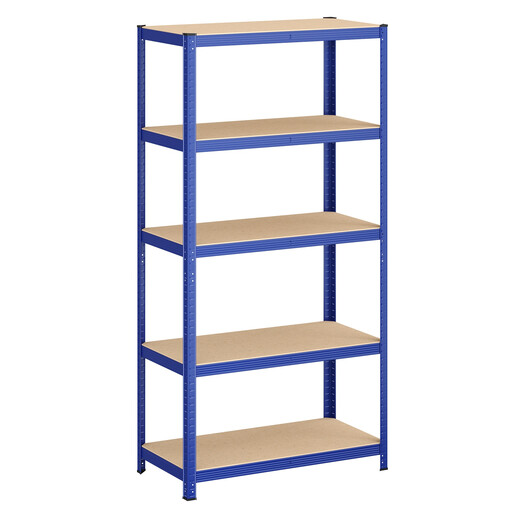
Why it stands out: This model offers an excellent balance of storage capacity and versatility. With a load of 120 kg per shelf (for a total of 600 kg), it covers most home storage needs. Its tool-free assembly and the option to split it into two separate units make it a solution that is as practical as it is effective.
Key features:
Who is it for? For individuals looking to organise their garage, cellar, or garden shed and store DIY tools, archives, or seasonal equipment.
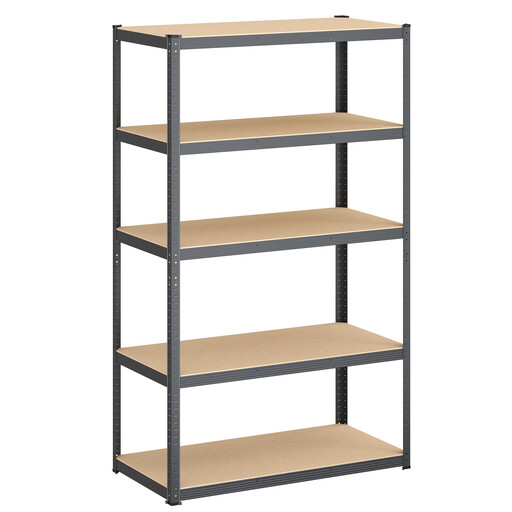
Why it stands out: Here we move up to the next level. With its more generous dimensions and increased load capacity, this model is aimed at those who store heavier or bulkier equipment. Each shelf supports up to 150 kg, for an impressive total load of 750 kg.
Key features:
Who is it for? For expert DIYers, craftspeople, or small businesses needing reliable heavy-duty shelving to store power tools, spare parts, or small inventories.

Why it stands out: This model proves that robustness can go hand-in-hand with style. It combines a very high load capacity with a particularly refined finish. Each tier can handle 175 kg, for a total of 875 kg. Its two-tone design (rustic brown and black) allows it to fit in even in spaces where looks matter, such as an open-plan workshop or a finished pantry.
Key features:
Who is it for? For those who demand uncompromising strength for their heavy-duty storage without sacrificing the design of their workshop or storage area.
Our selection covers the most common needs, but the world of storage is vast. If you require different dimensions, capacities, or styles, many other solutions are available.
Explore our full range of metal shelving to find the perfect model for your project.
Stability rests on three pillars: careful assembly according to the instructions, smart load distribution (always place the heaviest items at the bottom!), and using the provided anti-tip kit to secure the unit to the wall. This last point is an essential safety step.
The vast majority of modern models, like those in our selection, are boltless shelving units that assemble via a simple interlocking system. However, a rubber mallet can be useful for securely clipping the crossbars into place. In any case, wearing work gloves is highly recommended to protect your hands during assembly.
This is a crucial distinction. The load per shelf refers to the maximum weight that each individual shelf can support (provided the weight is evenly distributed). The total load is the cumulative weight that the entire shelving unit can sustain. To ensure the safety and longevity of your setup, it is imperative never to exceed either of these limits.