
Same-day & Next-day Delivery

Quality Guaranteed

Unlock Your Welcome Offers: FREE Delivery | Up to 80% OFF | Free 30-day JoyPlus trial
Download the APP
A well-organised garage, cellar, or workshop isn't a luxury: it's the guarantee of a functional and safe space. Yet, finding the right storage solution often turns into a headache. Faced with a sea of options, it's easy to fall into the classic traps that turn a good investment into a costly regret. As the Equipment Editor, my mission is to guide you toward making the right choice, with all the facts at hand.
Before you pull out your credit card, let's review the most common mistakes. A poorly chosen shelf doesn't just buckle under the weight of your belongings: it poses a real hazard.
The number that always jumps out is the total load capacity. A salesperson might promise you "800 kg," but this magic number is based on a perfectly even distribution of weight across all shelves. In other words, a situation that never happens in the real world. The only reliable indicator is the max load per shelf. Ignoring it means risking your shelves buckling, or even collapsing.
A shelf that wobbles at the slightest touch is a ticking time bomb. This instability often comes from steel that's too thin, flimsy interlocking systems, or a lack of reinforcement crossbars. Another crucial point that's too often forgotten is the absence of an anti-tip kit to secure the unit to the wall. This is a non-negotiable safety feature, especially in a high-traffic area.
Your cellar shelving or garage unit will inevitably be exposed to moisture. However, many entry-level models come with shelves made of raw MDF (Medium-Density Fibreboard). The first contact with moisture is a disaster: the wood swells, warps, grows mould, and loses all its strength. The result: a shelf that's headed for the scrap heap in just a few months.
For garage storage that goes the distance (and holds the weight!), here are the technical specifications to scrutinise.
Forget the total load capacity and swear by the maximum static load per shelf. It's the only guarantee that each level will support your toolboxes, paint cans, or mechanical parts without buckling. As a precaution, always aim for 20% more than your estimated need. A sturdy shelf worthy of the name will always display this information in black and white.
The frame of a good metal shelving unit is always made of steel. To protect it from rust, two treatments dominate the market:
As for the shelves, if you opt for MDF, check the thickness (8 mm minimum) and reserve it for dry environments. For a damp cellar, take no chances: all-metal shelves are the only truly long-lasting option.
A modular shelf offers game-changing flexibility. Make sure it includes these features:
workshop shelf.By applying these criteria to the letter, here are models that meet specific needs while avoiding the common pitfalls.
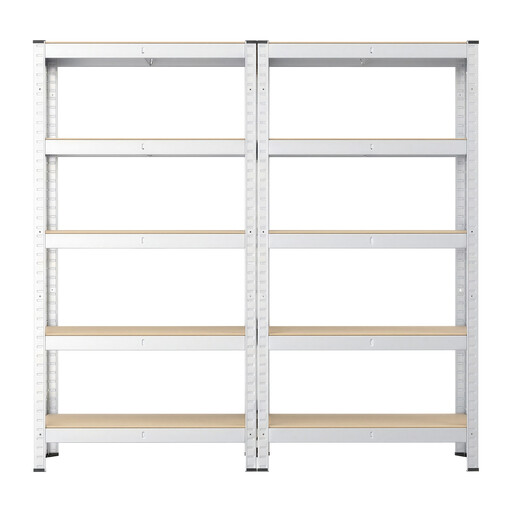
Why we chose it: This set of two 1.50 m shelves is the perfect solution for garages or cellars with low ceilings. It allows you to create a long line of storage or place them separately in the room, all while providing a very respectable load capacity for intensive home use.
The 130 kg per shelf load capacity is stated in black and white, which is reliable and reassuring information. The anti-tip kit is included by default to prevent any risk of instability.
Its great versatility (can be converted into two workbenches) and its simple, tool-free interlocking assembly that saves you a headache.
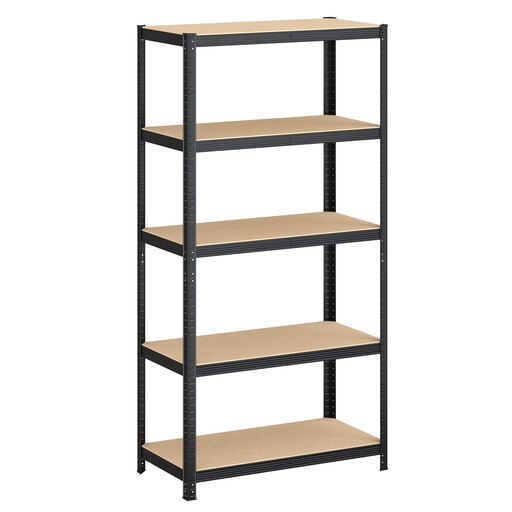
Why we chose it: With its 50 cm depth, this shelf is designed to hold the bulkiest items: storage trunks, tyres, or large power tools. Its 2-metre height allows you to exploit the full vertical storage potential of your garage or workshop.
Its black powder-coated steel frame provides an excellent barrier against rust, allowing it to avoid the pitfall of materials that degrade in humid environments.
Its extra-large 50 cm depth and its shelves that are adjustable every 5 cm provide rock-solid modularity.
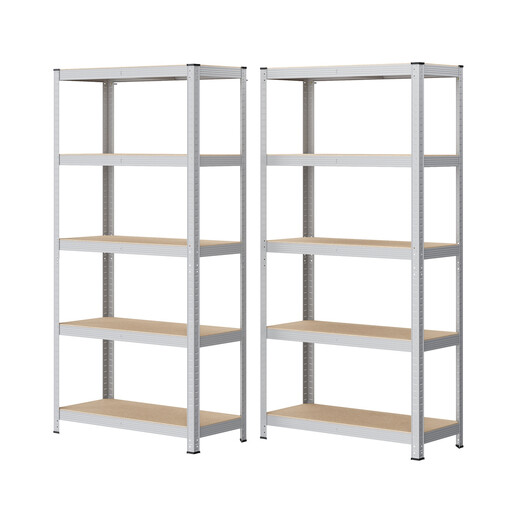
Why we chose it: For those who think big and need massive storage capacity, this set is the ultimate solution. With 175 kg per shelf, it's designed for extreme loads: engines, anvils, or large stocks of materials.
This model shatters the misleading load capacity pitfall by displaying an ultra-high and credible per-shelf capacity, guaranteed by a reinforced steel frame.
A monstrous load capacity of 175 kg per shelf and the flexibility of a two-unit set to organise a complete workshop.
Our editors have selected a full range of products for you that meet our quality criteria and current safety standards.
The basics: read the instructions carefully. Remember to wear work gloves to avoid cuts from the sheet metal. For interlocking systems, a rubber mallet will be your best friend for securely clipping the elements together. Always assemble the shelf on the floor, on a flat surface, and test its stability before you start loading it.
The steel frame (galvanized or powder-coated) can last for several decades if it isn't damaged. The weakest link is almost always the MDF shelves. In a dry garage, they will last for many years. However, in a damp cellar, their life expectancy can drop to 2 or 3 years if they are not treated or protected.
For private use, it's not a legal requirement, but it's a fundamental common-sense safety rule. Most quality models include an anti-tip kit. Installing it is highly recommended to prevent any accidents: a child climbing on it, a jolt, or simply a heavy object being pulled off a bit too abruptly. When it comes to safety, there are no compromises.