
Livraison le jour même ou le lendemain

Qualité garantie

Débloquez vos offres de bienvenue: Livraison GRATUITE | Jusqu'à -80 % | 30 jours d'essai gratuits à JoyPlus
Téléchargez l'application
Hanging wall decor across rental properties and modern homes in France often presents a dilemma. Standard hollow plasterboard partitions, commonly known as placo, crumble under traditional nails and easily tear under basic adhesive strips. Heavy power drills and masonry anchors feel disproportionate for decorative jobs, leaving unsightly holes that demand extensive plastering and repainting when moving out.
Engineered mechanical claw hooks provide a neat alternative, locking straight into drywall using hand pressure alone. Matching your decor piece to the appropriate load rating and anchor style ensures heavy framed mirrors, prints and multi-aperture frames hang straight and remain completely secure over time.
Sticky strips often detach prematurely in humid environments or on matte emulsion finishes, taking outer plasterboard paper layers with them. When hanging glazed frames or substantial mirrors, mechanical steel penetration into the gypsum core offers far greater structural stability than surface adhesives.
Traditional plastic wall plugs and metal toggle bolts require substantial pilot drill holes that compromise wall strength if spaced closely together. Over-drilling also risks hitting concealed cables, pipes or metal framing studs hidden behind standard French drywall partitions.
A frame weighing several kilograms exerts outward leverage beyond its deadweight if it sits away from the wall. Always choose a fixture rated comfortably above the bare weight of the frame, glass and backing combined to account for this forward tipping force.
Every wall anchor carries a rated static load limit that assumes weight pulls straight down against the vertical face.
Drywall relies on a solid gypsum core sandwiched between heavy lining paper, requiring anchors that lock mechanically without shattering the interior.
These selected wall hooks and complementary wall decor pieces help you furnish living spaces securely without power tools or messy wall plugs.
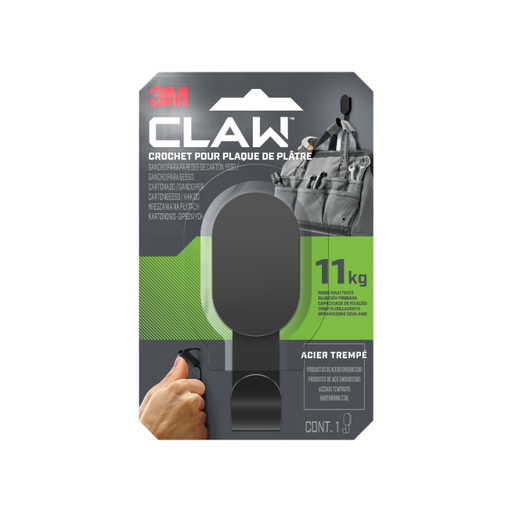
Why This Fits Their Persona: This individual black metal hook pushes directly into drywall using thumb pressure and supports up to 11 kg, making it ideal for hanging medium framed prints, large canvases and hallway notice boards without leaving substantial holes.
Eliminates the risk of drilling into concealed utilities or tearing delicate wallpaper with surface glue pads, relying instead on angled hardened steel teeth that grip internal plasterboard neatly.
Installs in seconds without a drill, hammer or measuring templates, delivering reliable 11 kg holding capacity with a tidy black finish.
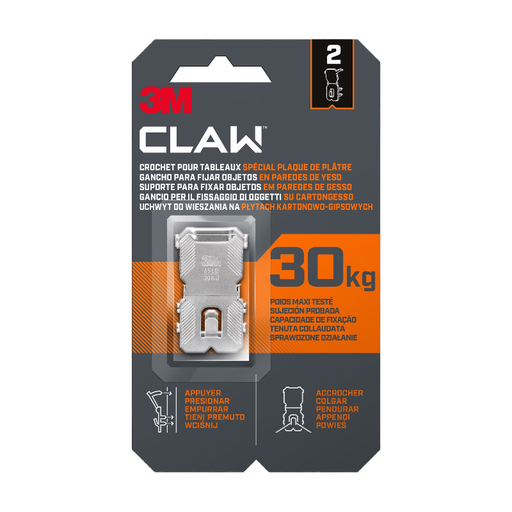
Why This Fits Their Persona: Engineered for substantial wall accents, this two-pack of metal hooks handles up to 30 kg directly on plasterboard, providing the heavy-duty stability needed for wide statement art, framed glass and solid vanity mirrors.
Prevents the hassle of renting or borrowing heavy drills and purchasing specialised expanding metal hollow-wall anchors that create irreversible, messy gouges across standard partition walls.
Engineered heavy-duty metal construction pushes straight into drywall to anchor up to 30 kg, offering robust peace of mind for valuable decorative items.
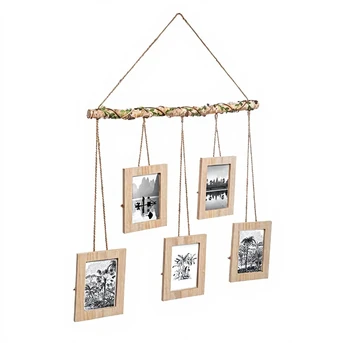
Why This Fits Their Persona: Measuring 60 by 58 cm, this beige MDF wooden collage displays five family photographs in a cohesive layout while weighing just 0.7 kg, making it an effortless pairing for lightweight push-in wall fixtures.
Solves the frustration of measuring, levelling and installing five separate mini-frames, delivering a balanced gallery wall look from a single balanced mounting point.
Generous visual footprint with minimal 0.7 kg deadweight, allowing quick placement on delicate plasterboard partitions without straining the wall.
Heavy-duty mechanical plasterboard hooks with hardened steel teeth can support up to 30 kg when installed flush against sound drywall partitions. For loads approaching this upper threshold, always verify that the plasterboard itself is in dry, undamaged condition before hanging heavy mirrors or glazed art.
Rather than relying on expansion bolts or adhesive chemistry, these anchors feature curved, hardened steel prongs that pierce the plasterboard face. As they enter, the prongs spread slightly into the gypsum core, anchoring firmly against the interior structure to distribute downward and forward shear forces.
To remove the hook cleanly, slide the tip of a flat-head screwdriver under the base of the fixture and gently lever it outwards away from the wall. This pulls the steel teeth straight out, leaving tiny pinpoint slots that require only a dab of standard filler and minimal paint touch-up.