
Livraison le jour même ou le lendemain

Qualité garantie

Débloquez vos offres de bienvenue: Livraison GRATUITE | Jusqu'à -80 % | 30 jours d'essai gratuits à JoyPlus
Téléchargez l'application
A heated hair brush can make styling at home much easier. The challenge is knowing what you are looking at when product listings sometimes bring together very different appliances. A heated straightening brush does not necessarily dry your hair, while a hot air brush does not always provide the same straightening effect as a heated brush.
Before placing your order, take the time to distinguish between the functions actually offered, check the available temperature settings and consider your hair type. Here are the key criteria to examine to avoid any unpleasant surprises.
A traditional heated brush is generally used on dry hair. It heats a surface or barrel to straighten the hair, add volume or create waves, but it does not replace a hair dryer.
A hot air brush, by contrast, blows warm air and may be designed for use on damp or towel-dried hair. The term ‘2-in-1’ therefore deserves a closer look: it may refer to a combination of brush and curling iron without necessarily including a drying function.
Ionic technology is often promoted as a way to reduce frizz and static. It can leave your hair feeling smoother, but it can never compensate for excessive heat or an appliance that is not suited to your hair.
An anti-frizz heated brush should also offer a suitable temperature range, even heat distribution and clear guidance for fine, bleached or damaged hair.
An appliance bought online may be fitted with a plug or require a power supply different from those used in France. Check that it has a plug compatible with France, supports the correct voltage and, for dual-voltage models, follow the conditions of use specified by the manufacturer.
A 360° swivel cord makes styling more comfortable, but it does not remove the need for regular checks. If the cable shows any damage, you notice an unusual smell or the appliance overheats, stop using it immediately.
To stay in control of your styling, choose a model with several heat settings. Fine, sensitised or bleached hair generally tolerates less heat than thick or very curly hair. Start with the lowest setting, then increase it gradually if necessary.
Some models specify their settings precisely: the Wavytalk Thermal Brush offers five temperatures, from 150 °C to 215 °C, while the Saint Algue Demeliss LISS & GO offers six, from 130 °C to 230 °C. A high maximum temperature is not enough on its own: it must be used with care and in accordance with the instructions.
The length and density of the bristles also matter. Teeth that are too short may struggle to grip thick hair, while a brush that is too wide will be less precise on short haircuts.
A ceramic or tourmaline coating can help distribute heat more evenly. However, the most important thing is still to follow the instructions and avoid holding a section of hair against the heated area for too long. Ionic functions, insulated combs and automatic shut-off are useful in everyday use, but they do not guarantee perfect results or absolute protection.
Always use the appliance as intended: on dry hair for a traditional heated brush, on towel-dried hair for a hot air brush that permits this type of use, and never near a bath or washbasin.
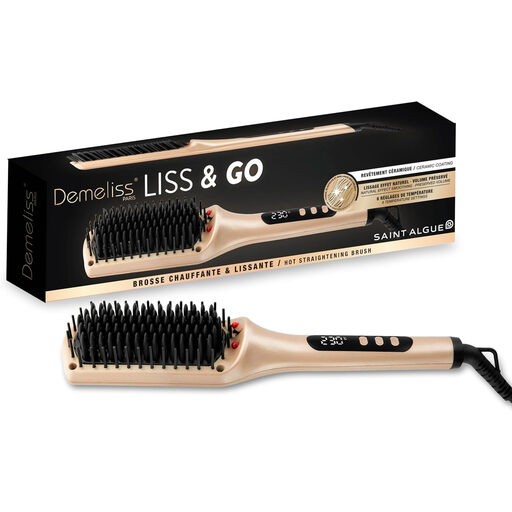
Why this choice suits this profile : This heated straightening brush is designed for a simple routine on dry hair, with six temperature settings and a control display. It is ideal for anyone who wants to tame their hair without building up a collection of accessories.
Its 130 °C to 230 °C range means you do not have to use the maximum heat every time. The automatic shut-off after 60 minutes is another useful safety feature.
Ceramic-coated teeth, ionic function, 360° swivel cord and stated 100-240 V power supply.
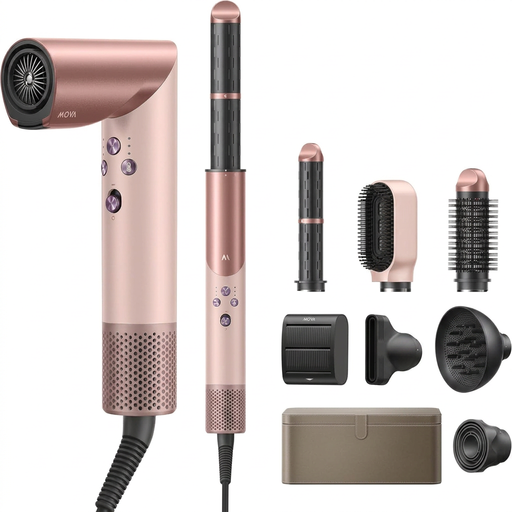
Why this choice suits this profile : This multi-styler combines drying, straightening, volumising and curling with its wide range of attachments. It is aimed at anyone who wants to replace several appliances with one more complete solution.
The product listing distinguishes between four temperature settings and three air speeds, rather than presenting a single power level as the answer to every use.
Stated Coanda airflow technology, attachment recognition, mode memory and a cool-air function.
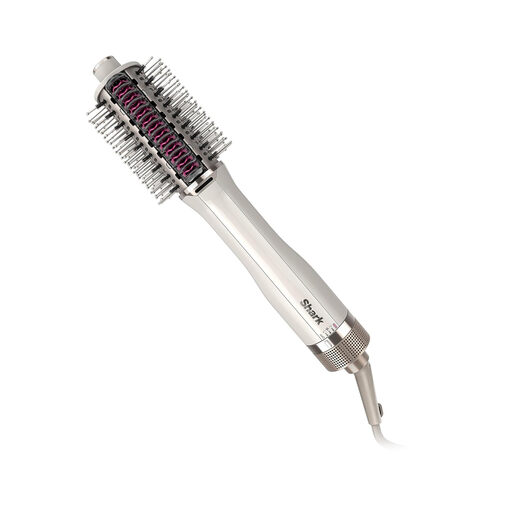
Why this choice suits this profile : Its two modes let you switch from drying to straightening on dry hair. It is suitable for frequent routines and a variety of hair textures.
The listing clearly explains how it can be used on damp and dry hair, helping you avoid confusing a hot air brush with a simple heated brush.
900 W motor, three temperature settings, three speeds and an integrated straightening comb combining nylon pins and boar bristles.
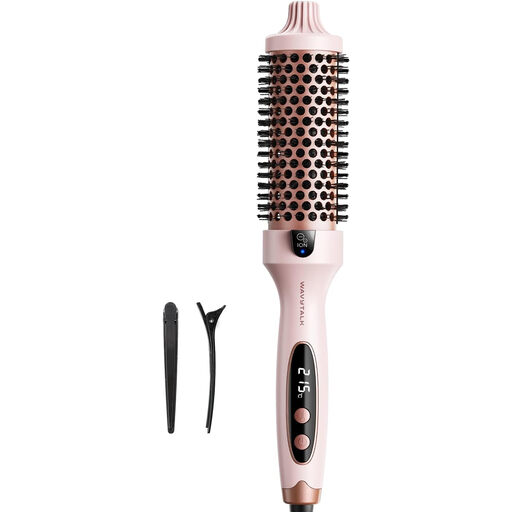
Why this choice suits this profile : Its round shape is designed to create soft waves, style the sections around your face and add volume. It is used on dry hair and does not replace a hot air brush.
The listing specifies that this is not a hair dryer brush. You will therefore need to dry your hair beforehand.
38 mm barrel, five settings from 150 °C to 215 °C, ceramic and tourmaline coating, negative ions and stated dual voltage.
We have put together a complete, real-time-updated selection of products that meet these demanding criteria as well as European safety standards.
Only if the manufacturer explicitly states that it has a damp-hair mode or drying function. A thermal brush such as the Wavytalk should be used on dry hair. A hot air brush or multi-styler may be suitable for towel-dried hair, depending on the instructions.
Generally, start with the lowest setting, often between 130 °C and 160 °C depending on the appliance. Make one quick pass over a small section and avoid repeated passes. Bleached or damaged hair requires particular care.
It depends entirely on the appliance’s power and how long you use it. A 60 to 80 W model used for a few minutes will consume less than a 900 W hair dryer brush or a 1,200 to 1,600 W multi-styler. To compare appliances, check their power rating in watts and estimate the actual length of each styling session.