Homes without an external vent
If you can’t connect a duct to the outside, a vented tumble dryer isn’t suitable for that space. Look at condenser models instead, and check that their dimensions and installation requirements are right for the room.


If you don’t have an opening or duct to the outside, rule out vented tumble dryers and look at condenser models instead. If you do laundry frequently and want to use less electricity, a heat pump model is worth considering. Be sure to compare cycle times and maintenance requirements too. An airer may still be an option if you have a large, well-ventilated room or suitable extractor, in line with recommendations cited by ADEME.
If you can’t connect a duct to the outside, a vented tumble dryer isn’t suitable for that space. Look at condenser models instead, and check that their dimensions and installation requirements are right for the room.
If you dry clothes frequently, compare capacity, electricity consumption and programme times. According to Que Choisir, heat pump models use less electricity than conventional condenser models; you should also consider cycle times in relation to your laundry routine.
Air-drying may still be an option if you have a large, well-ventilated room or one with a suitable extractor. The study cited by ADEME highlights the amount of moisture released by laundry drying indoors.
Start by checking the ventilation and installation options in your home, then compare the capacity and practical requirements of the solutions that will work for you.
Worth considering: if you can’t connect a duct to the outside and want to use a tumble dryer in the space available.
Things to consider: according to Que Choisir, a heat pump uses less electricity than a conventional condenser model. Also check how the collected water is drained on the model you choose.
Worth considering: if you dry laundry frequently and want to keep electricity consumption down.
Things to consider: compare programme times and plan to clean the filters and condenser as instructed in the manual.
Worth keeping: if you can dry laundry in a large, well-ventilated room or one with a suitable extractor.
Things to consider: air-drying releases a lot of moisture into your home, as highlighted in the study cited by ADEME.
| Criteria | What to check | What I need |
|---|---|---|
| Ventilation | If you’re using an airer, check the size of the room and how well it’s ventilated or extracted. Assess your home’s ventilation separately from your choice of appliance. | I dry laundry indoors: is the room really suitable for air-drying in the conditions recommended by ADEME? |
| External vent | Check whether there’s a suitable opening or duct before considering a vented tumble dryer. According to Que Choisir, a condenser model doesn’t need an external connection. | Without a suitable vent, I want to focus on technologies that don’t need one. |
| Space and capacity | Compare the width, depth and height with the space available. Check the stated capacity and the installation requirements in the model’s manual. | My appliance needs to fit in the room and handle my usual laundry loads. |
| Electricity and cycle time | Compare consumption in kWh per 100 cycles on a like-for-like basis, as well as the duration of the programme you’re considering. Que Choisir says a heat pump uses less than a conventional condenser model. | If I do laundry frequently, I want to know both how much electricity it uses and how long it takes to get through each load. |
| Water management | Check whether the model has a collection tank and whether it can be connected to a water drain. Consult the manual to find out what you’ll need to do. | I’d like to know how to empty or drain the water where the appliance will be installed. |
| Maintenance | Check the cleaning instructions for the filters and condenser. Make sure you can access the parts that need maintenance, even if automatic condenser cleaning is advertised. | I want to be able to carry out the required maintenance without disrupting regular use of the appliance. |
A condenser tumble dryer doesn’t need a duct to the outside. But that alone doesn’t solve the question of ventilation in your home; according to the study cited by ADEME, laundry drying on an airer remains a significant source of indoor moisture.
Consider the appliance location and room ventilation separately. If you’re using an airer, choose a large, well-ventilated room or one with a suitable extractor. For a tumble dryer, follow the installation instructions in its manual.
According to Que Choisir, this type of appliance needs an opening to the outside or access to a duct. It isn’t interchangeable with a condenser model in a home without this kind of installation.
Check what outlets are available before choosing a technology. If there isn’t a suitable one, look at condenser tumble dryers, including heat pump models.
The same capacity doesn’t necessarily mean the same performance in everyday use. According to Que Choisir, heat pump models use less electricity than conventional condenser dryers, but you should also consider how long they take to dry your loads.
Compare kWh per 100 cycles on a like-for-like basis, the duration of the programmes you’ll use and the capacity that suits your laundry loads.
Que Choisir says these parts need regular maintenance. AEG’s guidance also warns that a blocked condenser can increase energy consumption and damage the appliances concerned.
Before buying, check the model’s manual to find out how often it needs cleaning and whether you can access the parts that require maintenance.
The WQG24502FR is an example of Bosch’s heat pump tumble dryer range.
AEG’s range includes the TR9XA39PA heat pump tumble dryer.
The TSA523WP 8kg Active is an example of a heat pump tumble dryer featured by Miele.
These condenser models, some of which use heat pump technology, are worth considering if you’re looking for a tumble dryer without an external vent. Check the available space, capacity and installation requirements for each model.
 Image unavailable
This heat pump model is worth considering if you want to dry loads of laundry indoors without an external duct. It has a stated capacity of 8 kg and energy class C. Before choosing where to put it, compare its consumption in kWh per 100 cycles, programme times and dimensions.
 Image unavailable
With heat pump technology and a stated capacity of 8 kg, this model is worth considering if you’re looking for a tumble dryer without an external duct for your usual laundry loads. It has energy class D. Check its consumption in kWh per 100 cycles, programme times, dimensions and maintenance instructions.
 Image unavailable
This condenser tumble dryer is worth considering for a home without an external exhaust duct. It has a stated capacity of 8 kg. Before comparing it with heat pump models, check its energy use on a like-for-like basis, its dimensions and its maintenance instructions.
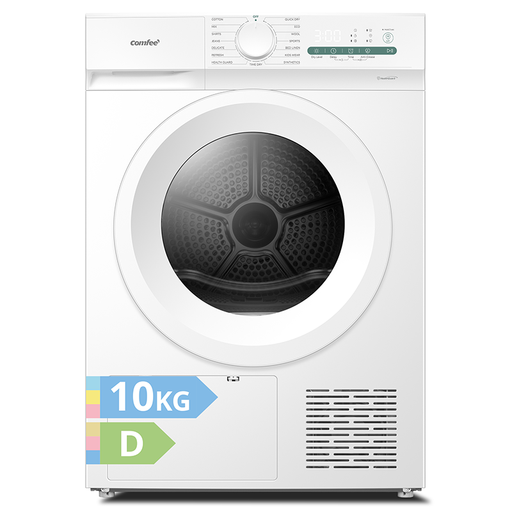 Image unavailable
This heat pump model is another option to consider if you want to dry laundry without an external duct. It has a stated energy class of D. Check the capacity of the variant before choosing it for your loads: the listed capacities of 8 kg and 10 kg differ. Also check energy use, cycle times and dimensions.
Not in this setup. According to Que Choisir, this type of tumble dryer needs an opening to the outside or access to a duct. If that isn’t possible, consider a condenser model and check its installation requirements in the manual.
No. The fact that the appliance doesn’t need an external connection says nothing about the overall ventilation in your home. If you also dry laundry on an airer, the study cited by ADEME recommends using a large, well-ventilated room or one with a suitable extractor.
If you dry laundry frequently and electricity consumption is an important factor in your decision. Que Choisir says this technology uses less electricity than a conventional condenser appliance. Also compare programme times, capacity and the maintenance required for the models you’re considering.
Compare figures measured on the same basis, such as kWh per 100 cycles when this information is shown on both appliances’ labels or product information sheets. Also check the duration of the programme in question: an energy class on its own doesn’t tell you everything about everyday use.
Follow the model’s manual for cleaning the filters and checking the condenser. For the appliances covered by its guidance, AEG recommends cleaning the filter after every cycle and warns that a blocked condenser can increase energy consumption and damage the appliance.