If you’re buying a new domestic tumble dryer for a home without an external air vent, consider heat pump models. According to the European Commission, only appliances using this technology can be placed on the EU market from 1 July 2025. When comparing an older conventional condenser dryer, take its age and installation into account. Indoor air-drying is another option if you have a large, well-ventilated room or one with a mechanical ventilation extract vent, as recommended by ADEME.
Who are these options for?
Homes without an external air vent
If there’s no opening or duct leading outside, rule out vented tumble dryers before comparing appliances. UFC-Que Choisir notes that this technology needs an external connection; condenser dryers, including heat pump models, are designed for a different type of installation.
People who do laundry frequently
If you run regular drying cycles, consider the stated energy consumption, the length of the eco programme, the capacity and the maintenance required together. A programme described as fast won’t necessarily reflect your usual conditions of use.
Those with space for an airer
An airer is worth considering if you have a large, well-ventilated room or one with a mechanical ventilation extract vent. These are the indoor drying conditions recommended by ADEME, but they shouldn’t be assumed to be available in every home.
How do the options compare?
Without an external vent, your first decision is whether you can install an appliance or set up an airer somewhere with enough ventilation. How often you do laundry and how much space you have will help you decide.
Heat pump
Consider it: when buying a new domestic tumble dryer without an external duct, especially if you run frequent cycles.
Bear in mind: the programme duration and the maintenance set out in the manual need to suit the way you use the appliance.
Conventional condenser
Consider it: mainly when assessing an appliance you already own or an older offer, checking its status and installation requirements.
Bear in mind: its energy consumption figures and old energy rating can’t be read in the same way as those on an appliance with the new label.
Indoor air-drying
Consider it: if you have a large, well-ventilated room or one with a mechanical ventilation extract vent where you can put your washing.
Bear in mind: the space it takes up and how you organise your laundry. ADEME points out that air-drying clothes adds moisture to the home.
| What matters to you |
What to check |
Who it suits |
| Installation without an external duct |
Check the model’s dimensions and installation requirements, then find out how its condensed water is collected or drained. |
I don’t have a duct leading outside, and the appliance needs to fit in the room I’ve chosen. Around 42% of consumers prioritise installation compatibility. |
| Energy use and cycle frequency |
Compare kWh/100 cycles on labels from the same generation, along with the duration of the full-load eco programme and the stated capacity. |
I do laundry frequently and want to manage electricity use without waiting longer than my routine allows; around 33% of consumers put this balance first. |
| Air-drying at home |
Make sure you can set aside a large, well-ventilated room or one with a mechanical ventilation extract vent, taking your usual laundry load into account. |
I’d rather dry clothes without an appliance, provided I have a suitable place for them. This would be the priority for around 25% of consumers. |
Mistakes to avoid
-
Choosing a vented model without an external outlet
According to UFC-Que Choisir, this type of tumble dryer needs an external opening or access to a ventilation duct. It’s therefore not suitable for the installation described here.
Rule it out before comparing capacities and programmes, then check the installation instructions for the model you’re considering.
-
Comparing an old A+++ rating with a current A rating
The European Commission says the energy label scale for the tumble dryers concerned has changed from A+++ to D to a scale from A to G. The letters alone aren’t a like-for-like basis for comparison.
When comparing appliances with the current label, check their consumption in kWh/100 cycles in particular.
-
Forgetting access to parts that need maintenance
The filter needs to be accessible, and instructions for the condenser vary by model. For appliances covered by its guidance, Electrolux says to clean the filter after every cycle.
Before buying, check how easy it is to reach these parts and how often maintenance is required, as stated in the exact model’s manual.
-
Putting an airer in a small, enclosed room
ADEME describes air-drying as a significant source of indoor moisture. Having enough space alone doesn’t mean the room is suitable for an airer.
Check whether you can dry your washing in a large, well-ventilated room or one with a mechanical ventilation extract vent.
Brands to compare
Electrolux
The range includes heat pump tumble dryers. To get a feel for a specific model, Electrolux describes the EW7HI395BN as a 9 kg condenser dryer rated at 106 kWh/100 cycles.
- The EW7HI395BN has several fabric programmes and a water collection tank.
- These features apply to this model only; check its manual for installation and maintenance requirements.
Bosch
The heat pump range includes models with a 9 kg capacity. Bosch gives the WQG2450SFR this capacity.
- Bosch lists a self-cleaning condenser and water drain hose for the WQG2450SFR.
- Check the dimensions and maintenance requirements for the model you choose; these features aren’t found across the entire range.
Miele
Miele’s T1 heat pump range offers maximum capacities of 7, 8 or 9 kg, depending on the model.
- These capacities make it easier to find an appliance suited to your usual laundry load. Miele recommends choosing the same capacity as your washing machine, if possible.
- SilenceDrum, SteamCare and DryCare 40 features vary by model, so check the details for each reference.
Beko
Beko offers heat pump tumble dryers and describes this technology as reusing warm air inside the appliance.
- You can compare capacity, programmes and maintenance features across models in the range.
- Features such as SteamCure are only listed for certain models; check the product page and manual for the one you’re considering.
Heat pump tumble dryers on Joybuy
These three models are options for machine-drying without an external duct. Before choosing one, compare its capacity, where it will fit and its cycle information with your usual laundry routine.
 Image unavailable
Hotpoint CHD84MWBSEE, heat pump, 8 kg
Worth considering if you want a tumble dryer without an external duct and with a stated capacity of 8 kg.
- Stated energy rating: C.
- The description mentions a 2-in-1 filter and a connectable drain hose; check the installation requirements in the manual.
- Before deciding, check the dimensions, the permitted room temperature, kWh/100 cycles and the duration of the eco programme.
View on Joybuy
 Image unavailable
Comfee CD08EHP05W-HR, heat pump, 8 kg
Worth comparing if a stated capacity of 8 kg suits your laundry loads and you want to avoid an external duct.
- Stated energy rating: D.
- The description mentions a double-layer filter and a refresh programme.
- Check the manual for the dimensions, room temperature and how condensed water is handled. Also check the kWh/100 cycles and the duration of the eco programme.
View on Joybuy
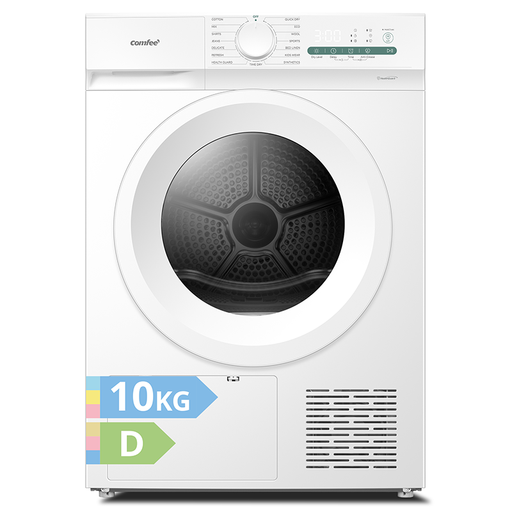 Image unavailable
Comfee CD10EHP05W-HR, heat pump, stated capacity 10 kg
Worth considering for drying without an external duct, once you’ve confirmed the capacity of this variant.
- The title and English description state 10 kg, while the detailed product page states 8 kg. Confirm the capacity before buying.
- Stated energy rating: D; a refresh programme is mentioned.
- Check the manual for the dimensions, room temperature and how condensed water is handled, then check the kWh/100 cycles and the duration of the eco programme.
View on Joybuy
Frequently asked questions
Is a vented tumble dryer suitable for a home without an external outlet?
No, not if there’s no external opening or ventilation duct available: UFC-Que Choisir says this connection is essential. For a new purchase, also bear in mind the EU market rule that has applied since 1 July 2025. According to the European Commission, domestic tumble dryers covered by the rule must use heat pump technology.
What should I compare on a tumble dryer’s energy label?
First compare appliances with the same generation of energy label, then look at kWh/100 cycles, capacity, the length of the eco programme and noise. The European Commission says the new A to G scale has replaced the old A+++ to D scale, so a letter from each scale can’t be compared directly.
Can an airer replace a tumble dryer in any room?
No. The room and its ventilation matter just as much as the space the airer takes up. For indoor air-drying, ADEME recommends a large, well-ventilated room or one with a mechanical ventilation extract vent.
What maintenance does a heat pump tumble dryer need?
Follow the manual for your chosen model for instructions on the filter and condenser. For example, Electrolux’s guidance for the models it covers says to clean the filter after every cycle. Access to the condenser and other maintenance tasks can vary by appliance.


