Households that do laundry frequently
If you regularly need to dry clothes, towels and household linens without a balcony, compare the appliance’s capacity and energy use, as well as how much space it will take up.


If you do laundry frequently, or your airer takes up valuable living space for too long, a heat pump tumble dryer is worth considering, provided you have a suitable ventilated space and enough room for installation. If you only have a small amount of laundry and are happy to wait for it to dry, an airer can work in a well-ventilated room, but you’ll need to take the added humidity into account. According to the European Commission, rules in force since 1 July 2025 mean that only new domestic heat pump tumble dryers can be placed on the EU market. These rules do not apply to appliances that were already on the market before that date.
If you regularly need to dry clothes, towels and household linens without a balcony, compare the appliance’s capacity and energy use, as well as how much space it will take up.
A tight space or an installation above the washing machine means you’ll need to measure the available room and check the required clearances, as well as whether the stacking kit is compatible.
If you’re happy to wait for your laundry to dry, an airer may be all you need in a well-ventilated room. However, according to ADEME, air-drying laundry adds a lot of moisture to the air indoors.
Start by considering how often you do laundry and how well the room is ventilated, then check the space available and the installation requirements for the model you’re considering.
Worth considering: if you do laundry frequently and have an indoor space that meets the model’s instructions.
You’ll need: a ventilated room, space for the appliance and the maintenance specified by the manufacturer.
A special case: you may still come across a second-hand appliance, or one that was already placed on the EU market before 1 July 2025, according to the European Commission.
Check: the energy label, condition, instructions and terms of sale for the specific appliance.
Worth considering: if you have a small amount of laundry, don’t need it to dry quickly and have a well-ventilated room.
Keep in mind: ADEME identifies air-drying laundry as a significant source of moisture indoors.
| Priority | What to check | To suit your needs |
|---|---|---|
| Humidity and ventilation | Locate the air inlets and room extractor. If you’re considering an appliance, check its ventilation requirements in the manual. If you’re using an airer, don’t block ventilation openings, as ADEME advises. | I need to dry my laundry indoors without leaving it in a small, poorly ventilated room. |
| Energy use | To compare tumble dryers on a like-for-like basis, check the current A to G energy rating and kWh/100 cycles on the label, rather than an older A+++ to D rating. | If I do laundry frequently, I want to compare the energy use of the models I’m considering. |
| Available space | Measure the width, height and depth, and allow for the door to open; also leave the clearances specified in the manual. For a stacked installation, Bosch says to check that the appliances and stacking kit are compatible. | I need to be able to use my utility room or bathroom once the appliance is installed. |
| Water management | Check whether the water collects in a tank or whether the model allows direct drainage, and find out which accessories you’ll need. Whirlpool says that drainage connection options depend on the model. | Am I happy to empty a tank after each cycle, or do I need a compatible drainage connection? |
According to ADEME, air-drying laundry adds a lot of moisture to the air indoors, so a small, poorly ventilated room shouldn’t be your default choice of space.
Choose a well-ventilated room or one with a working extractor, and don’t block air inlets or extractor vents.
According to the European Commission, since 1 July 2025, only domestic heat pump tumble dryers can be newly placed on the EU market. This does not apply to appliances that were already on the market before that date and are still in stock.
If you’re considering a conventional model, check the status of that specific appliance, its energy label, instructions and terms of sale.
The space you can actually use may be affected by the open door, required clearances and any accessories. Stacking also requires compatible appliances and a compatible kit.
Measure the space and check the installation instructions for the exact model before planning a stacked setup.
You may need to buy a compatible stacking kit in addition to the two appliances.
If the model isn’t designed for a drainage connection, condensed water must collect in its tank. Whirlpool says that whether a dryer can be connected to a drain depends on the appliance.
Check the manual to see which connection is allowed and what accessories are needed. Don’t modify your home’s drainage based only on a product listing.
The details below relate to specific models or accessories, not to every product in a brand’s range.
Worth looking at if the depth of your available space and how the condensed water is handled are important to your decision.
Its heat pump tumble dryer product pages let you compare the specifications of the exact model, rather than judging by brand alone.
Worth looking at for guidance on stacking a tumble dryer on top of a washing machine.
These three heat pump tumble dryers are options to consider if you do laundry regularly in a flat. Before choosing one, check its dimensions and instructions against the space you have available.
 Image unavailable
A heat pump tumble dryer worth considering if you do laundry regularly and don’t have an outdoor drying space.
The product name lists an 8 kg capacity and a C energy rating. Check the dimensions, clearances and ventilation requirements in the manual before deciding where to put it.
 Image unavailable
This heat pump model is worth comparing if you regularly dry laundry indoors.
Its name lists an 8 kg capacity and a D energy rating. Check its label for kWh/100 cycles, then consult the manual for dimensions and installation requirements.
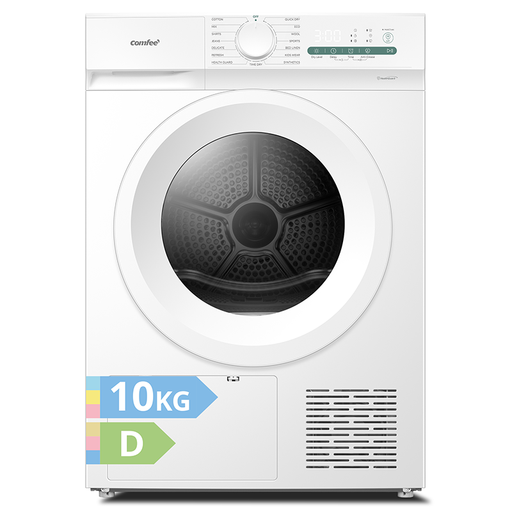 Image unavailable
This model may be an option if you’re choosing a tumble dryer for a flat without a balcony, provided you have a space that meets the instructions.
The product name lists a D energy rating. It states a 10 kg capacity, while another description for the same SKU lists 8 kg. Confirm the capacity of the CD10EHP05W-HR before choosing it for your laundry load. Also check its dimensions and kWh/100 cycles.
No, it doesn’t need an air exhaust hose leading outside. The water collects in a tank or, if the model allows it, drains away through a water outlet. You must still follow the ventilation and installation requirements in the manual.
According to the European Commission, since 1 July 2025, only new domestic heat pump tumble dryers can be placed on the EU market. This does not apply to appliances that were already on the market before that date and are still in stock, so check the status and energy label of the conventional model you’re considering.
It may be enough if you only have a small amount of laundry, can wait for it to dry and have a well-ventilated room available. ADEME identifies air-drying laundry as a significant source of moisture indoors, so avoid a small, poorly ventilated room and don’t block ventilation openings.
Yes, but only if both appliances and the stacking kit are compatible. Bosch recommends checking the relevant model numbers. Also measure the depth and follow the manufacturer’s installation instructions before planning this setup.
Compare their ratings on the current A to G scale and their energy use in kWh/100 cycles, using models measured on the same basis. Don’t compare an older A+++ to D rating directly with a rating on the new scale.