
Same-day & Next-day Delivery

Quality Guaranteed

Unlock Your Welcome Offers: FREE Delivery | Up to 80% OFF | Free 30-day JoyPlus trial
Download the APP
Choosing new pots and pans can quickly become a headache. Between marketing jargon and obscure technical sheets, it's hard to separate fact from fiction to find healthy, long-lasting equipment. Many people end up with scratched pans after just a few weeks or "induction-compatible" pots that, in reality, struggle to heat up. This guide is here to break down the key points and help you make the right choice.
Before we get to the products, let's review the common mistakes that lead to a disappointing purchase.
To equip your kitchen with reliable gear that's truly suited to your needs, focus on these key technical characteristics.
The material is the number one criterion. At the heart of current concerns are PFAS (per- and polyfluoroalkyl substances), a family of chemical compounds sometimes used in non-stick coatings, including the well-known PFOA and PTFE. Fortunately, several reliable alternatives exist for cooking with peace of mind:
The all-stovetop pot label is a good start, but for induction, the devil is in the details. An induction hob generates a magnetic field that heats the metal, so the cookware must have a ferromagnetic base. For rapid heat-up and even heat distribution, choose models with a thick, "encapsulated" or "sandwich" base. The latter alternates layers of aluminium (an excellent conductor) and steel (for induction compatibility).
In a well-designed kitchen, versatility is king. A piece of cookware that can go from the stovetop to the oven opens up a whole new world of culinary possibilities. And for small kitchens, a stackable cookware set with a removable handle isn't a luxury—it's a game-changer for your cupboards.
Here are a few products that check all the boxes, each designed for a specific need.
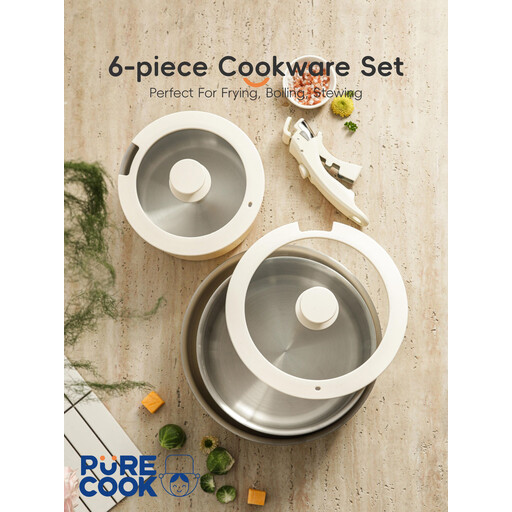
Why we love it: This set is the perfect solution for families where every square inch counts. The removable handle and stackable design are a breath of fresh air for cupboards, and the different sizes cover essential daily needs.
Its 304 stainless steel body is a reliable choice that won't degrade, unlike low-end coatings. The stackable cookware set concept directly addresses the dual problems of storage and versatility.
It combines the durability of stainless steel, all-stovetop compatibility (including induction), and ultra-optimised storage thanks to its removable handle. Bonus: it's oven and dishwasher safe.
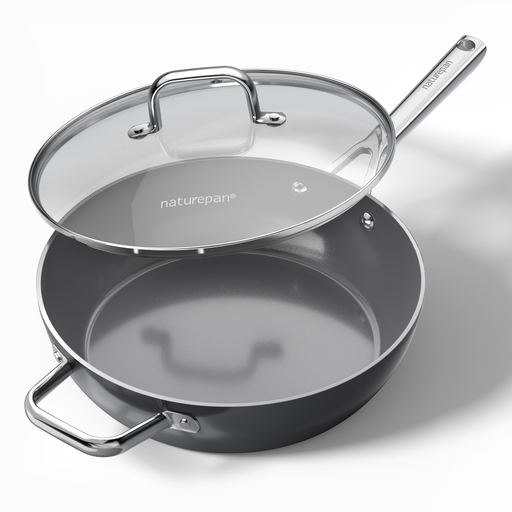
Why we love it: Perfect for searing meat on the stove before transferring it to the oven to finish cooking. Its resistance to high temperatures (up to 260°C) and high sides make it ultra-versatile: it doubles as a frying pan, a sauté pan, and even an oven dish.
Its ceramic coating, reinforced with titanium and diamond particles, promises far greater longevity than standard ceramics. Its thick base ensures even heat distribution on induction, so you can say goodbye to the "slow heating" effect of low-end pans.
A pfas-free pan that's oven-safe even at high temperatures. Compatible with all stovetops, its high sides transform it into a remarkably effective sauté pan.
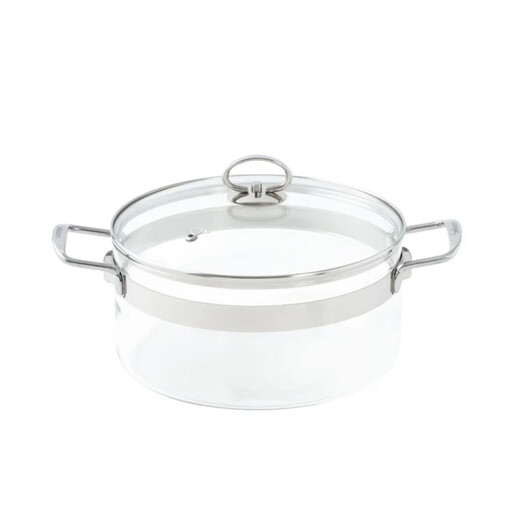
Why we love it: For those who demand absolute material neutrality. Borosilicate glass is non-porous and perfectly inert, meaning no chemical interaction with food, for total respect for the ingredients' original flavour.
Simple: it sidesteps the debate on coatings. Glass is by nature free of PFAS, PTFE, or PFOA. Its transparency allows you to monitor cooking at a glance, without lifting the lid and losing heat.
A 100% inert glass stockpot for absolute flavour purity and perfect visual control. Compatible with gas, electric hobs, and ovens (up to 180°C). Note: an induction adapter disc is required for induction hobs.
Discover our full selection of cookware that meets our strictest selection criteria and the latest regulations.
For stainless steel, a little white vinegar or baking soda is enough to restore its shine and remove stains. For a ceramic coating, the golden rule is to be gentle: use wooden or silicone utensils, prefer hand washing, and avoid thermal shock (never run a hot pan under cold water).
Performance can vary. A good ceramic coating is very effective but will often require a small amount of fat and careful temperature management. Unlike PTFE coatings, it's crucial not to overheat it while empty to preserve its long-term non-stick properties.
Absolutely not. Metal utensils (forks, knives, spatulas, etc.) are public enemy number one for ceramic coatings. They scratch the surface and destroy its non-stick properties. Always opt for silicone, wood, or nylon.