
Livraison le jour même ou le lendemain

Qualité garantie

Débloquez vos offres de bienvenue: Livraison GRATUITE | Jusqu'à -80 % | 30 jours d'essai gratuits à JoyPlus
Téléchargez l'application
Eating healthier is a great start. Using the right cookware makes it even better. But faced with a jungle of store aisles and marketing promises, it's hard to know what to choose. We've all been frustrated by a new pan that starts sticking after three months or a storage container that's impossible to close properly. To help you invest in gear that goes the distance, we're breaking down the pitfalls to avoid and the criteria that truly matter.
The 3 pitfalls to avoid when buying cookware:
To make an informed choice, forget the slogans and focus on objective technical features. Here are the essential checkpoints.
The composition of your cookware is the primary guarantee of its safety. Pay special attention to non-stick coatings.
Good cookware should adapt to your equipment and your lifestyle.
The small design extras often make the biggest difference in daily use.
Here are a few options that meet these criteria, adapted for different types of users.

Why we chose it: Ideal for preparing meals for the week. Its large 2-litre capacity can hold family-sized dishes, and its borosilicate glass body goes directly from the oven to the fridge, simplifying preparation and storage.
It avoids the trap of misleading versatility. The borosilicate glass body withstands high temperatures (up to 400°C / 752°F) and thermal shock, while the 4-clip lid ensures reliable airtight storage.
Its extreme versatility (oven, microwave, freezer, dishwasher) and its leak-proof locking system make it the perfect ally for meal prep.
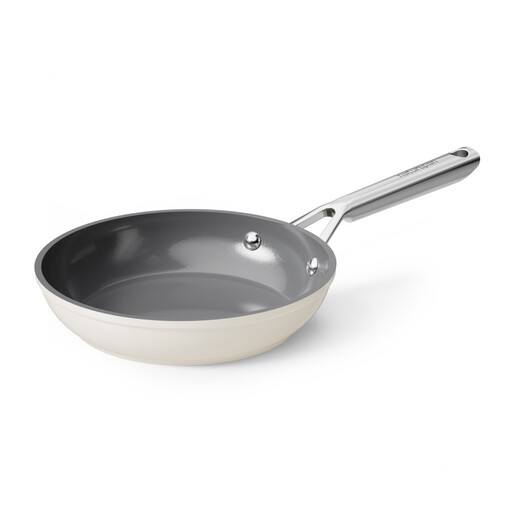
Why we chose it: A 24cm pan that's perfect for everyday cooking (eggs, vegetables, fish) for 2-3 people. It's ideal for healthy cooking with little to no oil.
It avoids the pitfall of vague claims. The coating is explicitly guaranteed PFAS-, PFOA-, and PTFE-free. The ceramic, reinforced with diamond and titanium particles, promises superior durability compared to classic ceramic coatings.
Its healthy ceramic coating and its compatibility with all hobs, including induction, make it a reliable and high-performing choice for daily use.

Why we chose it: This large 30cm non-stick wok is perfect for family meals. Its deep shape and large capacity make it ideal for stir-frying, simmering, or deep-frying large quantities, all in a single pan.
It avoids the pitfall of poor durability. Its composite stainless steel structure ensures robustness, while the interior honeycomb texture is designed to protect the coating from scratches and thus extend its lifespan.
Its large 30cm capacity, 3-ply construction for fast and even heating, and induction compatibility make it a high-performance family utensil.
We have selected a full range of products that meet these standards for quality and safety.
To preserve the non-stick properties of your ceramic pan, a few good habits are all it takes. Avoid metal utensils that could scratch it; opt for wood or silicone instead. Cook over low to medium heat, as ceramic conducts heat very well. Finally, even if it's dishwasher-safe, washing by hand with a soft sponge is still the best way to preserve the coating long-term.
Absolutely not! This is a critical point of caution. Only borosilicate glass is designed to withstand extreme thermal shock. Attempting to move a standard (soda-lime) glass dish from the freezer to a hot oven will almost certainly cause it to crack. And of course, it bears repeating: plastic lids NEVER go in the oven.
Modern ceramic coatings have made huge strides. They offer excellent non-stick performance, especially for cooking at controlled temperatures with a minimal amount of fat. While traditional PTFE coatings may sometimes feel more "slippery" when brand new, the advantage of a ceramic pan lies in its stability at high temperatures and the absence of controversial chemicals. That's significant peace of mind for healthy everyday cooking.