Families comparing protein per portion
After a training session, you want to know what’s in the portion actually going into the lunchbox, rather than relying on the word ‘hazelnut’ on the packaging.


For a secondary school lunchbox, plain, unsalted hazelnuts can be a useful addition to a meal, but their protein content per 100 g doesn’t tell you how much a small portion provides. If protein per portion is your main priority after sport, check the label of the specific product, even if hazelnut is only a flavour. Before packing nuts, check the school’s rules and any applicable individual care plan (PAI). Fresh products also need to be kept at the right temperature.
After a training session, you want to know what’s in the portion actually going into the lunchbox, rather than relying on the word ‘hazelnut’ on the packaging.
You’d like to add a small portion of shelled, unsalted hazelnuts to a meal that’s already been put together, without making them the main source of protein. Manger Bouger recommends a small handful of unsalted nuts.
Before preparing the lunchbox, you need to take account of any restrictions on nuts and any adjustments set out in an individual care plan (PAI) for the pupil. The French Ministry of National Education says a PAI can be put in place in cases of food allergy.
Start by deciding how the product will fit into the meal: as a plain addition of hazelnuts, or as a product where you want to know the protein per portion. In either case, check that it complies with the school’s rules.
Consider these: as a small addition to a meal, if nuts are allowed.
Bear in mind: the figures per 100 g may not reflect the amount you’re packing.
Consider this: if the protein listed per portion is your main priority.
Bear in mind: the hazelnut flavour tells you nothing about the protein content or storage requirements. For example, the HiPRO dessert listed by Monoprix must be kept between +1 °C and +6 °C.
Keep in mind: when the rules applying to the pupil exclude nuts.
Check: the ingredients of the product you choose, even if it’s described as hazelnut-flavoured.
| What matters | What to check | Who is this for? |
|---|---|---|
| Protein after sport | Compare the grams of protein in the portion you’re packing and, if it’s a fresh product, check its storage temperature. | After training, I want to know how much protein is in what I’m taking with me, rather than guessing from the hazelnut flavour. Around 45% of shoppers put measurable protein first. |
| A plain addition that’s easy to portion | Check the ingredients, whether salt or sugar has been added, and whether the pack makes it easy to prepare a small portion. | To add to a lunch that’s already prepared, I’m looking for plain hazelnuts that I can portion easily. This is the top priority for around 33% of shoppers. |
| Allergens and school rules | Check the ingredients and allergen information for the specific product, as well as the school’s rules and any applicable PAI. | If a restriction applies to the pupil or their class, I need to know whether the lunchbox can contain nuts before choosing a product. Around 22% of shoppers put compliance with these rules first. |
A flavour tells you nothing about a product’s nutritional value. Monoprix lists 18.4 g of protein in a 180 g pot of HiPRO chocolate and hazelnut dessert; that figure applies to this product and portion, not to every hazelnut-flavoured food.
Check the protein per portion on the label of each product you’re considering.
Auchan lists 19 g of protein and 653 kcal per 100 g for its shelled hazelnuts. These figures don’t tell you what a small lunchbox portion provides.
Decide how much to pack, then think of hazelnuts as part of the whole meal rather than the sole answer to a protein target.
Hazelnuts are nuts whether they’re whole, ground or included in another food. According to the French Ministry of National Education, a PAI can set out dietary adjustments for a pupil with an allergy.
Check the rules that apply to the pupil and the ingredients before adding the product to their lunchbox. If nuts are excluded, choose a suitable alternative.
The HiPRO chocolate and hazelnut dessert listed by Monoprix must be kept between +1 °C and +6 °C, including before the meal.
Only choose this product if you can keep it within this temperature range during transport and while it’s waiting to be eaten.
You’ll need suitable insulated equipment to keep it chilled.
Carrefour lists different types of hazelnuts, including shelled varieties under Carrefour Bio and Carrefour Le Marché.
E.Leclerc lists Bio Village shelled hazelnuts sold loose by the 100 g, as well as a 175 g bag of Couleurs Vives.
The 175 g pack of shelled hazelnuts from Auchan lists ‘HAZELNUTS’ as its ingredient.
Monoprix lists a 180 g pot of HiPRO chocolate and hazelnut dessert, which is different from plain hazelnuts.
ALDI has listed chopped and ground hazelnuts, in formats that are mainly intended to be added to recipes.
The food offers listed by Lidl can vary depending on which supermarket you select.
This Joybuy dark chocolate and hazelnut product is an option to consider if you’re looking for a hazelnut-flavoured food and want to compare it by portion. It’s not a substitute for a small portion of plain hazelnuts as part of a meal.
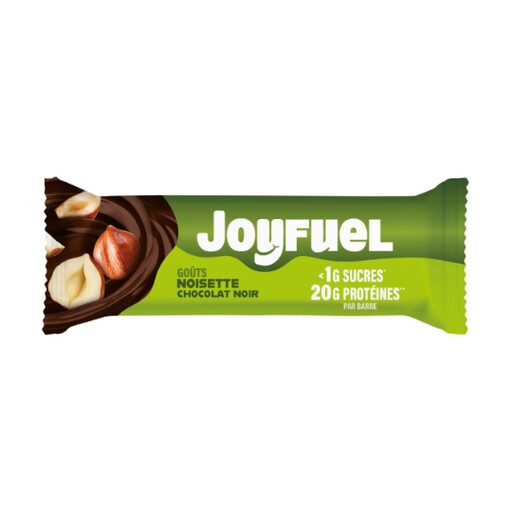 Image unavailable
The 55 g format makes it easy to compare the nutritional information with the amount you’re packing in the lunchbox. If you’re choosing it to meet a protein target, check the protein listed for this product and portion. Also check the ingredients, allergen information and school rules.
The figure per 100 g doesn’t tell you enough on its own. Auchan lists 19 g of protein per 100 g for its shelled hazelnuts, but the portion you pack may be smaller. Compare the protein in the portion you plan to pack with that in the other foods in the meal. Don’t judge a product’s protein content by its hazelnut flavour alone.
Plain, unsalted and unsweetened shelled hazelnuts make it easy to prepare a small portion to add to a meal, if nuts are allowed. Manger Bouger recommends a small handful of unsalted nuts. Check the ingredients of the bag you choose rather than treating it as equivalent to a chocolate product.
If the applicable rules exclude nuts, don’t pack hazelnuts or any product that contains them. The French Ministry of National Education says a PAI can set out adjustments for a pupil with a food allergy. Check the plan, the school’s rules and the label of the specific product.
The product listed by Monoprix must be kept between +1 °C and +6 °C. Only pack it if you can keep it at this temperature during transport and while it’s waiting to be eaten, using suitable insulated equipment.